
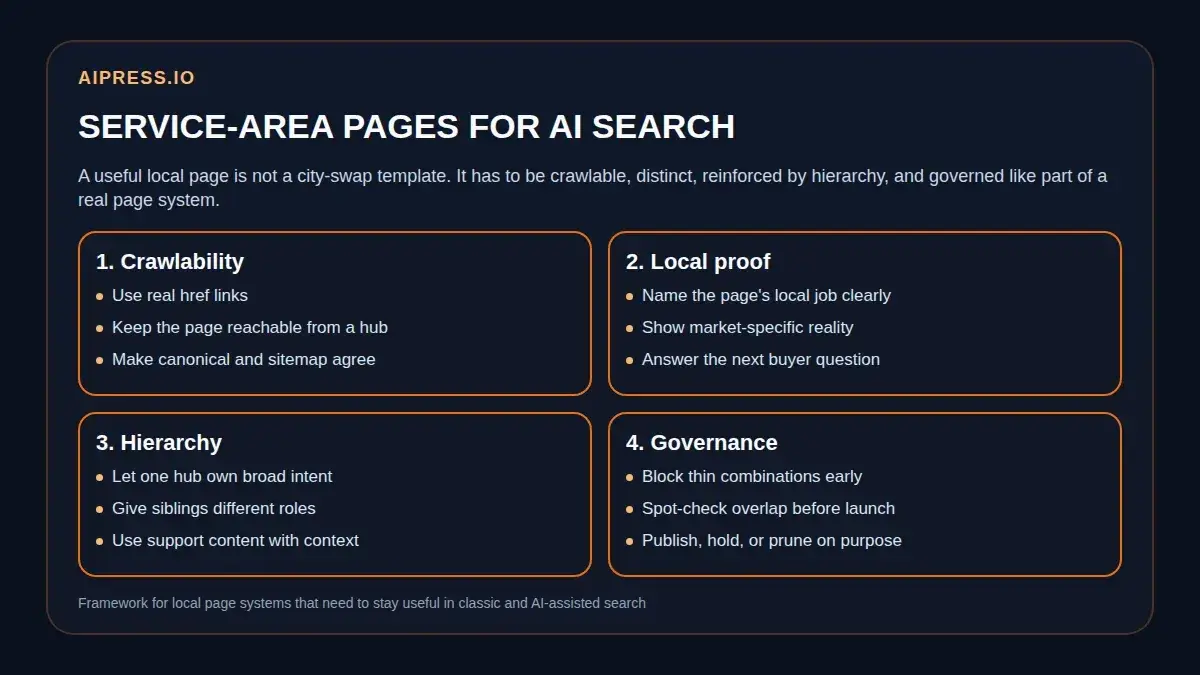
 AI-friendly service-area pages work when crawlability, unique proof, hierarchy, and governance all reinforce the same page job.
A durable service area pages AI search strategy starts by refusing to treat local pages like a coverage spreadsheet. Pick a city. Swap a heading. Duplicate the body. Publish another URL. That was already risky for classic local SEO. It is even riskier when the page also needs to make sense to AI-assisted search systems that are retrieving, comparing, and quoting pages at query time.
That is why the playbook starts with pages that do something more useful than repeating a service name next to a city name. Google's AI optimization guide says its generative AI features still rely on the core Search index, retrieval-augmented generation, and the same quality systems behind traditional search. In other words, the local page still has to be indexable, crawlable, distinct, and genuinely helpful before it can become easy to cite.
The good news is that this does not require weird new hacks. Google explicitly says you do not need llms.txt files, special AI markup, or artificial content chunking for generative AI visibility. The hard part is more operational: building service-area pages that show clear local proof, fit into a clean hierarchy, and avoid drifting into doorway-page sprawl.
This guide is for teams shipping local landing-page systems, not one-off brochure pages. Use it to decide what every service-area page must prove before you publish another city-service combination.
Why most service-area pages fail AI search
Service-area pages usually fail long before Google or any other engine has to decide whether to rank or cite them.
The failure starts in planning. Teams build the matrix first, then hope the copy can rescue it later. A business lists 40 cities, 8 services, and 3 modifiers, sees 960 possible URLs, and mistakes that spreadsheet for a publishing strategy. The result is a page set where the only consistent difference is the place name.
Google's Creating helpful, reliable, people-first content guidance gives a better standard. It asks whether the content offers original information or analysis, whether it serves a real audience, and whether the reader leaves satisfied enough to stop searching again. Most weak local pages fail that test immediately. They are technically pages, but not convincing answers.
The newer AI-search framing raises the bar even more. Google's AI optimization guide warns against creating separate pages for every possible query variation primarily to manipulate rankings or generative AI responses. The same page-spam instinct that once produced city-swap landing pages now shows up as "AI coverage" planning. More combinations does not mean more value.
Google's spam policies are blunt about what that turns into when left unchecked. Doorway abuse includes city- or region-targeted pages that funnel people to the same destination, along with substantially similar pages that sit closer to the search results than a clearly defined hierarchy. If your local page system cannot explain why neighboring URLs should coexist, that is not an AI-search problem. It is a page-governance problem.
A second failure pattern is assuming schema can carry a weak page. It cannot. Google's structured data introduction says markup should describe the content of the page it appears on, not invisible or unrelated facts. A service-area page with thin visible copy and a swollen JSON-LD block does not become more useful because the structured data is technically valid.
The third failure is hierarchy drift. Large local sites often publish pages faster than they define relationships among those pages. One URL tries to own the broad service term. Three more chase the same intent with neighborhood modifiers. A blog post targets the same phrase again. The business thinks it has "more coverage," while the crawler sees duplication, overlap, and a muddy internal-link map.
What Google says AI search still needs from local pages
The easiest way to overcomplicate AI search is to forget what Google already told us.
Google's AI optimization guide says foundational SEO is still the base layer for generative AI visibility. The guide describes AI responses as grounded in retrieved pages from the Search index, with query fan-out gathering more context from related searches. That means a service-area page still has to be strong enough to survive the ordinary parts of Search before it can help with the AI layer.
For local page systems, that reduces the work to a few practical questions:
| What Google is really asking | What your service-area page needs to prove |
|---|---|
| Can we crawl and index this page? | The page is reachable, linked, canonicalized clearly, and not buried behind broken navigation or JavaScript-only links |
| Is this page meaningfully distinct? | The place, service, proof, and CTA combine into a page job that is not interchangeable with its siblings |
| Does the page help a real local searcher? | The visible copy answers the local service question better than a boilerplate paragraph and generic trust block |
| Are page signals consistent? | The on-page facts, schema, sitemap entry, internal links, and business details point to the same page role |
Google also makes clear what not to obsess over. You do not need llms.txt. You do not need to rewrite every paragraph to mimic AI prompts. You do not need a special schema type just for generative AI. You do not need to split every long-tail variation into a new URL. Those are comforting myths because they feel like tasks. They are not the work.
The work is technical clarity plus proof.
- The page must be indexed and eligible to show a snippet in Search.
- The content must be useful enough to justify its own URL.
- The page should make business details, service scope, and next steps obvious to a human reader.
- The local page should sit inside a hierarchy that helps both people and crawlers understand where it belongs.
That is also where internal linking matters more than many local teams expect. Google's link best practices say every page you care about should have a link from at least one other page on your site. That sounds basic, but it rules out a surprising number of weak service-area launches that technically exist yet never become integral parts of the site.
The five proof blocks every service-area page should contain
 A service-area page becomes easier to trust when the page visibly connects the place, the service, the proof, the hierarchy, and the next action.
A good service-area page does not need more adjectives. It needs better evidence. These are the five blocks that make a local page easier for search systems and readers to understand.
1. A clear page job
The opening screen should tell the reader what this page is for.
Not just the keyword. The job.
Examples:
- emergency sump-pump repair in a flood-prone neighborhood
- insurance-minded leak detection for older condo towers
- weekend roof-tarp response in a specific service radius
That job statement matters because it creates a real reason for the page to exist next to other local pages. Without it, the page starts life as a duplicate with a different city token.
2. Operational proof that changes by place or service
The strongest service-area pages do not rely on a generic trust paragraph. They surface the details a serious buyer would actually compare:
- response or scheduling realities
- property types commonly served in that area
- permit, inspection, or access constraints when relevant
- proof blocks that match the service, not just the brand
- specific FAQs that would annoy a local prospect if you skipped them
This is where Google's people-first framework is useful. If the content is supposed to satisfy a real audience, the page needs some observable local logic. A city page that could be swapped into the next county with no meaningful edits is not doing enough.
3. Entity corroboration
AI-search discussions often get abstract here, but the practical version is simple: the page should line up with the rest of the business's visible signals.
If the page claims one service radius, the profile and site structure should not imply another. If the page targets one service type, the surrounding hub and supporting pages should reinforce that interpretation. AiPress's AI Overview checklist uses this same idea when it talks about service-page grounding, profile corroboration, and clear cluster roles.
For local pages, corroboration is often the difference between "technically published" and "easy to trust."
4. A crawlable, browseable hierarchy
The hierarchy should explain where the page lives:
- which hub owns the broad intent
- which sibling pages are meaningfully different
- which supporting article adds context
- which CTA or contact path this page advances
Google's crawlable link guidance is useful here for a reason beyond pure indexing. Proper anchor links are how the site narrates the role of a page. A service-area page that only exists in a sitemap is a weak signal. A service-area page that is linked cleanly from its hub, support articles, and relevant navigation is much easier to understand.
5. Structured data that matches visible reality
Structured data is still worth using. It just should not become a substitute for page substance.
Google's general structured data guidelines say the markup must be relevant, complete, and representative of what readers can actually see on the page. That means the page itself should already expose the service facts, business context, and hierarchy cues the schema is meant to formalize.
A good rule is to ask: if the JSON-LD disappeared, would the page still make its case?
If the answer is no, the page is too dependent on markup and not strong enough on its own.
How to avoid doorway pages and duplicate clusters
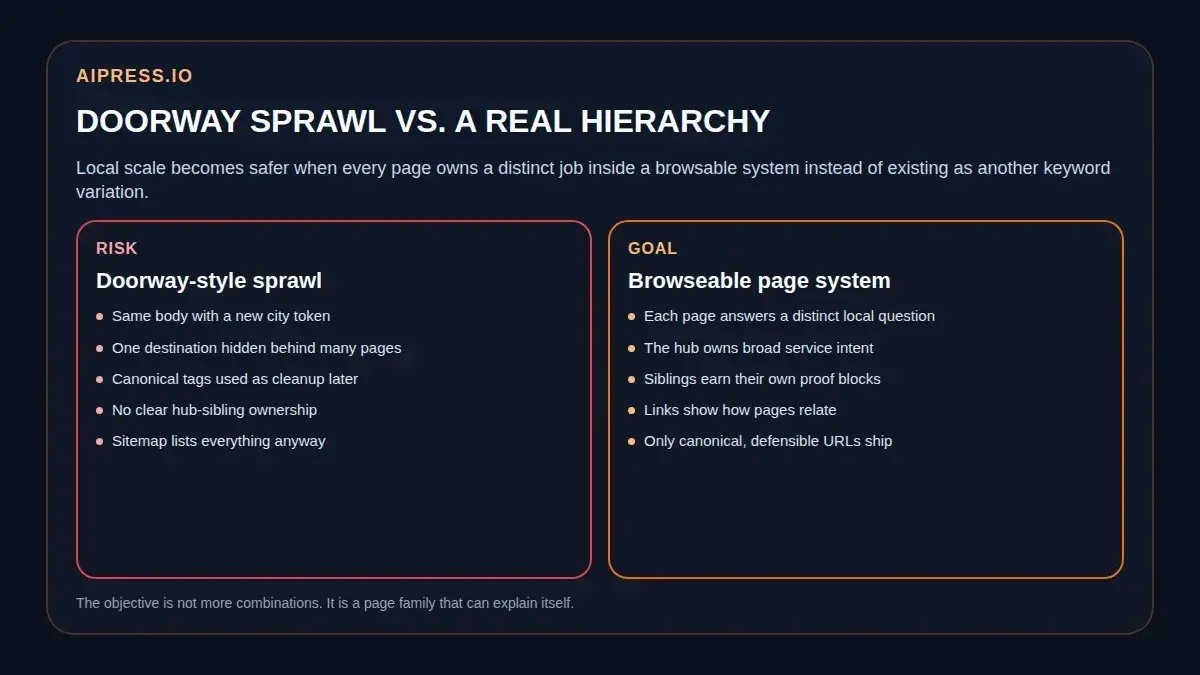 The goal is not more city pages. The goal is a browseable hierarchy where each page owns a distinct job.
The best way to avoid doorway behavior is to decide which pages deserve to exist before content production begins.
Google's canonicalization guidance helps here because it reminds teams what canonical tags actually do. Canonicalization is Google's process of choosing the representative URL from a cluster of duplicates. Your canonical hints matter, but Google can choose differently. In other words, rel="canonical" is not a cleanup miracle for a bad local-page strategy. It is a preference signal inside a system that still evaluates similarity and usefulness.
So build the hierarchy first.
A service-area page usually deserves its own URL only when at least one of these is true:
- the service intent is meaningfully different from the parent hub
- the place changes the buyer's question in a visible way
- the proof block changes, not just the keyword
- the page earns distinct internal links and support content
- the page can route the reader to a relevant next action without pretending to be the same page as its siblings
If none of that is true, merge it, rewrite it, or leave it unpublished.
This is also where sitemap discipline matters. Google's build and submit a sitemap guidance says sitemaps should include the canonical URLs you want in search results, use absolute URLs, and split when they exceed 50,000 URLs or 50MB uncompressed. For large local sites, that means the sitemap should reflect your hierarchy decisions, not hide them. If five thin sibling pages barely deserve discovery, the sitemap should not pretend otherwise just because the generator can emit them.
AiPress's own Multi-Location Sitemap Strategy article makes the same operational point: once you manage large local page families, sitemaps become part of launch control. A confused hierarchy produces a confused sitemap. A governed hierarchy produces a cleaner sitemap, better internal discovery, and easier post-launch review.
The simplest duplicate test is still one of the best: if two neighboring service-area pages could trade bodies with only minor edits, they probably do not both deserve to exist.
The 30-minute QA pass before you publish a new page set
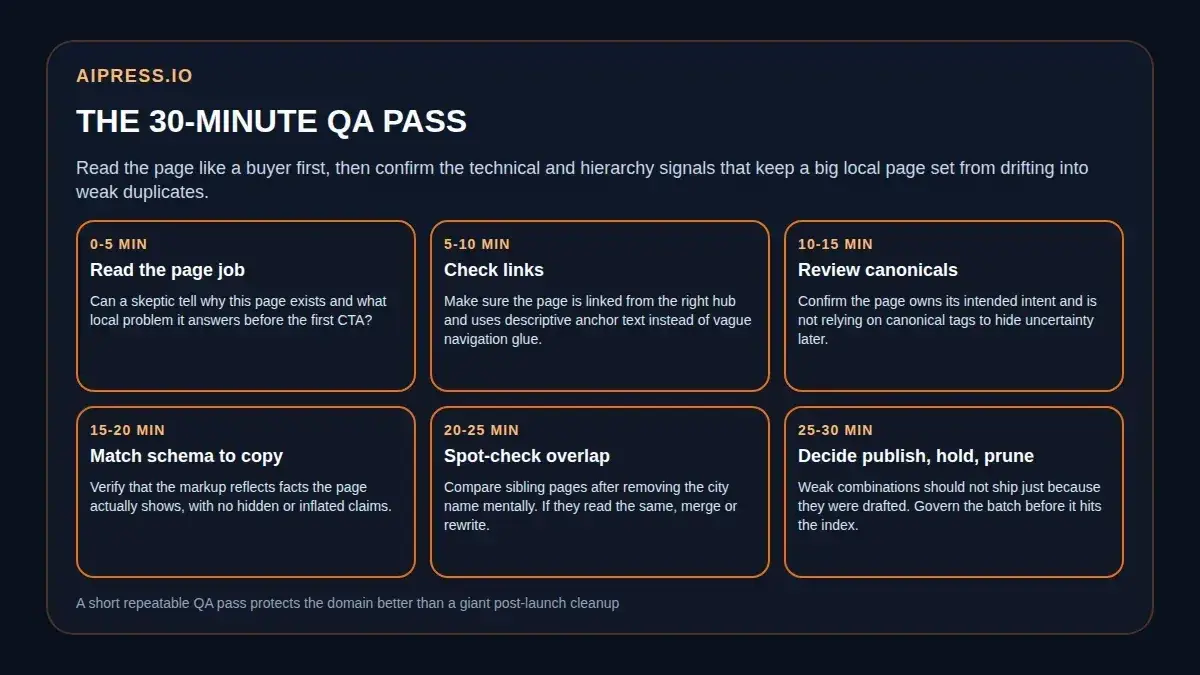 A fast prepublish spot check should read the page like a user first, then confirm links, canonicals, proof, overlap, and sitemap hygiene.
The most useful QA pass for service-area pages is short enough to repeat and strict enough to block weak batches.
Minutes 0-5: Read the page like a skeptical buyer
Ignore the keyword for a moment.
Ask:
- What job is this page doing?
- What is locally different here?
- What detail would irritate the reader if it were missing?
- Would a real prospect learn anything useful before the first CTA?
If the answer is mostly "it mentions the city," stop there.
Minutes 5-10: Check hierarchy and links
Use Google's link guidance as the standard.
Confirm that the page:
- receives at least one contextual internal link
- links back to the correct hub
- links to one relevant supporting resource when useful
- uses descriptive anchor text instead of vague "learn more" chains
This is the fastest way to catch orphaned pages and accidental intent overlap.
Minutes 10-15: Review canonical and index signals
Confirm that the chosen canonical matches the page's intended owner in the cluster. Do not use canonical tags as a bandage for uncertainty. If the team is unsure which page should own the intent, the architecture problem still exists.
Then check the sitemap plan:
- Is this URL supposed to appear in the next sitemap export?
- Is it the canonical version?
- Does it belong in the correct page-family file or sitemap index slice?
Those questions are boring right up until a whole local cluster underperforms because the launch workflow treated discovery as an afterthought.
Minutes 15-20: Compare visible copy and structured data
Use Google's structured data documentation and quality guidelines as the bar.
Check whether the schema is:
- describing facts the page actually shows
- aligned with the page's main purpose
- complete enough to be useful
- free of exaggerated or invisible claims
If the page needs markup to say what the reader cannot confirm visually, the content layer is too thin.
Minutes 20-25: Spot-check sibling overlap
Open two neighboring service-area pages. Strip away the city names mentally. What is left?
If the remaining logic, proof, and CTA are basically identical, you are looking at a duplicate cluster before launch. That is the moment to merge, reduce, or rewrite. It is much cheaper than waiting for a bigger cleanup cycle.
Minutes 25-30: Decide publish, hold, or prune
Do not let every drafted page graduate just because it exists.
A practical service-area QA workflow should end with one of three calls:
- Publish — the page has a clear job, proof, and place in the hierarchy
- Hold — the concept is valid, but the proof or hierarchy is incomplete
- Prune — the page adds no distinct value and should not be indexed as its own URL
That last decision matters most. Google's spam policy on scaled content abuse is essentially a warning against sentimental publishing at scale. If the page adds little value, exclude it from Search or never ship it as its own node in the first place.
How AiPress frames service-area architecture
AiPress's own product and editorial positioning are most useful when they push teams toward governed scale instead of page-count theater.
The live Programmatic SEO with AI page makes two ideas clear:
- scalable local pages should be unique and valuable, not templates with swapped keywords
- systems like internal linking, schema, and technical SEO should be handled consistently across the page family
That pairs well with the rest of AiPress's local-content cluster:
- Programmatic SEO QA checklist for local businesses covers launch governance at a broader local-system level
- AI Overview Visibility Checklist for Local Businesses focuses on the narrower support signals that make local pages easier to trust
- Scaling Service Area Pages Safely shows the data-uniqueness side of doorway-safe expansion once the page family grows
Put together, the AiPress view is not "publish a page for every modifier." It is closer to this:
- define the job of each local page
- give the page visible proof a human can trust
- link it into a real hierarchy
- keep the sitemap and canonical signals consistent
- block thin combinations before they enter the index
That is the difference between a service-area system and a page dump.
If your team wants to see what that kind of governed page architecture looks like on a modern stack, Plan My AI Website is the right next step. The goal is not more local pages at any cost. The goal is a page system that can expand without losing clarity.
FAQ
Do I need llms.txt for service-area pages to appear in AI search?
No. Google's AI optimization guide explicitly says Google Search does not use llms.txt or other special AI text files for visibility in Search, including generative AI features.
Can a canonical tag rescue a set of duplicate city pages?
Not by itself. Canonical tags are useful hints, but Google still evaluates the similarity and usefulness of the cluster. If the page set lacks distinct value, the architecture problem remains.
Should every city or neighborhood get its own page?
Only when the page can prove a distinct job, distinct proof, and a distinct place in the hierarchy. If not, merge it into a stronger hub or hold it until the page can justify itself.
What is the minimum internal-link expectation for a service-area page?
At minimum, every page you care about should be linked from another page on your site, ideally from the correct hub and from context that clarifies what the page owns.
This article is educational, not legal or platform-policy advice. Google Search behavior, AI features, and local-search workflows can change, so confirm important architecture decisions against the latest official documentation before publishing at scale.