Emergency-First Layout
24/7 messaging, sticky tap-to-call, and hero CTAs sized for thumbs—so flooded basements become your dispatch, not your competitor's.
AI SEO for plumbers, built into the site: tap-to-call emergency pages, service-city coverage with real job proof, and structure Google and AI answers can read.
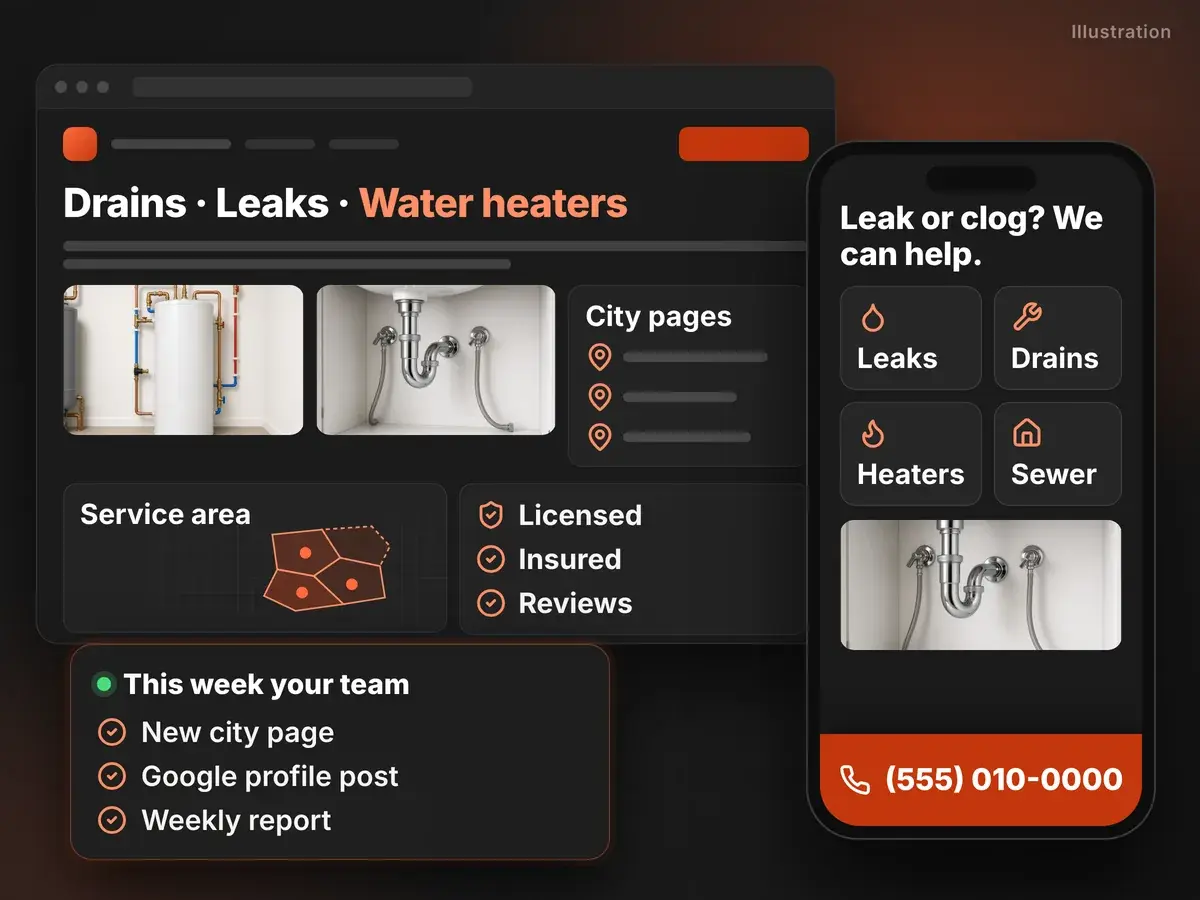
Real results
Their old site was a few brochure pages. We gave each service in each city its own page, then cleaned out the pages that weren't earning their place.
A site built for the call that comes at 2 AM.
24/7 messaging, sticky tap-to-call, and hero CTAs sized for thumbs—so flooded basements become your dispatch, not your competitor's.
Lean pages built for phones on weak signal, so you are not eliminated before the first ring.
License numbers, insurance, guarantees, and reviews surfaced where anxious homeowners actually look.
Before/after installs, clean truck-and-tool credibility, and short job stories—optimized images, no slideshow bloat.
Separate pages for the services and towns you actually cover, each carrying local proof instead of a swapped city name.
Plain answers, consistent business facts, and structured data that search engines and AI assistants can read. No guaranteed placements.
Comes with your AI website
Most websites sit still after launch. Yours comes with an AI marketing team that works on it every week.
So your service and city pages stay current while you're out on calls.
Writes helpful articles and pages your customers actually read.
Makes sure Google knows exactly what you do and where.
Keeps your Google Maps listing fresh, posted and watched.
Keeps your business name, address and phone the same everywhere.
Keeps your social pages busy every week.
Sends you a plain-English update every week.
Add-on
Runs ads built for calls and quotes.
A real person
Sets your strategy and reviews the work before it goes out.
What each teammate does depends on your plan.
Map geography × intent before you scale pages. Thin city templates without unique proof burn crawl budget and trust.
Swipe for more columns
| Coverage tier | Page types | Search intent | Primary CTA |
|---|---|---|---|
| Primary metro + suburbs | City hubs + neighborhood pages | Near-me / emergency plumber | Click-to-call + book online |
| Secondary towns (drive-time) | Town landing + top 2–3 services | Service + city modifiers | Call + short estimate form |
| Commercial / property managers | Vertical landing + proof | Commercial plumbing / maintenance | Quote request + account CTA |
| High-ticket services | Service detail (repipe, sewer, water heater) | Problem + solution queries | Financing note + phone |
Need this built for your license area? Request a plumber site preview.
Track your progress
Progress is saved in this browser until you clear site data.
Basement flooding at midnight. A water heater that quits before a holiday dinner. A main line backup on a Sunday.
Those homeowners are not comparing five blog posts. They pick the first credible plumber whose site loads now and shows how to reach you now.
That is where AI SEO for plumbers has to start. Aipress.io builds the plumbing website and the search system behind it as one product: an emergency-first site with tap-to-call everywhere, service and city pages that carry real proof, structure that Google and AI answers can read, and content agents that keep those pages accurate after launch. No WordPress plugin stack, and no thin city templates.
If your current site is slow, buried in sliders, or hides the phone number behind a hamburger menu, you are handing that job to whoever got the basics right.
"AI SEO" often gets sold as a separate retainer. Google's own guidance on AI features in Search says there are no additional requirements or special optimizations for AI Overviews or AI Mode: the same SEO fundamentals apply. So we don't sell a trick. We build those fundamentals into the site and use AI where it actually helps: drafting, structuring, and maintaining pages at a volume a plumbing office can't staff.
| What we build | What it does for a plumbing company |
|---|---|
| Emergency conversion layer | Sticky tap-to-call, after-hours messaging, and trust proof near every CTA |
| Service + city architecture | Separate pages for the work people search for, in the towns you actually serve |
| Proof modules | Job maps, job blurbs, and local details that make each page different |
| Consistent business data | Hours, phone, service area, and services that match your Google Business Profile |
| Content agents with review gates | Drafts grounded in your services and job notes; pages that fail review don't publish |
Two things this page is not. It is not a Google Business Profile or review-generation playbook; for that, read our local SEO guide for plumbers. And if you want to score your current site before you talk to anyone, run it through the AI SEO for plumbers page checklist.
They search on a phone, one hand on the flashlight. They need:
We put tap-to-call in the header, hero, and a persistent mobile action. No hunting.
They will open a few tabs and ask follow-up questions: what a repipe involves, whether tank or tankless fits the house, how long the job takes. We give them scannable service pages, short process blocks, plain answers to those questions, and galleries that load fast enough that they actually see your work.
Planning research is also where specific, well-structured answers on your own pages matter most. A homeowner comparing water heater options has time to read, and so does any system summarizing the options for them.
The after-hours checklist above is the short version. Here is how each piece shows up on the page.
Not a tiny "contact us" link. Clear language: 24/7 emergency (only if your dispatch really runs 24/7), response framing you can honor, and the number as the primary CTA.
Drain cleaning, water heaters, leak detection, sewer, repipes—each with plain-language symptoms ("gurgling drains," "no hot water," "water in the yard") and a direct path to call or request service.
A burst pipe and a water heater quote should not land in the same generic contact form. Emergency visitors get the phone and a text-back option; planned-work visitors get a short estimate form and a confirmation page that tells them what happens next, so they don't call twice.
Tank installs, repipes, clean trenchless jobs—shown with captions and short context. Images are resized, compressed, and lazy-loaded so galleries don't drag down mobile speed.
Emergency visitors are usually on a phone, sometimes on weak signal. Thumb-sized targets, no pinching to read the number, and forms that do not demand a novel in a crisis.
Speed is part of that. Google's "good" mark for Largest Contentful Paint is 2.5 seconds or less, measured at the 75th percentile of real page loads, and we build emergency landings to hit it on mobile.
"Emergency plumber near me." "Drain cleaning in [city]." "Water heater repair [neighborhood]." Local plumbing is won in the map pack, local organic results, and long-tail service + city searches. That takes fast pages, clean information architecture, and proof of real work in each market—not one homepage pretending to rank everywhere.
Google's spam policies name scaled content abuse directly: generating many pages, with AI tools or any other method, that add little value for users. City pages that only swap the town name are the textbook case, and they are the first thing we cut.
For Hernandez Plumbing, which serves Miami-Dade and Broward, we rebuilt the site into a service-and-city architecture. Peak documented inventory was about 1,200 pages (March 2026 crawl); after quality pruning the live sitemap lists 328 URLs (as of Oct 8, 2026). Cities are tiered by search demand, money pages run on a strict internal-link budget, and each city carries its own intro, local factors, housing-stock notes, and permit guidance. The Miami plumbing SEO case study walks through the URL structure, linking rules, and schema.
Showing how much work you have done where you say you work is a high-trust signal. On city and service-area pages we can deploy programmatic job maps:
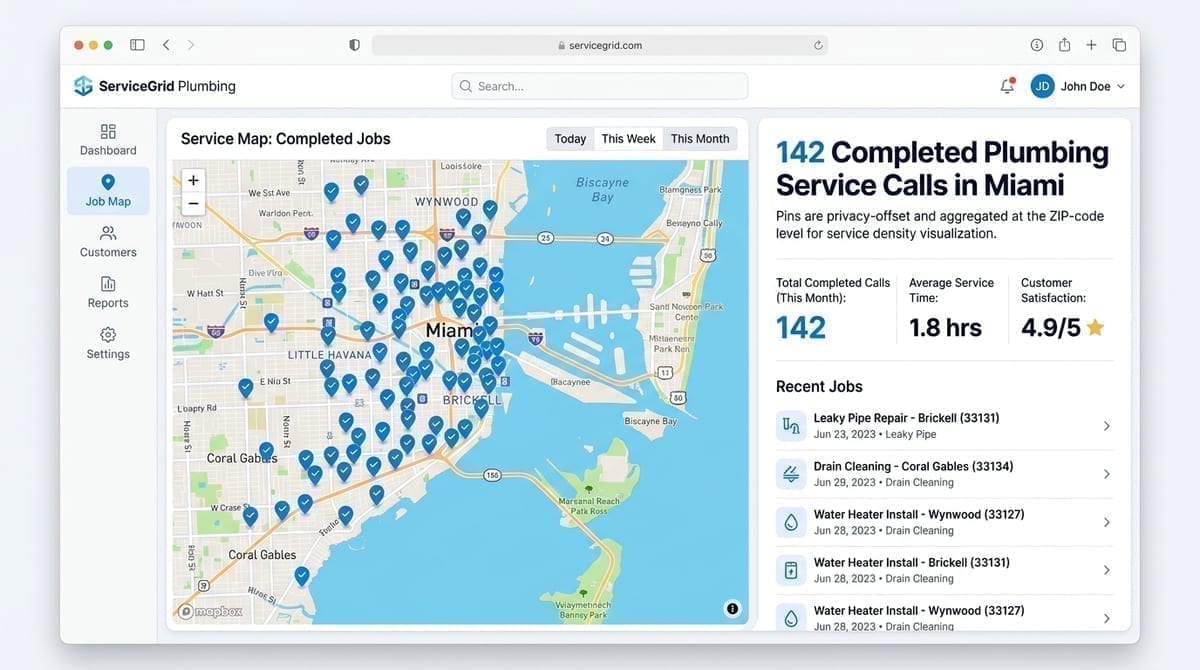
We align name, address, phone, hours, and service area with your Google Business Profile and on-page copy. Structured data typically includes LocalBusiness markup (the Plumber subtype where it fits) and Service markup for major trade lines. Emergency and 24/7 messaging stays consistent across copy, structured data, CTAs, and your profile, so what a searcher sees in results matches the page they land on.
FAQs stay on the page because people read them, not for a search feature: Google stopped showing FAQ rich results in May 2026.
Google says the same SEO fundamentals apply to AI Overviews and AI Mode. In practice, an AI answer about who to call or what a sewer line replacement involves can only work from what already exists about your business: your pages, your Business Profile, your reviews. There is no submission form. What you control on the site:
What we won't do is promise that your company will be named in AI Overviews, ChatGPT, or any other assistant. Nobody controls that. Judge the work by calls, form fills, and booked jobs from the pages we build.
A plumbing office doesn't have a content team, and service-area pages go stale: new towns, new services, a new license number, changed hours. Aipress.io trains content agents on your own material (your services, existing pages, voice, examples, and job notes) so drafts start from your business, not a generic template. Every draft then goes through review:
We can also add interactive tools where they help a buyer decide, like the service-area matrix and after-hours checklist on this page, or estimators for planned work. The page-generation side is covered in more depth on programmatic SEO for plumbers. The rule is the same either way: pages that don't pass review don't publish.
Already on WordPress or a page builder and worried about losing rankings? See plumber website migration.
You are not paid for "traffic." You are paid for trucks rolling.
AI SEO for plumbers is worth paying for only when it makes calling you the path of least resistance the second a homeowner realizes they have a problem, and keeps your pages accurate as you add towns and services.
Fast. Clear. Credible. One tap to your crew.
That is what we build.
Not in its foundations. Google says its AI Overviews and AI Mode follow the same SEO best practices as regular Search, with no special optimization required. The difference is how the work gets done: AI helps draft, structure, and maintain service and city pages at a volume a plumbing office can't staff, and review gates keep thin pages from shipping.
No, and be wary of anyone who does. We build what those systems can read: fast pages, plain answers, consistent business facts, and real local proof. Judge the work by calls and booked jobs, not by screenshots of an AI answer.
Speed plus frictionless contact. People in emergencies do not read essays—they scan for 24/7, license/insured, and a phone number they can tap. We design the whole page around that moment.
Yes. The conversion layer pairs with service + city architecture, job maps, and structured data, all covered further down this page. Not every town gets the same depth: your primary markets get the most pages and internal links.
No. Images are resized, compressed, and lazy-loaded so galleries stay sharp without killing mobile performance.
No WordPress maintenance circus. You update copy and media through a simple workflow; the stack stays fast and secure.
See a free preview of your homepage as an emergency-ready plumber site: tap-to-call, trust proof, and fast mobile pages.
Get Your Free Preview