Your best work, up front
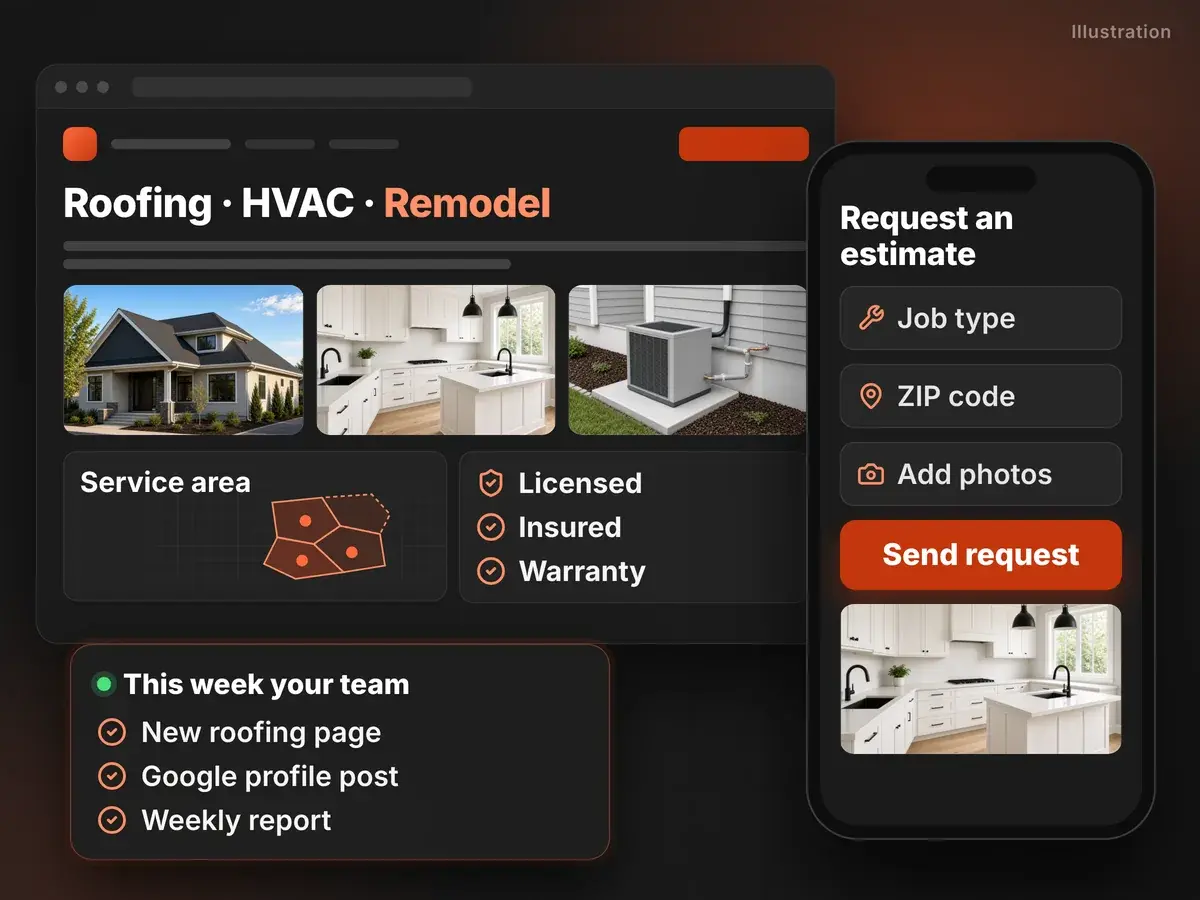
Photos of real jobs load fast on any phone, so homeowners see what you can do before they look at anyone else.
Contractor websites that win bids: fast portfolios, clear estimates CTAs, mobile-first trust signals for HVAC, roofers, and GCs—zero WordPress babysitting.
Real results
Their old site was a few brochure pages. We gave each service in each city its own page, then cleaned out the pages that weren't earning their place.
A site built to win the job, in plain terms.
Photos of real jobs load fast on any phone, so homeowners see what you can do before they look at anyone else.
A few quick questions: job type, ZIP code, optional photos. Your estimator knows what the job is before the first call.
Your license, insurance, certifications and warranty sit near the top, where homeowners check before they reach out.
Every town and trade you cover is spelled out, so the right customers find you and the wrong ones don't waste your time.
Big call and quote buttons on every page. No tiny links, no slideshow hiding how to reach you.
Storm repairs, AC tune-ups or furnace checks move to the top of the site when demand shifts. No rebuild needed.
Comes with your AI website
Most websites sit still after launch. Yours comes with an AI marketing team that works on it every week, and a real person who reviews everything before it goes out.
So the site that wins you jobs this spring is still fresh when the season turns.
Writes helpful articles and pages your customers actually read.
Makes sure Google knows exactly what you do and where.
Keeps your Google Maps listing fresh, posted and watched.
Keeps your business name, address and phone the same everywhere.
Keeps your social pages busy every week.
Sends you a plain-English update every week.
Add-on
Runs ads built for calls and quotes.
A real person
Sets your strategy and reviews the work before it goes out.
What each teammate does depends on your plan.
Homeowners do not hire a domain name—they hire the team that shows up on time, protects the house, and finishes.
Your website is the audition. If it feels slow, stock-photo generic, or hides how to get a quote, you lose to the competitor whose site feels as organized as your job sites.
License, insurance, manufacturer certs, years in business, process (how you protect floors, how crews badge up)—these belong high on the page, not buried in a PDF from 2019.
Roofing customers want steep-slope proof. HVAC customers want equipment and duct context. Remodel clients want finish-level taste. We structure trade-specific galleries with captions so the proof matches the visitor.
Tap-to-call, schedule/consult CTAs, and short forms that work one-handed. Long questionnaires belong after you have the lead—not as a gate.
When hail hits or heat waves spike demand, the hero and sticky CTAs should say what you do today—without a site redeploy from scratch.
Fields tied to dispatch reality: service type, ZIP, brief description, optional photo upload. Enough for triage; not enough to abandon.
Fall furnace, spring AC, storm response—rotated emphasis modules so the homepage matches the market without feeling like a different brand every month.
Your customers are on couches, driveways, and lunch breaks—on LTE. Thumb-sized buttons, readable type, no carousel that hides the phone number.
Homeowners search trade + city—"roof replacement Tampa," "furnace repair Naperville," "kitchen remodel contractor near me." Winning the long tail takes clean information architecture, unique local context per page, and proof you work in those neighborhoods—not one generic "we serve the area" paragraph.
If you run HVAC and roofing (or GC + remodel), pages must be siloed so each trade owns its intent:
Seasonal emphasis (AC vs. furnace) can show up in modules and FAQs without rewriting your entire IA every quarter.
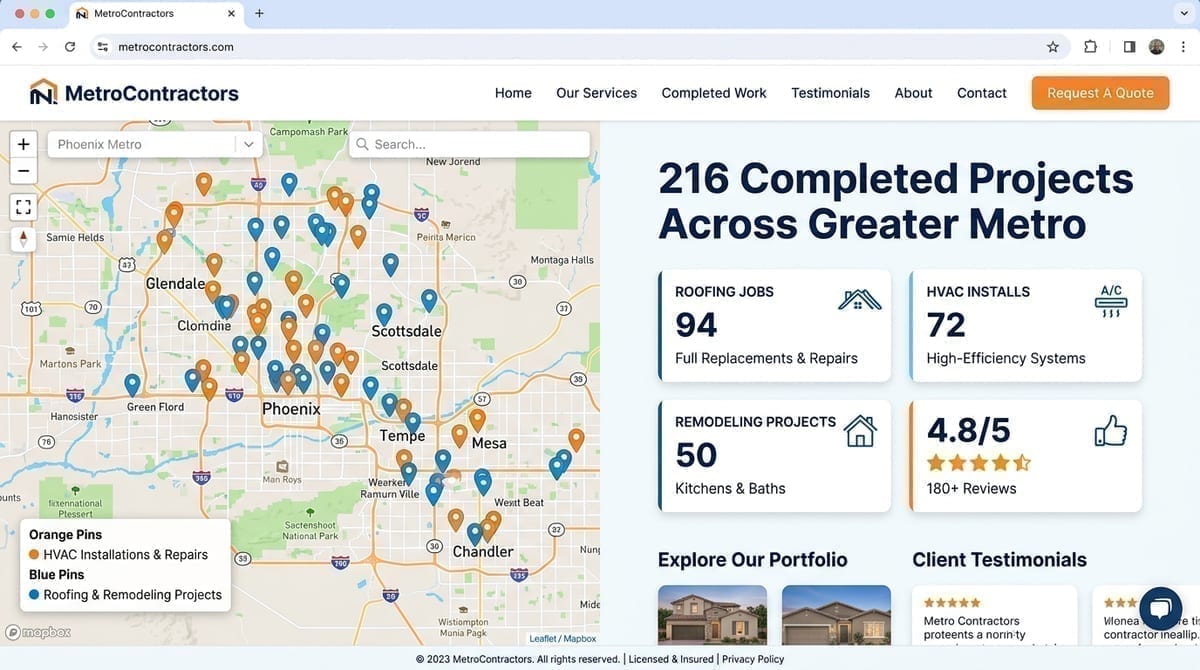
Completed-job maps answer: Do you really work here, or are you keyword-stuffing?
LocalBusiness (and subtype where it fits), Service entities for major lines, and FAQ markup only on visible FAQs. License numbers, insurance, and warranty copy stay consistent across GBP, footer, and structured data.
FAQ: We cover 40 cities—duplicate content? Not if each page layers trade FAQs, local risk factors (wind, hail, freeze), permits culture, and dynamic project-derived content—empty templates with swapped city names are what fail.
For massive programmatic scale, see Programmatic SEO with AI.
Your crew is judged before the truck leaves the yard. Give them a digital storefront that is as tight as your safety briefing—clear, fast, credible, easy to contact.
That is how you fill the schedule.
Proof plus speed. Homeowners compare 3–5 sites on their phones. If yours loads fast, shows real jobs, and makes requesting a quote trivial, you earn the call or form.
No. We separate HVAC, roofing, remodel, etc. into clear paths so visitors land in the right story and you do not compete with yourself in the UI.
Yes. Prominent seasonal modules (tune-ups, storm response, AC peak) without rebuilding the whole site.
Conversion UX is above; programmatic city pages, completed-job maps, and schema are covered in the section below on this page.
Ship a site that matches the quality of your craft—and keeps your PMs off plugin duty.
Get Your Free Preview