
Most teams approach AI Overview visibility as if it were a brand-new channel. For a local business, it is usually a supporting-link clarity problem: can Google trust your page enough to use it as a supporting link, and does the page say enough, early enough, for the answer to stay accurate when Google summarizes it?
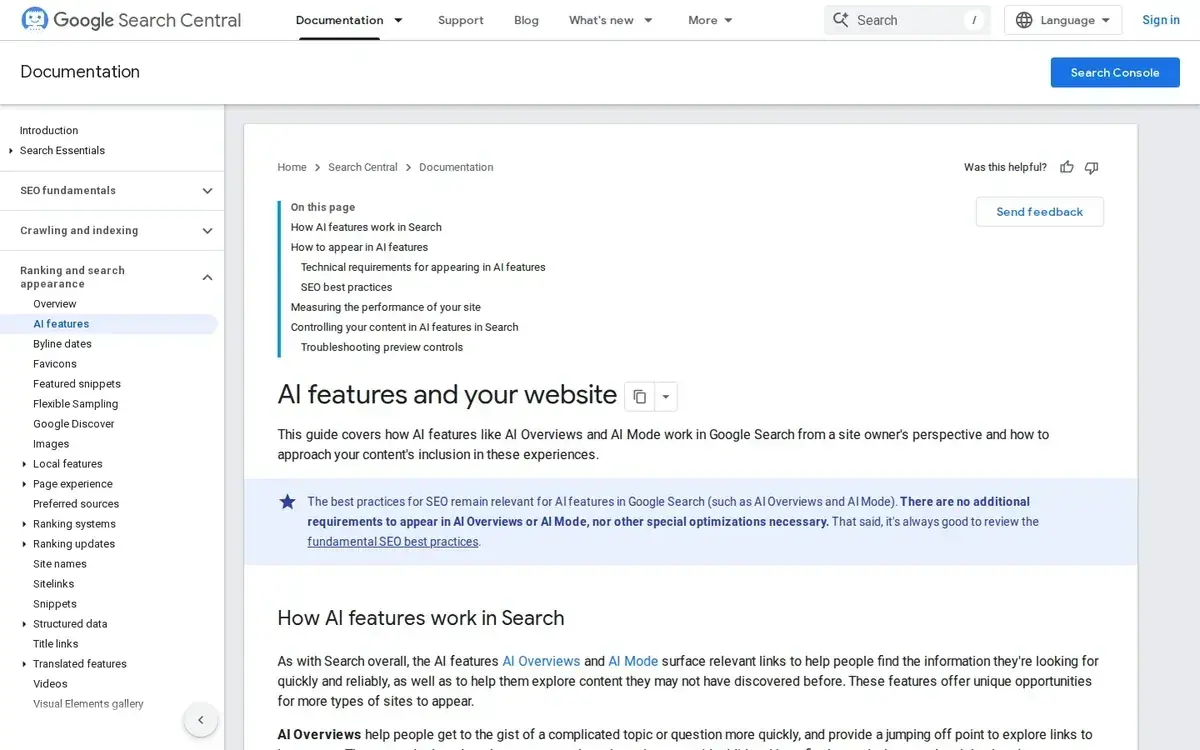
Google's own documentation is much less mystical than the GEO chatter online. Its AI optimization guide says generative AI features in Search are rooted in Google's core ranking and quality systems. Its AI features documentation says a page must be indexed and eligible to appear in Search with a snippet before it can be shown as a supporting link in AI Overviews or AI Mode.
That is good news for local brands. It means you do not need a secret AI formatting trick. You need stronger pages, cleaner business details, and clearer supporting-link signals on the pages that already matter.
 Google frames AI Overviews and AI Mode as experiences that surface relevant supporting links, not as a separate game with separate technical rules.
Use this checklist when you review your top local service pages:
| Checklist area | What to verify first |
|---|---|
| Supporting-link eligibility | The page is indexed, snippet-eligible, crawlable, and internally linked |
| Service-page grounding | The page answers the question directly, shows real scope, and includes visible proof |
| Profile corroboration | Your Business Profile categories, hours, service area, and attributes reinforce what the page says |
| Cluster split | Use this page for AI Overview supporting links, the AI Mode audit for the broader AI-features workflow, and the GBP article for listing operations |
This page intentionally owns the narrower supporting-link job in the cluster. If you want the broader 12-check workflow across AI features, read Google AI Mode SEO Audit for Service Businesses. If the listing itself is the operational bottleneck, read Google Business Profile Management for Local Service Businesses. For the higher-level strategy, our AI search playbook is still the right starting point.
What AI Overview visibility really means for a local service business
The first mental shift is simple. AI Overview visibility is not the same thing as "ranking number one."
Google says AI Overviews and AI Mode can surface a wider and more diverse set of helpful links than a classic search result. It also says those experiences may use query fan-out, which means Google can run several related searches behind the scenes to build the response. For a local service business, that matters because buyers rarely ask only one clean query.
A homeowner may start with:
- "why is my water bill suddenly high"
- "who finds hidden slab leaks near me"
- "is mold testing worth it after a leak"
- "emergency plumber or leak detection company"
That is the real visibility challenge. Your page is not being judged only on one exact-match keyword. It may be evaluated as part of a cluster of related sub-questions. So the local winner is often not the page with the most AI buzzwords. It is the page that is easiest for Google to interpret, easiest for a buyer to trust, and specific enough to support a direct answer.
For local service brands, AI Overview readiness usually comes down to three things:
- Eligibility: the page can actually appear as a supporting link.
- Grounding: the page contains clear, visible information Google can quote or summarize accurately.
- Consistency: the website, structured data, and Business Profile do not contradict one another about what the business does, where it serves, and when it is available.
If one of those breaks, the page may still rank for ordinary searches. But it becomes less reliable as an AI Overview supporting source.
The supporting-link eligibility checks to pass first
Before you rewrite a sentence, confirm the page qualifies for the boring basics.
Google's AI features guidance is explicit: to be shown as a supporting link in AI Overviews or AI Mode, a page must be indexed and eligible to appear in Google Search with a snippet. Google also says there are no additional technical requirements.
That gives local teams a practical first pass:
1. Make sure the page is indexable and snippet-eligible
If the page is blocked, thin, or not eligible to show a normal snippet, you do not have an AI Overview problem yet. You have a Search basics problem.
Google's snippet documentation also says snippets are primarily created from page content. That matters because many local pages are still written like brochure blurbs instead of answer-ready pages. If the useful content is vague, hidden, or too thin, the snippet and the supporting-link potential both suffer.
2. Check whether your internal links are real links
Google's link best practices remind site owners that Google generally crawls links when they are anchor elements with real href attributes. That sounds obvious, but local sites still break this with builder widgets, JavaScript-only click targets, and decorative cards that look clickable but are not crawlable enough.
 If important service pages are reachable only through weak widgets or nonstandard click behavior, Google gets less help discovering and understanding them.
For a local service site, ask:
- Does every service page I care about have a text link from at least one other important page?
- Is the anchor text descriptive enough to tell Google and the reader what the next page is about?
- Are the city and service pages buried under tabs, carousels, or click handlers that weaken discovery?
If your most important service page is hard to find from the rest of the site, that page is less likely to become a dependable supporting source.
3. Clean up duplicates before you create more pages
Google's AI guide says to reduce duplicate content when you can. Local sites often ignore this because duplication can hide inside city/service combinations, old landing pages, or overlapping "problem" pages.
That becomes expensive in AI search because overlapping pages blur which page should represent the business for a given question. If you have three versions of the same offer, Google has to guess which one best explains it.
A good weekly check is simple:
- one primary URL per main service
- one intentional page pattern for city or service-area content
- one clear internal-link path toward the page you want to own the topic
When the page map is messy, the AI Overview fix is usually not "write more." It is "pick the real canonical page and support it properly."
How to make service pages easier to ground and cite
Once the page is eligible, the next job is making it easy for Google to ground an answer on what the visitor can actually see.
Google's AI optimization guide keeps coming back to helpful, reliable, people-first content. Its structured data documentation adds another important rule: structured data should describe the page, and site owners should not add structured data about information that is not visible to the user.
That is the key local-service-business insight: your page needs visible, quotable specifics before any markup can help.
4. Put the direct answer near the top
Do not make Google or the buyer dig through three hero slogans before the page explains the service.
For each top service page, open with a short block that answers:
- what the service is
- who it is for
- what problem it solves
- when someone should call
- whether the business inspects, repairs, remediates, or refers out
This is where many local brands lose the plot. A leak detection page should say whether it handles slab leaks, irrigation leaks, pool leaks, or commercial systems. A mold-testing page should say whether it tests, remediates, or both. A restoration page should say whether it covers emergency mitigation, rebuild, or documentation.
The page is stronger when Google does not need to infer your service scope from scattered paragraphs.
5. Make FAQs useful, not decorative
FAQ sections still matter, but not because they are magical schema bait.
Google's snippet guidance says the page content itself is the main source for snippets, and its structured data guidance says markup should reflect visible content on the page. So the safest FAQ pattern is:
- use real buyer questions
- answer them directly in visible text
- keep the answer consistent with the service page body
- only mark up what the reader can already see
That avoids a common local SEO mistake: a page with thin visible copy and an overstuffed FAQ block that tries to carry the whole topic by itself.
6. Show proof that narrows the summary
Generic adjectives do not help much in AI-generated summaries. Specific evidence does.
Useful proof blocks for local service pages include:
- equipment or process details
- service-area specifics
- inspection or documentation steps
- photos that reflect the actual work
- credentials that are current and relevant
- clear exclusions when the business does not handle a related service
Google's AI guide also notes that high-quality images and video can create additional opportunities for content to appear beyond web page links. That does not mean every page needs a stock gallery. It means original, relevant media can reinforce what the page is really about.
7. Keep structured data aligned with the visible page
 Structured data is strongest when it confirms the page instead of compensating for missing visible information.
Structured data is still useful, but the wrong mindset is "schema will fix the page." The better mindset is "schema should confirm the page."
If the page says the team serves Miami-Dade and Broward, the profile and schema should not imply statewide coverage. If the visible page says inspections only, the markup should not read like a full repair offering. If the FAQ answers are weak or absent on the page, do not expect markup to save the topic.
For local brands, that alignment work is where a cleaner site architecture matters. It is much easier to keep service scope, supporting proof, and internal links consistent across dozens or hundreds of pages when the page system is not fighting the team.
Which Business Profile details still influence supporting-link trust
Google's AI guide explicitly points site owners toward local business details, and it says Google Business Profiles can help products and services be visible in AI responses and other Search results where appropriate.
That does not mean the profile replaces the website. For this checklist, the listing has one job: corroborate the page Google would use as a supporting link.
8. Confirm the listing and the service page tell the same story
Google's Business Profile editing guide says verified profiles can be updated with current business information such as hours, contact info, and photos.
 For supporting-link visibility, the profile is a corroboration source. If it contradicts the page, Google has two stories to reconcile.
Before you treat a page as Overview-ready, check whether the listing contradicts it:
- same primary category and service names
- same service area
- hours that match the operating model the page promises
- photos and attributes that reflect the real offer
If the page says "24/7 emergency leak detection in Miami-Dade" and the profile describes a weekday storefront in a different county, the page is harder to use as a clean supporting source.
The weekly operating system for categories, reviews, posts, and metrics belongs on Google Business Profile Management for Local Service Businesses. Use that article to run the listing. Use this page only to confirm the listing does not undermine the pages you want cited.
How this page fits the broader AI-search cluster
The cleanest way to avoid cannibalization is to give each URL one clear job.
This page owns the AI Overview supporting-link checklist:
- snippet eligibility
- crawlable internal links
- direct-answer blocks near the top
- visible proof and scope
- Business Profile corroboration
The related Aipress pages own adjacent jobs:
- Google AI Mode SEO Audit for Service Businesses covers the broader AI-features audit, including the weekly prompt routine and workflow questions this page intentionally skips.
- Google Business Profile Management for Local Service Businesses covers weekly listing operations, review handling, posts, and metrics in far more detail than this page should.
- AI websites is the next step when the page system itself makes accurate local publishing too slow or too fragile.
That split matters because Google treats AI Overviews and AI Mode as related surfaces. If every post tries to own every AI-search question, the cluster becomes harder to understand. A stronger cluster gives the broad workflow to one URL, the listing-operations system to another, and the supporting-link readiness checklist to this page.
 Google still builds snippets mainly from the page itself, so this page focuses on supporting-link readiness rather than the broader AI-mode audit workflow.
Next steps
Start with your top five revenue-relevant service pages and run this checklist in order:
- confirm indexability, snippet readiness, and internal-link access
- tighten the top-of-page answer, service scope, and proof blocks
- align any structured data with what the visitor can actually see
- confirm the Business Profile does not contradict the pages you want cited
- if you need the broader AI-features workflow next, continue with the Google AI Mode SEO audit
When those five pages are only the start of a larger service area, see our SEO service.
If the listing itself is the bottleneck, move to the Google Business Profile management guide. If the page system itself is the bottleneck, use that as the brief for a better content system. The goal is not to "game AI Overviews." The goal is to make the clearest, most trustworthy local page the easiest page for Google to use.
This article is educational, not platform-policy or legal advice. Google Search behavior, AI Overview presentation, and Business Profile features can change, so confirm major local SEO decisions against the latest Google documentation before updating production pages.