
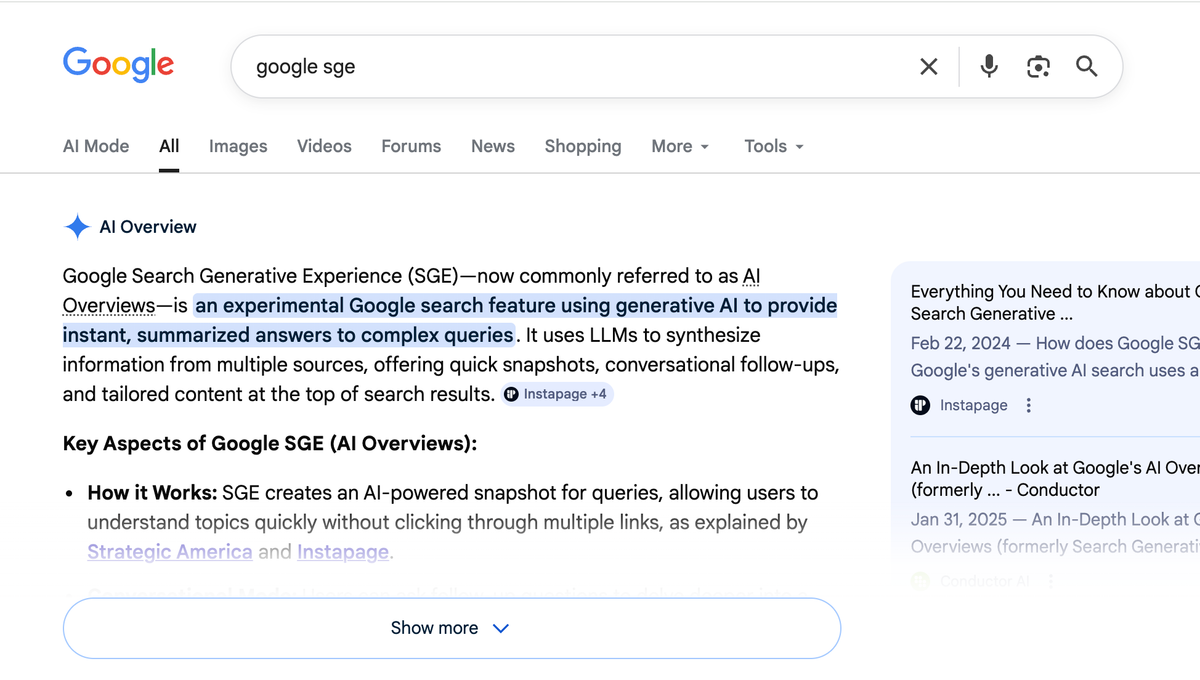
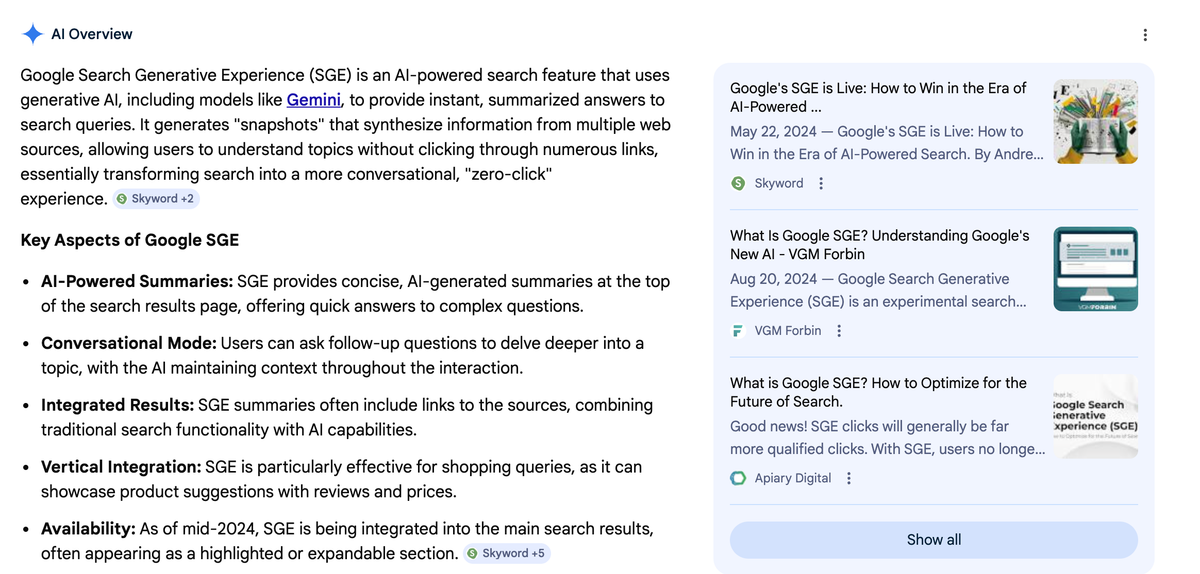
The integration of Large Language Models (LLMs) into primary search interfaces has fundamentally altered the mechanics of Search Engine Optimization. As Google’s Search Generative Experience (SGE) matures in 2026, the traditional SEO playbook—relying on keyword density, exact-match anchor text, and superficial content length—has become obsolete. SGE does not merely retrieve documents containing matching strings; it synthesizes answers by traversing complex, multi-dimensional knowledge graphs and extracting factual consensus from authoritative entities.
To thrive in an SGE-dominated landscape, websites must evolve from collections of unstructured text into machine-readable knowledge bases. This article provides a highly technical blueprint for optimizing architecture, content strategy, and metadata for Google SGE, emphasizing the necessity of entity-based SEO, robust JSON-LD implementations, and the performance benefits of Static Site Generation (SSG).
Understanding How LLMs Process and Retrieve Information
To optimize for SGE, engineers must first understand the retrieval mechanisms of the underlying LLMs (like Gemini). In traditional indexing, an inverted index maps keywords to documents. In modern neural search, content is processed into high-dimensional vector embeddings that capture semantic proximity.
When a user issues a complex query to SGE (e.g., "What are the structural differences between Next.js and Astro for enterprise e-commerce?"), the system performs several operations:
- Query Expansion & Intent Parsing: The LLM breaks the query into discrete entities ("Next.js", "Astro", "Enterprise E-commerce", "Structural Architecture").
- Vector Retrieval (RAG): The system queries a vector database for chunks of text that are semantically close to these entities and their relationships.
- Fact Extraction & Synthesis: SGE extracts facts from the top-k retrieved documents, prioritizing sources with high entity authority and structured consensus.
- Generation & Citation: The model generates a conversational response, appending citations (links) to the sources that provided the verified facts.
If your content is unstructured, fluffy, or buries facts inside verbose marketing copy, the retrieval mechanism will bypass your site in favor of one that presents data clearly and concisely.
Entity Salience and Knowledge Graphs
In 2026, SEO is synonymous with Knowledge Graph engineering. An entity is any distinct, well-defined concept (a person, place, abstract concept, product, or organization). Google’s Knowledge Graph links these entities via relationships (e.g., [Next.js] --is-a--> [React Framework] --created-by--> [Vercel]).
"Entity Salience" is a metric that measures how prominent and relevant an entity is within a specific document. To optimize for SGE, your content must clearly define entities and establish their relationships to other known entities in the graph.
Moving from Keywords to Contextual Vectors
Instead of ensuring the phrase "best React framework" appears three times on the page, optimization now involves ensuring the document contains a dense cluster of related entities. An article about Next.js should naturally include highly salient references to "Server-Side Rendering", "Static Site Generation", "Vercel", "Hydration", and "App Router". The presence of these related entities validates the document's expertise to the NLP model.
JSON-LD Schema Architecture: Feeding the Machine
The most direct way to communicate entity relationships to Google's NLP models is through application/ld+json Schema markup. While basic schemas (like Article or LocalBusiness) have been standard for years, SGE optimization requires deeply nested, interconnected schema graphs that explicitly declare the "Aboutness" of a page.
The about and mentions Properties
To establish high entity salience, technical SEOs must leverage the about and mentions properties within the schema, directly linking page concepts to established Wikipedia or Google Knowledge Graph URIs.
{
  "@context": "https://schema.org",
  "@type": "TechArticle",
  "headline": "Next.js vs Astro for E-commerce",
  "about": [
    {
      "@type": "Thing",
      "name": "Next.js",
      "sameAs": "https://en.wikipedia.org/wiki/Next.js"
    },
    {
      "@type": "Thing",
      "name": "Astro (framework)",
      "sameAs": "https://en.wikipedia.org/wiki/Astro_(framework)"
    }
  ],
  "mentions": [
    {
      "@type": "Thing",
      "name": "Static Site Generation",
      "sameAs": "https://en.wikipedia.org/wiki/Static_site_generator"
    },
    {
      "@type": "Thing",
      "name": "Server-side rendering"
    }
  ],
  "author": {
    "@type": "Organization",
    "name": "AiPress Engineering Team",
    "url": "https://aipress.io"
  }
}
By explicitly defining what the document is about and what it mentions, you remove the ambiguity from the NLP extraction process, significantly increasing the likelihood that SGE will use your document as a primary source for generated answers.
Semantic HTML and Static Site Generation (SSG)
While JSON-LD provides the explicit map, the actual HTML structure of your page must be highly semantic. LLMs utilized in RAG pipelines rely heavily on HTML structure to chunk documents into manageable pieces for vectorization.
Structuring Content for LLM Retrieval
If your HTML is a soup of unsemantic <div> tags, the chunking algorithm may split related thoughts or fail to recognize the hierarchy of information.
- Use strict heading hierarchies (
<h1>-><h2>-><h3>) without skipping levels. - Use
<table>tags for comparative data. LLMs are exceptionally good at parsing standard HTML tables to answer comparative queries in SGE. - Use
<dl>(description lists) for glossaries and term definitions. - Keep paragraphs focused on a single entity or concept to ensure clean vector chunking.
Why Static Site Generation is Mandatory for SGE
The speed and deterministic nature of Static Site Generation (Next.js, Astro) provide a massive competitive advantage in an SGE world over legacy, runtime platforms like WordPress.
- Crawl Budget and WRS Bypass: SGE requires rapid re-crawling to update its active indices. Client-Side Rendering (CSR) or slow PHP-rendered pages force Google to utilize its Web Rendering Service (WRS), slowing down indexation. SSG delivers pre-rendered, static HTML instantly, ensuring all entity data and semantic markup is immediately parsed by Googlebot.
- Clean HTML Output: Legacy CMS plugins inject thousands of lines of inline styles, tracking scripts, and bloated DOM structures. This noise dilutes the semantic signal to noise ratio. Modern SSG setups output highly optimized, clean DOM trees, making it mathematically easier for LLMs to extract the raw entity data.
- Core Web Vitals: SGE generation takes time on Google's end. To maintain a fast overall user experience, Google heavily biases its source selection toward sites with near-zero Time to First Byte (TTFB) and perfect Core Web Vitals. Static HTML served from a CDN is fundamentally the fastest way to deliver bytes over a network.
Code Implementation: Structuring for SGE in Next.js
Building an SGE-optimized page in a modern framework involves strict separation of data and presentation, ensuring the data is exposed both visually and semantically.
// Example of an SGE-optimized Next.js Component
import Head from 'next/head';

interface EntityProps {
  frameworkA: { name: string; type: string; url: string; ssgSupport: boolean };
  frameworkB: { name: string; type: string; url: string; ssgSupport: boolean };
}

export default function FrameworkComparison({ frameworkA, frameworkB }: EntityProps) {
  // Generate nested schema programmatically
  const schema = {
    "@context": "https://schema.org",
    "@type": "Article",
    "about": [
      { "@type": "SoftwareApplication", "name": frameworkA.name, "url": frameworkA.url },
      { "@type": "SoftwareApplication", "name": frameworkB.name, "url": frameworkB.url }
    ]
  };

  return (
    <article itemScope itemType="https://schema.org/TechArticle">
      <Head>
        <script type="application/ld+json" dangerouslySetInnerHTML={{ __html: JSON.stringify(schema) }} />
      </Head>

      <header>
        <h1 itemProp="headline">Comparing {frameworkA.name} vs {frameworkB.name} for SSG</h1>
      </header>

      <section>
        {/* SGE loves well-formatted tables for extracting comparative facts */}
        <h2>Feature Comparison</h2>
        <table>
          <thead>
            <tr>
              <th>Feature</th>
              <th>{frameworkA.name}</th>
              <th>{frameworkB.name}</th>
            </tr>
          </thead>
          <tbody>
            <tr>
              <td>Static Site Generation (SSG)</td>
              <td>{frameworkA.ssgSupport ? 'Native' : 'Requires Plugin'}</td>
              <td>{frameworkB.ssgSupport ? 'Native' : 'Requires Plugin'}</td>
            </tr>
          </tbody>
        </table>
      </section>

      <section>
        <h2>Architectural Differences</h2>
        {/* Highly focused, entity-dense paragraphs */}
        <p>
          While <strong>{frameworkA.name}</strong> utilizes a virtual DOM for client-side hydration,
          <strong>{frameworkB.name}</strong> employs an Islands Architecture, shipping zero JavaScript
          by default. This drastically improves Time to Interactive (TTI) for static content.
        </p>
      </section>
    </article>
  );
}
Conclusion
As we navigate 2026, Google SGE continues to redefine how users interact with information. The era of writing "content for search engines" via keyword stuffing has been permanently replaced by the era of "engineering knowledge for language models." By adopting an entity-based SEO architecture, deploying deeply nested JSON-LD knowledge graphs, and leveraging the speed, security, and deterministic rendering of Static Site Generation, engineering teams can ensure their content remains the primary factual source for AI-generated search experiences. The future belongs to structured data; unstructured, boilerplate content will simply not be retrieved.