
For over two decades, Search Engine Optimization was largely an exercise in string manipulation. SEO practitioners analyzed keyword density, meticulously optimized <title> tags to include exact-match phrases, and debated the ideal length of a meta description. This era, characterized by lexical search algorithms like TF-IDF (Term Frequency-Inverse Document Frequency), treated words as disconnected strings of characters.
Today, modern search engines operate on semantic understanding powered by advanced Natural Language Processing (NLP) models. Google doesn't process strings; it processes entities. The transition from keyword-centric optimization to Entity-Based SEO requires a fundamental shift in how developers and content architects structure websites. This highly technical guide breaks down the mechanics of entity-based search, the construction of semantic knowledge graphs, and why Static Site Generation (SSG) is the optimal architecture for delivering entity-rich content.
What are Entities in Search?
In the context of information retrieval and NLP, an entity is a singular, unique, well-defined, and distinguishable concept. An entity can be a:
- Person: Alan Turing, Linus Torvalds
- Place: San Francisco, The Eiffel Tower
- Organization: Google, Vercel, Microsoft
- Concept/Idea: Artificial Intelligence, Static Site Generation, SEO
- Product: iPhone 15, Next.js
Unlike a keyword, an entity has a persistent identity that transcends language and phrasing. The strings "The Big Apple," "NYC," and "New York City" are lexically different but map to the exact same entity in Google's Knowledge Graph.
Google’s algorithms identify entities on a webpage and map them to their massive internal Knowledge Graph, evaluating the relationships between the entities present. If an article mentions "Apple," the NLP model uses surrounding entities to determine disambiguation: does the text also mention "iPhone," "Tim Cook," and "Cupertino" (the technology company entity), or does it mention "Pie," "Orchard," and "Cider" (the fruit entity)?
NLP and Content Analysis: Salience and Confidence
When Googlebot crawls a modern webpage, it runs the text through an NLP pipeline that extracts entities and assigns them mathematical scores. The two most critical metrics are:
- Salience: A measure (usually from 0.0 to 1.0) of how central an entity is to the overall meaning of the text. An entity with a salience of 0.8 is the primary subject; an entity with 0.05 is merely a passing mention.
- Confidence: How certain the model is that it correctly mapped the string of text to the correct entity in its Knowledge Graph.
The goal of Entity-Based SEO is not to repeat a target keyword 15 times, but to structure the content so that the target entity achieves maximum salience, surrounded by a dense, logically connected cluster of related entities that provide high confidence and semantic depth.
Building a Semantic Knowledge Graph via Architecture
To excel in an entity-first ecosystem, your website must be built as a machine-readable knowledge graph. This involves structural internal linking, semantic HTML, and rigorous programmatic metadata.
1. Semantic HTML as Entity Containers
Search engines use the Document Object Model (DOM) to understand hierarchy and context. Semantic HTML tags act as explicit containers for entity relationships.
<article>bounds the primary entity context.<h1>to<h6>define the taxonomic hierarchy of sub-entities.<figure>and<figcaption>link visual entities (images) to textual descriptions.<table>provides structured, relational data between multiple entities (e.g., comparing features of Next.js vs Astro).
A generic <div> soup, common in bloated WordPress themes and page builders, strips this semantic context away, forcing the NLP model to guess the structural relationships.
2. Internal Linking using Entity Relationships
Internal links are the edges connecting the nodes (pages) in your site's knowledge graph. In entity-based SEO, anchor text should not be optimized for exact-match keywords, but rather represent the precise entity you are linking to.
If you have a hub page about [Web Frameworks], it should link to child entity pages using precise node names: [Next.js], [Astro], [Gatsby]. This algorithmic clustering allows Google to understand that your domain is a topical authority covering the entire ontology of web frameworks.
Code Example: Implementing Entity Metadata
The most powerful tool for explicit entity optimization is application/ld+json Schema markup. Instead of hoping the NLP model deduces the entities correctly, you can explicitly declare them using the about and mentions properties, linking them directly to authoritative, verifiable URIs like official social profiles, Google Business listings, or Wikidata.
Here is a technical implementation using Next.js to dynamically generate an entity-rich schema for a blog post:
// lib/schemaGenerator.ts

interface PostEntity {
  title: string;
  description: string;
  url: string;
  primaryEntity: {
    name: string;
    sameAsUrls: string[];
  };
  relatedEntities: Array<{
    name: string;
    sameAsUrls?: string[];
  }>;
}

export function generateEntitySchema(post: PostEntity) {
  return {
    "@context": "https://schema.org",
    "@type": "TechArticle",
    "headline": post.title,
    "description": post.description,
    "mainEntityOfPage": {
      "@type": "WebPage",
      "@id": post.url
    },
    // Explicitly defining the Primary Entity
    "about": {
      "@type": "Thing",
      "name": post.primaryEntity.name,
      "sameAs": post.primaryEntity.sameAsUrls
    },
    // Explicitly defining surrounding contextual entities
    "mentions": post.relatedEntities.map(entity => ({
      "@type": "Thing",
      "name": entity.name,
      ...(entity.sameAsUrls && entity.sameAsUrls.length > 0 && { "sameAs": entity.sameAsUrls })
    }))
  };
}
// app/blog/[slug]/page.tsx
import { generateEntitySchema } from '@/lib/schemaGenerator';

export default async function BlogPost({ params }) {
  const post = await getPostData(params.slug);
  const schema = generateEntitySchema(post);

  return (
    <article itemScope itemType="https://schema.org/TechArticle">
      {/* Injecting the Knowledge Graph directly into the `<head>` */}
      <script
        type="application/ld+json"
        dangerouslySetInnerHTML={{ __html: JSON.stringify(schema) }}
      />

      <h1 itemProp="headline">{post.title}</h1>
      <div itemProp="articleBody">
        {/* Render content */}
      </div>
    </article>
  );
}
Best Practices for sameAs Identity
While pointing sameAs to Wikipedia or Wikidata can be powerful, a common mistake is using it aspirationally. You should only link to a Wikipedia page if it genuinely exists for your exact entity. Pointing to a loosely related topic or category page weakens trust instead of building it. Schema.org defines sameAs as a URL that "unambiguously indicates the item's identity."
In practice, especially for local businesses and brands, the cleanest and safest sameAs set consists of official profiles you control:
- Official Google Business / Maps profile
- Major social platforms (Facebook, Instagram, LinkedIn, YouTube)
- Authoritative review and business profiles (Yelp, BBB, Apple Business Connect)
This provides Google with consistent, verifiable identity signals. Wikipedia is a bonus, not a replacement for official, controlled presence.
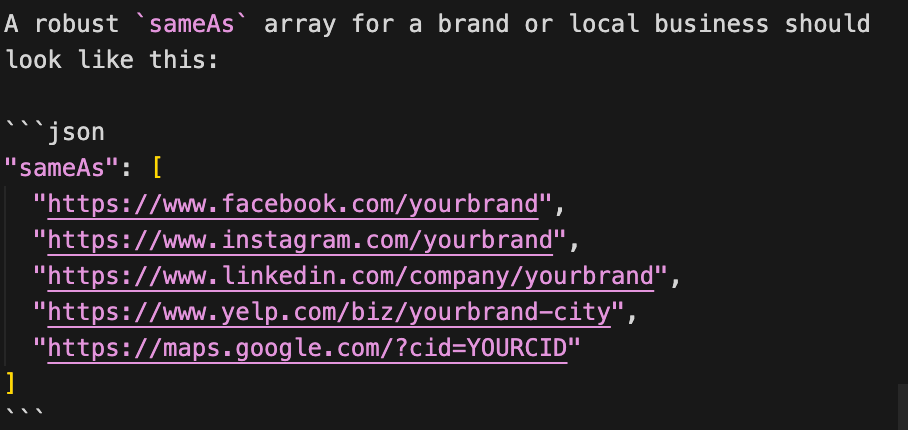
A robust sameAs array for a brand or local business should look like this:
"sameAs": [
  "https://www.facebook.com/yourbrand",
  "https://www.instagram.com/yourbrand",
  "https://www.linkedin.com/company/yourbrand",
  "https://www.yelp.com/biz/yourbrand-city",
  "https://maps.google.com/?cid=YOURCID"
]
By prioritizing official, controlled profiles across authoritative platforms, you establish a cleaner, safer entity footprint without relying on third-party editorial platforms like Wikipedia unless you already have an established page.
Performance: Why Static Sites Serve Entities Better
The architectural foundation of your site dictates how efficiently search engines can extract your entities. This is where Static Site Generation (SSG) provides a monumental advantage over legacy runtime CMS platforms like WordPress or Drupal.
The JavaScript Rendering Penalty
If your site relies heavily on Client-Side Rendering (CSR)—where a blank HTML page is sent to the browser, and JavaScript dynamically fetches and renders the content—you are severely handicapping your entity SEO. Googlebot must queue CSR pages for its Web Rendering Service (WRS). This delays indexation, often by days or weeks. Furthermore, if the JS execution fails or times out, the NLP model evaluates an empty page, finding zero entities.
The TTFB and Crawl Budget Advantage
Entity extraction is computationally expensive for Google. They allocate a finite "crawl budget" to your domain. SSG frameworks like Next.js or Astro pre-compile the entire DOM tree into static HTML at build time.
When Googlebot requests an SSG page:
- The server (often an Edge CDN) responds in milliseconds (ultra-low TTFB).
- The response is a fully-formed HTML document containing all semantic tags and JSON-LD data.
- No database queries (MySQL) or runtime processing (PHP) are required.
- No JavaScript needs to be executed to discover the content.
This efficiency allows search engines to crawl deeper, index faster, and map your entity relationships with mathematically perfect accuracy.
Conclusion
Entity-Based SEO is not a trend; it is the permanent architecture of modern search engines. Continuing to focus on keyword density and text spinning is a guaranteed path to algorithmic obsolescence. By transitioning to an entity-first mindset, engineers and marketers can build interconnected semantic knowledge graphs that directly speak the language of NLP models. When coupled with the speed, deterministic rendering, and clean DOM output of Static Site Generation, an entity-based approach creates a highly defensible, authoritative digital footprint capable of dominating modern search interfaces.