
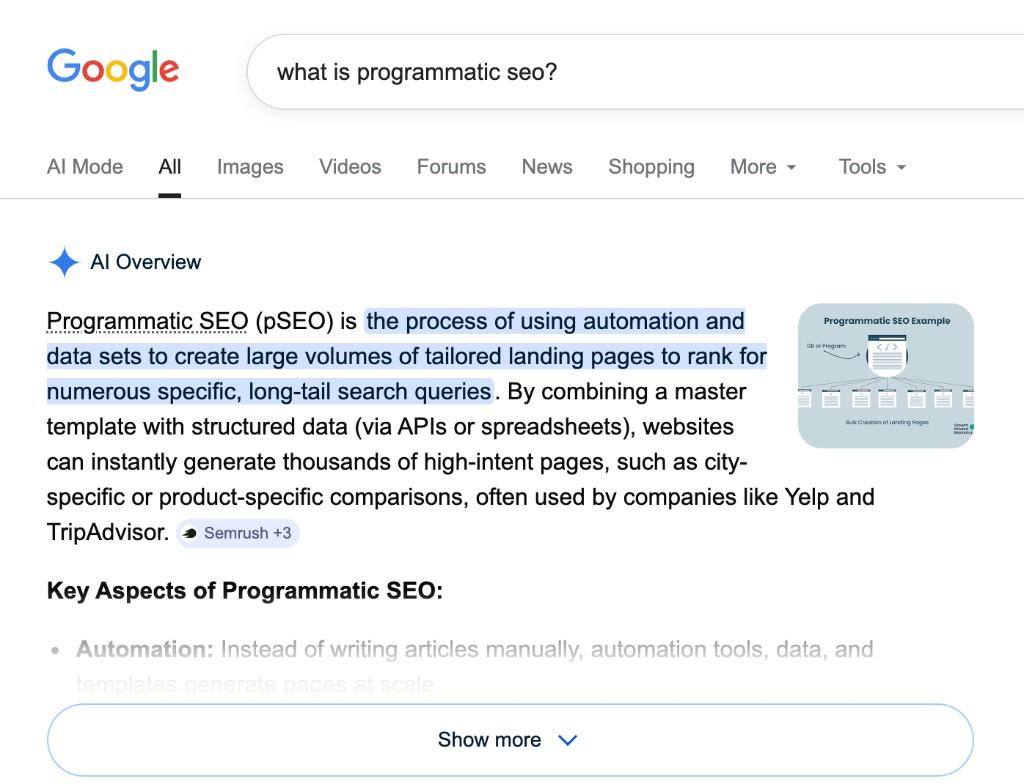
In the ever-evolving landscape of technical SEO, the distinction between high-quality programmatic SEO (pSEO) and low-effort boilerplate content has never been more critical. As search engines like Google deploy increasingly sophisticated natural language processing (NLP) models and knowledge graphs, the "Mad Libs" approach to content generation—where a single variable like a city name is swapped out in a static template—has become a massive liability. Websites relying on this outdated tactic are routinely penalized by Helpful Content Updates, while those employing an entity-based approach continue to capture massive long-tail traffic.
This article dives deep into the technical mechanics, architectural patterns, and structural differences between boilerplate content and modern, entity-based programmatic SEO. We will explore how to model data effectively, the engineering advantages of Static Site Generation (SSG) over runtime systems like WordPress, and how to build a scalable pSEO pipeline capable of generating 5,000+ unique, highly valuable pages without triggering duplicate content filters.
The Death of "Mad Libs" SEO
Historically, programmatic SEO was synonymous with doorway pages. A marketer would write a generic 500-word article about "plumbing services," inject a [City Name] variable into the H1, title tag, and a few paragraphs, and generate 10,000 pages for every city in the United States.
<!-- Example of obsolete boilerplate content -->
<h1>Best Plumber in [City Name]</h1>
<p>If you are looking for a reliable plumber in [City Name], you have come to the right place. Our [City Name] plumbing experts are ready to help with your leaky faucets and broken pipes. Call our [City Name] office today!</p>
This approach is fundamentally flawed in modern search because it lacks information gain. The underlying semantic meaning of the page is identical across all 10,000 variations. Search engine crawlers compute the cosine similarity of these pages, recognize that they are 98% identical, and group them together as duplicates or classify them as thin, unhelpful content.
The Paradigm Shift: Entity-Based Programmatic SEO
Entity-based SEO represents a paradigm shift from string matching to concept matching. An "entity" is a distinct, well-defined concept with specific attributes and relationships to other entities. Instead of swapping strings, an entity-based programmatic SEO architecture programmatically constructs pages by weaving together unique, structured data attributes associated with a specific entity.
In the context of local SEO, a city is not just a string; it is an entity with:
- Geographical coordinates (latitude, longitude)
- Climate and weather patterns
- Population demographics
- Specific local building codes or state regulations
- Local landmarks, neighborhoods, and zip codes
- Historical service data (e.g., "We repaired 50 HVAC systems in this zip code last year")
By injecting these unique entity attributes into the content generation pipeline, we create pages that are structurally and semantically unique, providing genuine value to the user.
Architectural Advantages of Static Site Generation (SSG)
When building an entity-based pSEO engine, the choice of tech stack is paramount. Traditional monolithic CMS platforms like WordPress (relying on PHP and MySQL at runtime) are ill-equipped for large-scale programmatic content. Generating 10,000 pages on WordPress requires expensive caching layers, complex database queries on every page load, and a brittle plugin ecosystem that drastically increases Time to First Byte (TTFB).
Static Site Generation (SSG) via frameworks like Next.js, Astro, or Gatsby shifts the computational heavy lifting to build time.
Why SSG Outperforms WordPress for pSEO:
- Zero Runtime Database Queries: The data pipeline fetches all entity data during the build process, compiling it into static HTML and JSON files. This results in blazing-fast TTFB, easily passing Core Web Vitals.
- Infinite Scalability: Serving static files from a Global Edge CDN (like Vercel, Cloudflare, or AWS CloudFront) costs a fraction of scaling a fleet of WordPress servers. You can serve 5,000 or 5,000,000 pages with virtually the same infrastructure.
- Security: Static HTML has no moving parts. There is no admin panel to brute-force and no database to inject via SQLi.
- Deterministic Rendering: With SSG, what you build is exactly what is served to Googlebot, ensuring predictable crawling and indexing. Client-Side Rendering (CSR), often used in Single Page Applications (SPAs), forces Googlebot to render JavaScript, delaying indexing and consuming crawl budget.
Technical Implementation: Engineering the Entity Pipeline
Let's look at how to engineer an entity-based pipeline using Next.js and a headless CMS or database (like Supabase or PostgreSQL).
Step 1: Designing the Database Schema
To support entity-based generation, our database must store more than just text. It must store relational data that can be dynamically assembled.
-- PostgreSQL Schema for Entity-Based pSEO
CREATE TABLE locations (
    id UUID PRIMARY KEY,
    city_name VARCHAR(255) NOT NULL,
    state_code VARCHAR(2) NOT NULL,
    population INT,
    climate_zone VARCHAR(100),
    local_building_codes JSONB,
    latitude DECIMAL(10, 8),
    longitude DECIMAL(11, 8)
);

CREATE TABLE service_data (
    id UUID PRIMARY KEY,
    location_id UUID REFERENCES locations(id),
    service_type VARCHAR(100),
    jobs_completed_last_year INT,
    common_local_issue TEXT,
    average_permit_cost DECIMAL(10,2)
);
Step 2: Fetching and Assembling Data at Build Time
In Next.js, we utilize getStaticPaths and getStaticProps (or the newer App Router equivalent generateStaticParams) to fetch this data at build time.
// app/service/[city]/page.tsx (Next.js App Router)
import { notFound } from 'next/navigation';
import { db } from '@/lib/db';
import { generateLocalSchema } from '@/lib/schema';

export async function generateStaticParams() {
  const locations = await db.locations.findMany();
  return locations.map((loc) => ({
    city: loc.city_slug,
  }));
}

export default async function CityServicePage({ params }: { params: { city: string } }) {
  const locationData = await db.locations.findUnique({
    where: { city_slug: params.city },
    include: { service_data: true }
  });

  if (!locationData) return notFound();

  const { city_name, climate_zone, local_building_codes, service_data } = locationData;

  return (
    <article>
      <h1>Professional Plumbing in {city_name}</h1>
      <section>
        <h2>Handling {climate_zone} Weather Challenges</h2>
        <p>
          In {city_name}, the {climate_zone} climate creates specific challenges for plumbing infrastructure.
          {climate_zone === 'Freezing' && ' Frozen pipes are a major risk during winter months, requiring specialized insulation.'}
        </p>
      </section>
      <section>
        <h2>Local Regulations and Permits</h2>
        <p>
          Before starting work, it is critical to understand local codes. In {city_name},
          permit costs average ${service_data.average_permit_cost}, and we handle all compliance
          with {local_building_codes.authority_name}.
        </p>
      </section>
      {/* Injecting dynamic JSON-LD Schema */}
      <script
        type="application/ld+json"
        dangerouslySetInnerHTML={{ __html: JSON.stringify(generateLocalSchema(locationData)) }}
      />
    </article>
  );
}
This architecture guarantees that the page for "Miami" (Tropical climate, specific hurricane building codes) is vastly different from the page for "Minneapolis" (Freezing climate, heavy snow load codes). The content diverges naturally based on the underlying entity attributes, eliminating the boilerplate footprint.
Edge Cases and De-duplication Logic
When scaling to thousands of pages, you will inevitably encounter edge cases that require sophisticated programmatic logic to prevent thin content generation.
Handling Sparse Data
What happens when a database record is missing local_building_codes or climate_zone? A naive template will render empty sections or broken grammar. Robust pSEO pipelines implement fallback logic and conditional rendering. If an entity lacks sufficient data to generate a unique, 1500-word page, the pipeline should either:
- Fall back to a higher-level entity (e.g., redirect the city page to the state page).
- Skip generating the page entirely during the build process to preserve crawl budget.
- Utilize a generative AI step (like an LLM API call during build) to synthesize surrounding context, provided it is fact-checked against a vector database (RAG).
Algorithmic Variation
To further distance pSEO from boilerplate, engineers often implement algorithmic variation. This involves defining multiple structural templates and randomly assigning them to entities, or using AST (Abstract Syntax Tree) transformations to reorder sections of the document where logically permissible.
// Example of structural variation logic
const renderSections = (data) => {
  const sections = [];
  if (data.climate) sections.push(<ClimateSection data={data} />);
  if (data.laws) sections.push(<LegalSection data={data} />);
  if (data.reviews) sections.push(<ReviewSection data={data} />);

  // Randomize order based on a deterministic seed (e.g., location ID) so it doesn't change on every build
  return deterministicShuffle(sections, data.id);
};
Conclusion
The era of boilerplate SEO is dead, penalized into obscurity by algorithm updates designed to surface genuinely helpful content. Entity-based programmatic SEO is the modern standard, requiring a rigorous approach to data modeling, software architecture, and content logic. By leveraging the power of Static Site Generation, structured data, and rich entity attributes, enterprise websites can safely scale their footprint to thousands of pages, capturing highly specific long-tail queries without running afoul of duplicate content penalties. Building this architecture requires an upfront engineering investment, but the resulting organic traffic moat is highly defensible and perfectly aligned with the future of semantic search.