
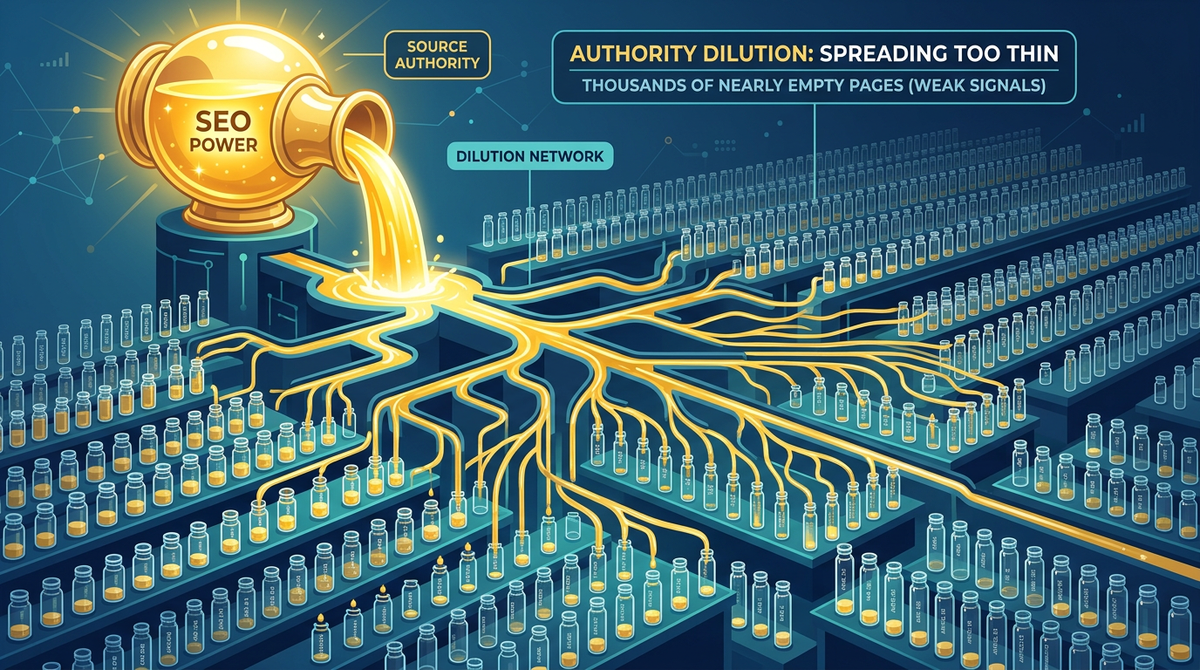
Keyword cannibalization is one of the most misunderstood concepts in technical SEO. The common, simplified definition—that having two pages targeting the same keyword hurts rankings—is technically inaccurate. Search engines do not penalize sites for having multiple pages on a topic. Instead, cannibalization is an intent dilution problem.
When multiple URLs on your domain satisfy the exact same user intent and share overlapping vector embeddings, search engine algorithms (like Google's RankBrain) struggle to assign primary relevance. This results in fluctuating rankings, split link equity, and stalled organic growth.
In Local SEO, especially for enterprise service-area businesses scaling to thousands of pages, the line between building hyper-local topical authority and triggering cannibalization is razor-thin. This guide explores the technical diagnosis of intent overlap, the algorithmic thresholds for consolidation versus expansion, and how modern Static Site Generation (SSG) architectures prevent structural cannibalization.
The Mechanics of Keyword Cannibalization in Local Search
To understand cannibalization, we must look at how search engines evaluate intent using TF-IDF, BM25, and Dense Vector Similarity.
When a user searches for "Emergency Plumber Brooklyn," the algorithm evaluates the query intent. If your architecture contains:
/brooklyn/plumber//brooklyn/emergency-plumbing-services//services/emergency-plumber/brooklyn/
The engine processes the semantic vectors of these three pages. If the cosine similarity between the content payloads of these URLs is too high (e.g., > 0.85), the algorithm cannot confidently determine the canonical answer. Consequently, it may rotate the URLs in the SERPs, resulting in none of them achieving a top 3 position.
The WordPress Taxonomy Trap vs SSG Precision
Traditional CMS platforms like WordPress are notorious for causing automated cannibalization. By default, WordPress generates Category pages, Tag pages, Author archives, and Date archives. If you tag a post with "Brooklyn Plumber" and put it in the "Emergency Services" category, WordPress automatically spins up multiple indexable URLs with thin, duplicate content that cannibalize your core landing page.
AiPress utilizes Static Site Generation (SSG). In an SSG architecture, URLs do not exist unless explicitly defined in the routing logic. There are no accidental tag archives or bloat. Every URL generated is intentional, mapped, and mathematically distinct, providing absolute control over the site's footprint.
Technical Diagnosis: Identifying Cannibalization at Enterprise Scale
Manual rank-checking is insufficient for an enterprise site with 5,000+ service area pages. You must approach diagnosis programmatically through vector similarity and log file analysis.
Vector Similarity Detection
The most accurate way to detect cannibalization before Google does is to calculate the cosine similarity of your own content. Below is a Python conceptual script utilizing scikit-learn to identify pages that are semantically too close.
from sklearn.feature_extraction.text import TfidfVectorizer
from sklearn.metrics.pairwise import cosine_similarity
import pandas as pd

def detect_cannibalization(pages_data):
    """
    pages_data is a list of dicts: [{'url': '/page1', 'content': '...'}, ...]
    """
    urls = [page['url'] for page in pages_data]
    texts = [page['content'] for page in pages_data]

    # Convert content to TF-IDF matrix
    vectorizer = TfidfVectorizer(stop_words='english')
    tfidf_matrix = vectorizer.fit_transform(texts)

    # Calculate cosine similarity across all pages
    similarity_matrix = cosine_similarity(tfidf_matrix)

    cannibal_pairs = []

    # Iterate through upper triangle of matrix to find high similarities
    for i in range(len(urls)):
        for j in range(i+1, len(urls)):
            score = similarity_matrix[i][j]
            # Threshold set to 0.80 (80% semantic overlap)
            if score > 0.80:
                cannibal_pairs.append({
                    'url_1': urls[i],
                    'url_2': urls[j],
                    'similarity_score': round(score, 3)
                })

    return pd.DataFrame(cannibal_pairs)

# Output reveals exact URL pairs causing intent dilution
Log File Analysis
Vector similarity identifies potential cannibalization. Log file analysis confirms it. By analyzing server logs, you can identify if Googlebot is violently alternating its crawl budget between two similar URLs. If /service-a and /service-a-alt are both being crawled daily but neither is ranking stably, you have active algorithmic confusion.
The Threshold Matrix: When to Consolidate vs Expand
Once intent overlap is identified, enterprise SEOs must make a binary decision: Consolidate or Expand.
When to Consolidate (Merge and 301 Redirect)
Consolidation is the correct action when the User Intent is identical.
Indicators for Consolidation:
- The SERP results for "Keyword A" and "Keyword B" show an 80%+ overlap in competing URLs. (If Google shows the same pages for both queries, the intent is merged).
- The vector similarity between your two pages is > 0.85.
- Both URLs suffer from thin content, and merging them would create one highly authoritative, comprehensive document.
Example: /roofing-repair-chicago/ and /fix-roof-chicago/. The intent is identical. Consolidate.
When to Expand (Differentiate and Optimize)
Expansion is required when the User Intent is distinct, but your content fails to communicate that distinction.
Indicators for Expansion:
- SERP overlap between the two queries is less than 30%.
- The queries represent different stages of the funnel (e.g., informational vs. transactional).
- The services require distinct entities, schema markup, or specialized knowledge.
Example: /commercial-roofing-chicago/ and /residential-roofing-chicago/. The intent, pricing, and audience are entirely different. Do not consolidate. Instead, aggressively expand the content of both to reduce their vector similarity. Add specific commercial B2B terminology to one, and residential B2C terminology to the other.
Technical Implementation of Consolidation
When consolidating at scale, proper redirection architecture is paramount. Standard .htaccess rules become unmanageable and computationally heavy at 5,000+ URLs.
Next.js Edge Middleware for Complex Redirects
Using an SSG framework like Next.js allows you to handle massive 301 redirect maps at the Edge (CDN level), resulting in zero latency for the user and immediate signal transfer for the crawler.
import { NextResponse } from 'next/server';
import type { NextRequest } from 'next/server';

// In an enterprise setup, this map is fetched from a distributed cache (like Redis)
const redirectMap: Record<string, string> = {
  '/services/emergency-plumber/brooklyn/': '/brooklyn/emergency-plumber/',
  '/brooklyn/plumbing-repair/': '/brooklyn/plumber/',
  // ... thousands of mapped cannibalized URLs
};

export function middleware(request: NextRequest) {
  const { pathname } = request.nextUrl;

  // Check if the current path requires consolidation
  if (redirectMap[pathname]) {
    const targetUrl = new URL(redirectMap[pathname], request.url);
    // Issue a 301 Permanent Redirect to pass PageRank
    return NextResponse.redirect(targetUrl, 301);
  }

  return NextResponse.next();
}

export const config = {
  // Only run middleware on potential service pages to optimize edge execution
  matcher: ['/services/:path*', '/:city/:service*'],
};
This Edge execution ensures that link equity from cannibalized pages flows instantly to the canonical canonical version without taxing the origin server.
Structuring the URL Hierarchy to Prevent Future Cannibalization
The ultimate defense against cannibalization is a strict, logically nested URL architecture governed by code, not content editors.
For local SEO, enforce a strict parent-child routing structure:
/{State}/{City}/{Primary-Service}/{Sub-Service}/
Correct: /tx/austin/hvac/commercial-installation/
Incorrect: /austin-commercial-hvac-installation/ (Flat architecture leads to infinite horizontal sprawl and overlapping intent).
By enforcing this structure in the Next.js App Router (e.g., app/[state]/[city]/[service]/page.tsx), you programmatically constrain content creation. If a user tries to create a new page, it must fit into an existing ontological node, preventing the creation of rogue, overlapping service pages.
Edge Cases: Overlapping Zip Codes and Hybrid Services
The Geo-Proximity Dilemma
Service area businesses often target neighboring towns (e.g., /dallas/plumber/ and /plano/plumber/). Because the content payload detailing the plumbing service is identical, these pages often cannibalize each other if not carefully managed.
Solution: You must inject dynamic, hyper-local entities into the SSG build. Do not just swap the city name. Programmatically pull in distinct Google Maps API coordinates, localized reviews, distinct neighborhood names, and localized schema for each build. This alters the semantic vector of the page enough to differentiate the intent based on spatial relevance.
Post-Consolidation Monitoring and Recovery
After executing a large-scale consolidation, expect temporary SERP turbulence. Google's index must recalculate the entity graphs and flow PageRank through the new 301s.
Monitor the Crawl Stats report in Google Search Console. You should see a spike in 301 crawl activity, followed by a stabilization of impressions on the primary consolidated URL. If impressions drop and do not recover within 21 days, the vector similarity between the old and new pages was too disparate, and the engine rejected the relevance transfer.
Conclusion
Keyword cannibalization is an architectural failure, not a content penalty. By utilizing programmatic vector similarity detection, enforcing strict SSG routing protocols, and executing zero-latency Edge redirects, enterprise brands can surgically resolve intent dilution. Understand the algorithmic thresholds, control your site's topology, and consolidate relentlessly to build unstoppable local topical authority.
The Role of the Canonical Tag in Consolidation
While 301 redirects are the strongest signal for consolidating cannibalized pages, there are edge cases where a 301 is not feasible. For instance, if you have two slightly overlapping service pages that must remain active for paid media campaigns, a 301 would break the tracking or the specific ad landing page experience.
In these scenarios, enterprise SEOs must rely on the rel="canonical" tag. This tells search engines, "I know these pages are semantically similar. Keep both accessible to users, but assign all organic ranking power to the canonical version."
Code Example: Next.js Dynamic Canonicalization
import Head from 'next/head';

export default function ServicePage({ canonicalUrl, isPaidLandingPage }) {
  // If this is a paid landing page with high overlap, canonicalize it to the organic master
  const finalCanonical = isPaidLandingPage ? "https://www.aipress.io/chicago/primary-service/" : canonicalUrl;

  return (
    <Head>
      <link rel="canonical" href={finalCanonical} />
    </Head>
  );
}
Using SSG, you can mathematically determine which page should be the canonical master during the build process based on internal link counts, and dynamically assign the canonical tags to all overlapping child pages.
Cross-Domain vs Single-Domain Cannibalization
For massive franchise brands, cannibalization often transcends a single domain. If a franchisor operates brand.com/local-store and the local franchisee operates localstore-brand.com, both domains will compete for the same local SERP, confusing the algorithm and splitting the link equity.
The Technical Solution:
The parent brand must enforce a single-domain architecture. The local franchisee domain should be 301 redirected to the brand.com/local-store URL. To execute this at scale without losing local traffic, you map the old URLs (e.g., localstore-brand.com/about) to the exact local node on the parent domain (e.g., brand.com/local-store/about).
This unified architecture consolidates the domain authority, dramatically increasing the semantic weight of the service pages and neutralizing cross-domain cannibalization entirely.
Internal Linking Architecture to Prevent Dilution
Beyond URLs, cannibalization is often caused by sloppy internal linking. If your site links to /roofing-repair/ using the anchor text "Chicago Roofer" and also links to /chicago/roofing/ using the exact same anchor text, you are actively confusing the crawler.
Enterprise teams must build programmatic internal linking scripts that enforce a strict mapping of anchor texts to destination URLs. If the canonical intent of "Chicago Roofer" is mapped to /chicago/roofing/, the SSG build process should automatically parse markdown files and standardize the anchor texts globally, ensuring a singular, consolidated signal is sent to the search engines.
Ready to transform your WordPress site?
Get a free preview of your site as a fast, modern site.
Free preview