
Published November 23, 2026.
Short answer: In real experiments, AI writes marketing about as well as professionals, makes sales and support teams faster, and helps the people who are still learning the most. The same research shows three ways it backfires. It gives confident wrong answers on hard judgment calls. Generic AI advice made weaker small businesses worse. And buyers walked away from an AI sales caller once they knew it was a bot. The businesses that come out ahead use AI for the volume work and keep a person on the calls that matter.
This piece looks only at studies that tested AI with real people and real work, plus large company surveys from four firms, one benchmark test, and two AI companies' own data on their products, each labeled for what it is.
The question every owner is asking
You can already get an AI tool to write a follow-up email or a Facebook ad in a minute. The real question is whether any of it brings in more money, or whether it is just faster junk. Here is what the evidence says, in plain terms.
Yes, AI can do the writing
It writes everyday business copy faster, and better. In a study published in Science, 453 college-educated professionals, including marketers, consultants and HR staff, did writing tasks from their own jobs: press releases, short reports, delicate emails. Half were given an AI writing assistant. It cut writing time by 40% and raised quality by 18%, as graded by professionals in the same fields. The weaker writers gained the most.
AI emails sold about as well as a professional writing team. Chicago Booth researchers ran three field experiments with online wine retailer Wine Access, each with about 27,500 newsletter subscribers. AI-written marketing emails sold about as well as emails from professional writers. The writers spent about three hours on each newsletter; the AI drafted in seconds. That is one newsletter format at one retailer, but it was a live sales test, not a classroom exercise.
AI-drafted ads, edited by a person, won more clicks. In live search-ad tests for an education campaign and an IT and software campaign, AI-drafted ads that a human lightly edited won more clicks than ads written by professional media buyers, and in a follow-on test cut cost-per-click by 38%. Notice the human edit. The winning setup was an AI draft plus a person, not copy shipped straight from a machine.
An AI agent helped people make 50% more ads, and the results tied. In a randomized study by Harang Ju and Sinan Aral with 2,234 participants and 11,024 ads, people working with a GPT-4o agent produced 50% more ads than people working in two-person human teams. The AI teams wrote stronger copy and weaker images. When the ads ran in a live campaign on X, the difference in overall campaign performance was not statistically significant. The participants were recruited online, not professional ad teams. The gain was more output and better text, not a jump in sales.
On a benchmark, the best model matched experts on just under half the tasks. In OpenAI's GDPval test (research paper), expert graders compared AI work with work from experienced professionals on 220 real tasks. Work from Claude Opus 4.1 was rated as good as or better than the professional's on 47.6% of them. GPT-5 was at 39.0% on the same test, and GPT-4o at 12.5%. The test includes sales jobs, but it is a benchmark: one-shot documents, slides and spreadsheets graded by experts, not a live sales result. The models also did best on short tasks and worse as tasks got longer.
For a local business, this means the first draft of the email, the ad, the proposal and the FAQ can take minutes. Then a person checks it.
Yes, it makes a team faster, especially the people still learning
Support agents resolved more issues. In a study of more than 5,000 customer-support agents at a large company that sells business software to small and mid-size US businesses, an AI assistant raised issues resolved per hour by 15%. Less experienced agents improved the most. This was customer support, not outbound sales, but the daily work is close: read a question, write a good answer, move on.
Consultants did more, faster, on work inside AI's range. In a Harvard and BCG field experiment with 758 consultants, those using AI completed 12% more tasks and worked 25% faster, with quality scores about 30% higher, on work inside AI's range. Hold on to that last phrase. It matters below.
Put together, a receptionist, a newer closer or a small sales team can cover more conversations without sounding green.
What companies say they are seeing
Most of these are surveys, not experiments. People report what they believe happened, and companies that buy AI may already be better run. The last two items are AI companies' own data about their own products. Treat all of them as context, not proof.
- Revenue gains are common but usually small. In McKinsey's November 2025 State of AI survey, marketing and sales was the function with the greatest reported revenue benefit from AI. 67% of respondents whose companies use AI in marketing and sales reported a revenue increase. Most of those increases were 5% or less, and only 39% of companies reported any effect on company-wide profit. McKinsey's 2026 follow-up found the share reporting any profit effect still stuck at 37%.
- AI teams report growth more often. In Salesforce's 2024 State of Sales survey of 5,500 sales professionals, sales teams using AI were more likely to report revenue growth: 83% did, compared with 66% of teams not using AI. That is a reported link, not proof that AI caused the growth.
- Plenty of teams have not been paid back yet. In a Gartner survey of 418 marketing leaders, 27% of CMOs said their organization had limited or no generative AI adoption in marketing campaigns, and Gartner notes that many CMOs "feel that their GenAI investments have yet to pay off."
- Most sales teams use AI, few see it in win rates. In a BCG survey of 398 revenue leaders, published in October 2026, nine in ten sales leaders said they already use AI in a meaningful way, but only 13% reported a measurable lift in win rates and only 14% reported improved conversion. Having the tool is not the same as getting deals from it. How it is set up, and who checks its work, still decides that.
- Companies are already handing sales tasks to AI. Anthropic's Economic Index found that business sales and outreach tasks, such as lead qualification, customer-data enrichment and cold-email drafting, at least doubled as a share of Claude API traffic between late 2025 and early 2026. That measures usage, not results. It does not mean reply rates or sales doubled.
- Microsoft's own numbers, not an independent trial. Microsoft reported that high users of Copilot on one of its sales teams had 9.4% more revenue per seller and 20% higher close rates, compared with low users. That comparison covered 687 sellers in the first half of 2024. It is observational: the heaviest users may already have been the stronger sellers.
The honest read: most companies have an AI tool, not a system around it.
Where AI fails, and why a person stays in the loop
This is the part most AI sales pitches leave out.
1. It gives fluent wrong answers on hard calls. The Harvard and BCG researchers also gave consultants a harder business problem designed to sit outside what the AI could do. Consultants with no AI got it right 84.5% of the time. Consultants using AI did worse, by an average of 19 percentage points. The AI's answer sounded convincing, and people leaned on it. In a sales business, the hard calls are pricing exceptions, tough objections and an unhappy big customer. Those are exactly where a polished wrong answer costs the most.
2. Generic advice made weaker businesses worse. In a five-month experiment with 640 small-business owners in Kenya, half got an AI business assistant. On average it made no measurable difference to revenue or profit. But owners who started out weaker did nearly 10% worse, while stronger owners may have gained over 15%. The AI's advice was not the difference. What owners chose to act on was. Weaker owners acted on generic moves like lowering prices or advertising more. Stronger owners used the same tool to find changes that fit their own business. These were small firms in Kenya, not US service companies, but it is the clearest small-business warning in this research: generic advice can hurt the businesses that most need help.
3. Trust breaks fast once buyers know it is a bot. In a field experiment with 6,255 loan customers at a large lender in Asia, an AI voice caller was as effective as the company's skilled human agents when customers were not told it was a bot. When the caller said it was a bot at the start of the call, purchases fell 79.7%. The lesson is not to hide the bot. Hiding that a caller is a bot is illegal or restricted in many markets, and it is a bad bet for any brand. The lesson is that trust is fragile. Be open about automation, make sure finding out never feels like a bait-and-switch, and put a real person on anything that needs empathy or a judgment call.
4. Even good tools help people unevenly. In the support study above, the most experienced agents saw small gains in speed and small declines in quality. In a telemarketing experiment with more than 3,000 credit-card sales calls, agents with AI help achieved higher purchase rates than agents working alone, but the lift was bigger for strong agents. Weaker agents felt slower and overchallenged once the AI sent harder conversations their way.
5. Newer models still need a person on hand. The consulting test above used a 2023 model. In Anthropic's Project Vend, an AI shopkeeper built on Claude Sonnet 4 and later Sonnet 4.5 ran real in-office shops. It could source products, set prices and sell, and it largely stopped having weeks where it lost money. That was a big step up from the first phase, when an older model sold items at a loss and handed out discounts. But Anthropic still would not leave it to run a business on its own. It needed human backup and could still be talked into bad discounts. Same lesson, current model: let AI do the work, and keep a person close enough to say no.
Why Aipress.io keeps a human in the loop
Read the research together and the setup that works is plain: AI drafts at volume, a person checks, and a person owns the hard calls. That is how Aipress.io built Sales Agents for B2B sales teams.
- AI does the volume. The inbound desk sorts every enquiry and drafts a reply in the buyer's language.
- Your reps send. Nothing goes out on its own. A person on your team edits each draft and sends it from your own mailbox.
- No invented prices. Price, lead time and commitments stay as placeholders until your rep writes them.
- Sensitive messages go to a person. Legal questions and data requests are flagged to a person, not drafted.
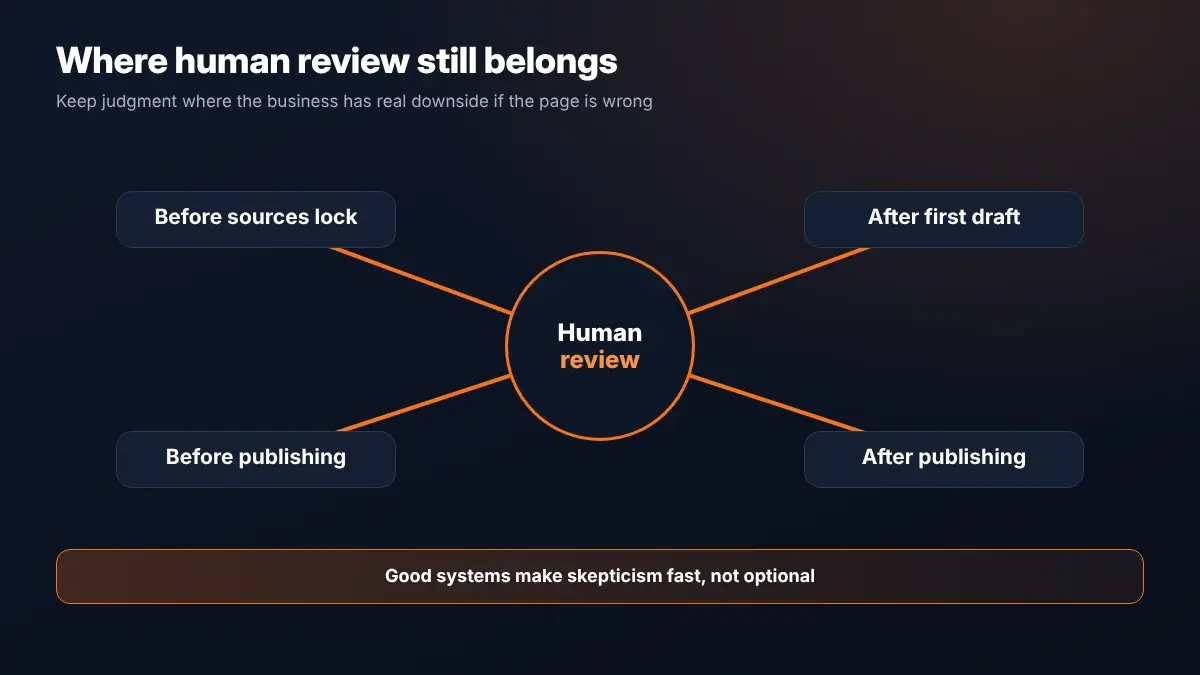
The same idea applies to content. Our post on why content agents need rules, not just prompts walks through where human review belongs.
What to do with this if you run a local business or a B2B sales team
- Use AI for volume work it handles well: first drafts, list research, appointment follow-ups, ad variations and after-hours coverage.
- Keep a person on the hard calls: pricing exceptions, tough objections and anything you would be sorry to see go out wrong.
- Be open about automation. Never let a bot pretend to be a person.
- Test generic advice before you act on it. If an AI suggests cutting prices or spending more on ads, check that it fits your customers and your margins first.
- Measure what pays: replies, booked jobs and revenue, not "we posted more."
Get AI working for your sales, with a person on the hard calls
If you run a B2B company with a sales team, see how Sales Agents work and book a demo on your own enquiries. If you run a local business and want help with your marketing, contact the Aipress.io team.
FAQ
Does AI actually help sell more?
In live tests, AI-written marketing emails sold about as well as emails from professional writers, and AI-drafted search ads that a person lightly edited won more clicks than ads written by professional media buyers. In a randomized study, people working with an AI agent made 50% more ads than two-person human teams, and the ads tied in a live campaign. In McKinsey's November 2025 survey, 67% of respondents whose companies use AI in marketing and sales reported a revenue increase, and most of those increases were 5% or less. The research supports AI as a faster way to produce good work, not as a replacement for a good salesperson.
Where does AI go wrong in sales and marketing?
Three places stand out. On a hard problem built to sit outside what the AI could do, consultants using it got the answer right 19 percentage points less often than consultants without it. Small-business owners who started out weaker did nearly 10% worse after getting an AI business assistant, because they acted on generic moves like cutting prices. And an AI sales caller lost 79.7% of its purchases when it said it was a bot at the start of the call. Newer models have not removed the need for a person: an AI shopkeeper built on Claude Sonnet 4 and 4.5 still needed human backup and could still be talked into bad discounts.
Should I tell customers when they are talking to AI?
Yes. Hiding that a caller is a bot is illegal or restricted in many markets and is a risk to your brand. The research shows trust is fragile, so be open about automation and keep a person on conversations that need empathy or a judgment call.
What should a small business use AI for first?
Volume work the AI handles well: first drafts of emails, ads and proposals, list research, appointment follow-ups and ad variations. Keep a person on pricing exceptions, hard objections and anything you would be sorry to see go out wrong, and judge the results by replies, booked jobs and revenue.