
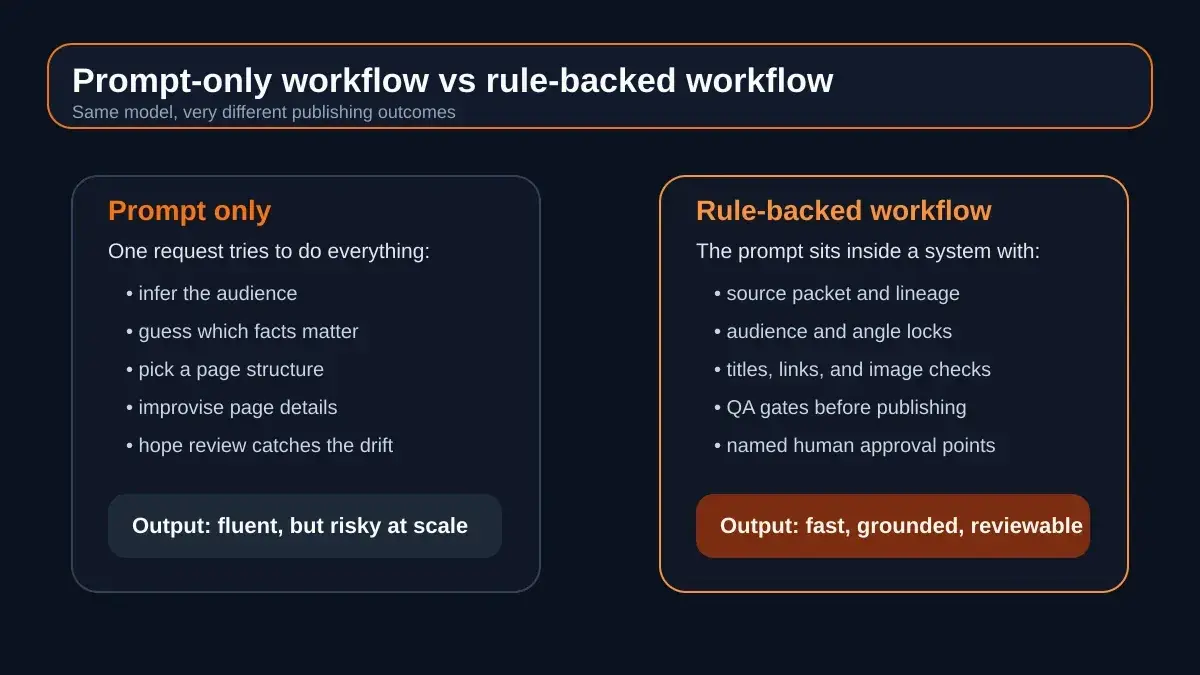
 The quality of an AI draft is rarely decided by the prompt alone. It is decided by the rules, sources, checks, and approvals around the draft.
An AI content agent workflow breaks down when the team treats the model like a freelance writer with a perfect memory. That assumption sounds efficient right up until the page invents a fact, misses the brand voice, or ships a title and image package that no one would actually want indexed.
That is why the real question is not, "What is the best prompt?" The better question is, "What system keeps the agent grounded before it writes, constrained while it writes, and reviewable before it publishes?"
AiPress already hints at that answer in two places. Its AI websites page describes a workflow that moves from analysis to generation to review before launch. Its programmatic SEO with AI page is even more explicit: scalable pages come from templates, data, and rules, and the durable formula is AI draft plus human polish plus unique insight.
That matches what Google says from the search side. In its people-first content guidance, Google asks whether a page adds original value, demonstrates expertise, and actually helps the visitor complete a goal. In its guidance on generative AI content, Google also says automatically generated pages still need accuracy, quality, relevance, and reliable search-facing details such as titles, meta descriptions, and image alt text.
Once you accept that standard, prompt engineering becomes only one layer in a larger operating system.
Why prompt-only workflows drift
A good prompt can absolutely improve a draft. It can set tone, ask for structure, and reduce obvious mistakes. What it cannot do by itself is supply missing business context, prove a claim, or decide which parts of a page deserve human skepticism.
That is the trap. Teams see one strong output and assume they have solved the system. Then the same setup meets a harder topic, a thinner source packet, or a higher-stakes page, and the draft starts making quiet substitutions:
- general language instead of first-hand specifics
- plausible facts instead of verified ones
- generic calls to action instead of the real next step
- borrowed phrasing instead of a differentiated point of view
- sloppy page details around titles, descriptions, authorship, and images
Google's framing makes that drift easier to understand. Search does not care whether the text came from a person typing from scratch or an agent executing instructions. It cares whether the final page is helpful, original, and created for people rather than for ranking manipulation. Google is also direct in its spam policies: scaled content abuse happens when many pages are generated primarily to manipulate rankings instead of helping users.
That means a prompt-only system creates two risks at once. The first is editorial drift: the page simply is not good enough. The second is operational drift: when the workflow scales, the weak pages start to look systematic rather than accidental.
NIST's Generative AI Profile describes a similar problem in different language. It calls out confabulation as a distinct risk, and it warns that human-AI configuration can create automation bias when people defer too easily to the model. In plain English, if the workflow is built to trust the draft too early, the team's review habits will slowly get worse.
That is why prompt quality is not the moat. Governance is.
What rules actually do
Rules are the part of the workflow that decide what the model is allowed to do, what it must look at first, and what evidence it has to leave behind.
That sounds rigid until you compare it with the alternative. Without rules, the model has to infer your audience, invent your threshold for proof, guess which internal pages deserve links, and decide which claims sound safe enough to publish. Even a very capable model will fill those gaps with averages.
With rules, the agent gets a much more useful job description:
- write for this audience, not for everyone
- stay inside this product or service scope
- use these sources before drafting
- keep these claims out unless they are verified
- structure the page so a reader can act without hunting
- leave page details clean enough that the result is ready for search and sharing
 The winning workflow does not replace prompts. It nests prompts inside a larger rule stack that controls audience, sources, structure, page details, and approvals.
AiPress's own programmatic SEO page makes the point cleanly: templates and data matter, but rules are what keep automated generation from collapsing into keyword swapping. That is especially important once a team moves beyond one article and starts operating a repeatable publishing lane.
Google's generative-AI guidance adds another practical layer. It is not enough for the main body copy to be decent. The automatically generated parts around the page also need to be accurate. If the title oversells, the description misleads, or the image text is lazy, the page is already leaking quality before the reader reaches paragraph two.
So when I say "rules," I do not only mean tone notes. I mean the whole set of guardrails that make the page harder to fake.
The five rule layers every content agent needs
The cleanest AI content systems usually have five layers. Skip one, and the draft may still look fine for a moment. But the publishing lane becomes unreliable.
| Rule layer | What it controls | What breaks without it |
|---|---|---|
| Purpose and audience | Who the page is for, what problem it solves, and what action it should support | The draft becomes generic and tries to help everyone at once |
| Source packet and lineage | Which pages, documents, and facts the agent must use before drafting | The draft fills gaps with plausible guesses |
| Structure and originality | What sections must appear, what angle makes the page distinct, and which examples add lived context | The article sounds like a tidy rewrite of existing material |
| Search-facing page details | Titles, descriptions, bylines, image text, links, and other reader-visible support fields | The page body may be acceptable, but the overall package feels sloppy or misleading |
| Review and approval gates | What gets checked before publish and who signs off | The system quietly teaches the team to trust unreviewed output |
1. Purpose and audience
Google's people-first framework starts here for a reason. A page without a real intended reader usually becomes a ranking-shaped compromise. It answers broad questions halfway, avoids specifics, and gives the model too much room to sound helpful without being useful.
A strong rule set names the audience directly. For AiPress, that might mean growth-minded owners, marketers, or operators deciding how to scale publishable pages without creating thin content. That is a very different reader from a hobbyist experimenting with prompts for fun.
2. Source packet and lineage
This is where many AI content teams underinvest.
If the agent is writing from memory and general training alone, your workflow has no durable connection to what the business actually knows. The better pattern is to assemble the source packet first: current service or product pages, approved positioning, approved source material, and any external authorities that define the real constraints of the topic.
AiPress's AI website flow starts from inputs such as an existing site URL or supplied content. NIST pushes the same concept from the governance angle, recommending test and evaluation around content flows, original data sources, and decision criteria. Those ideas matter because they turn drafting into a traceable step rather than a leap.
3. Structure and originality
The model should not be responsible for inventing the entire page strategy from scratch each time. It needs a brief that says what this article must cover and, just as importantly, what makes it worth existing beside the other pages already in the cluster.
That is how you avoid the slow death of okay-looking duplicates. A page can be fluent and still add very little. Google's helpful-content questions are ruthless on this point: does the page provide original information, research, or analysis, and would someone leave feeling satisfied rather than needing to search again?
If your workflow cannot answer those questions before drafting, it is asking the model to create differentiation on demand. That is not a writing problem. It is a planning problem.
4. Search-facing page details
One of the easiest ways to spot an immature AI workflow is to look at the surrounding page package. The body might read well, but the supporting fields are weak: vague descriptions, lazy author treatment, awkward image text, and internal links that feel random.
Google explicitly warns that automatically generated pages still need accurate titles, descriptions, and image text. That matters because those details shape how the page is interpreted before a reader ever engages deeply with the copy.
In other words, publishability is not just a body-copy standard. It is a packaging standard.
5. Review and approval gates
The last layer is the one teams try to remove too early.
AiPress's public workflow includes a review step before launch because review is where the system proves that the draft remained inside the lane. The human reviewer is not there to rewrite everything manually. The reviewer is there to validate the risky parts: factual claims, angle discipline, brand fit, internal links, and the overall promise of the page.
 The right question is not whether AI can draft fast. It is whether the workflow makes bad drafts easy to catch before they become indexed liabilities.
That distinction gets more important as output volume grows. A high-volume workflow without review gates does not save time for long. It simply moves the cleanup later, when mistakes are more public and more expensive.
Where human review still belongs
Some teams hear "human review" and imagine a person line-editing every sentence forever. That is not the point.
The best human review sits at the points where the business has real downside if the page is wrong:
- before the source packet is finalized
- after the first draft, when claims and gaps are easiest to spot
- before publishing, when packaging details and links are verified together
- after publishing, when the team can see how the page performs and whether anything needs correction
That review pattern does two jobs. First, it catches bad output. Second, it teaches the workflow what "good" actually means for the next page.
This is where the cluster split matters. If you want the narrower question of what to feed the system before it drafts, read the AI content agent training checklist. If you need the pre-draft page strategy, read AI content brief checklist before scale. The related AI content operations for home service brands article is still useful as a niche-specific implementation example. Together, those pages make the job split clearer: training packet, brief, and publishing workflow are related, but they are not the same step.
NIST's warning about automation bias belongs here too. The risk is not only that the model says something false. The risk is that the team begins to trust fluent output without checking whether the right evidence was present upstream.
A healthy workflow makes skepticism cheap.
A simple publishable workflow
If you need a practical model, keep it this simple:
- define the reader, intent, and success action
- assemble the source packet and current facts
- write the brief that locks the angle and required sections
- let the agent draft inside those constraints
- run a page-level QA pass on claims, links, and packaging
- approve, publish, and review performance with the next iteration in mind
 Human review works best as a loop around the draft and the published result, not as a panic response after the system has already drifted.
The value of this workflow is not that it sounds sophisticated. The value is that it gives every page a repeatable path from idea to approval.
That is also why I would rather see a business publish fewer governed pages than many loosely prompted ones. Google has been consistent for years: automation is acceptable when it helps create useful material for people, and dangerous when it becomes an easy way to flood the index with low-value pages.
So if your current content agent only accepts a prompt and returns a draft, you do not yet have a full publishing system. You have a writing component.
When content agents remove real ops drag
This is the encouraging part. Once the rules exist, content agents genuinely can remove painful, repetitive work.
They can:
- turn a raw source packet into a cleaner first draft
- keep recurring page structures consistent
- speed up supporting tasks such as summaries and draft comparisons
- prepare content for a faster approval pass
- help a small team operate a larger publishing surface without lowering standards
That is the model AiPress is built around. The advantage is not merely that AI writes quickly. The advantage is that a rule-backed system can analyze, generate, review, and ship pages in a way that still feels controlled.
For teams planning that kind of system, AI websites is the best high-level starting point.
Prompts still matter. They just should not be carrying the whole business.
The publishable workflow is the moat: better sources, clearer constraints, cleaner review gates, and a team that knows exactly where human judgment still belongs. That is how an agent stops being a novelty and starts becoming useful infrastructure.
This article is educational, not legal or platform-policy advice. Search guidance and AI workflow standards can change, so confirm important publishing decisions against the latest official documentation.