
It’s an incredibly seductive idea. You discover modern AI tools like Lovable, Bolt.new, or v0. You hook up a database, write a template, and hit "Deploy." In a matter of hours, you’ve generated 3,000 localized service pages.
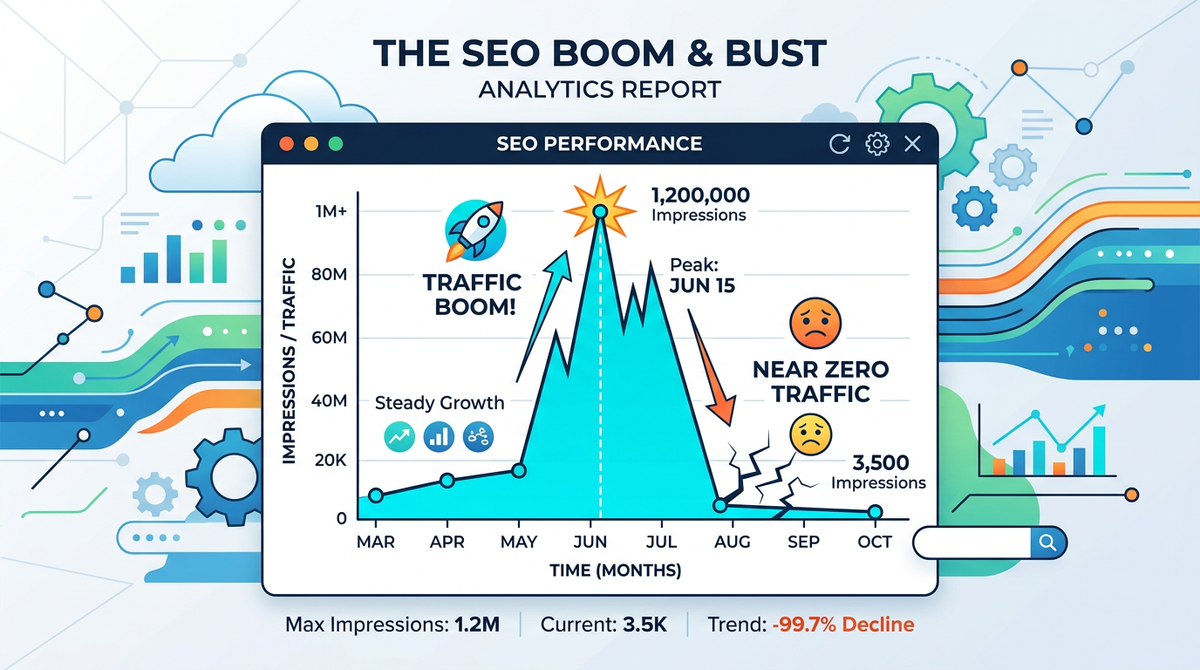
At first, you feel like an absolute genius. You check Google Search Console (GSC) a few days later, and you see a massive, vertical spike in impressions. The strategy is working!
And then... the crash.
As quickly as the impressions arrived, they vanish. Traffic flatlines. Your pages start dropping from the index, and your core, money-making pages suddenly start ranking lower. You are caught in the classic Programmatic SEO (pSEO) Boom and Bust cycle, and you have no idea what to do.
This isn’t just theoretical; this is something we know from personal experience. Let’s break down exactly why this happens, the top five mistakes you likely made, and the aggressive recovery strategy required to fix it.
Why the "Boom and Bust" Happens
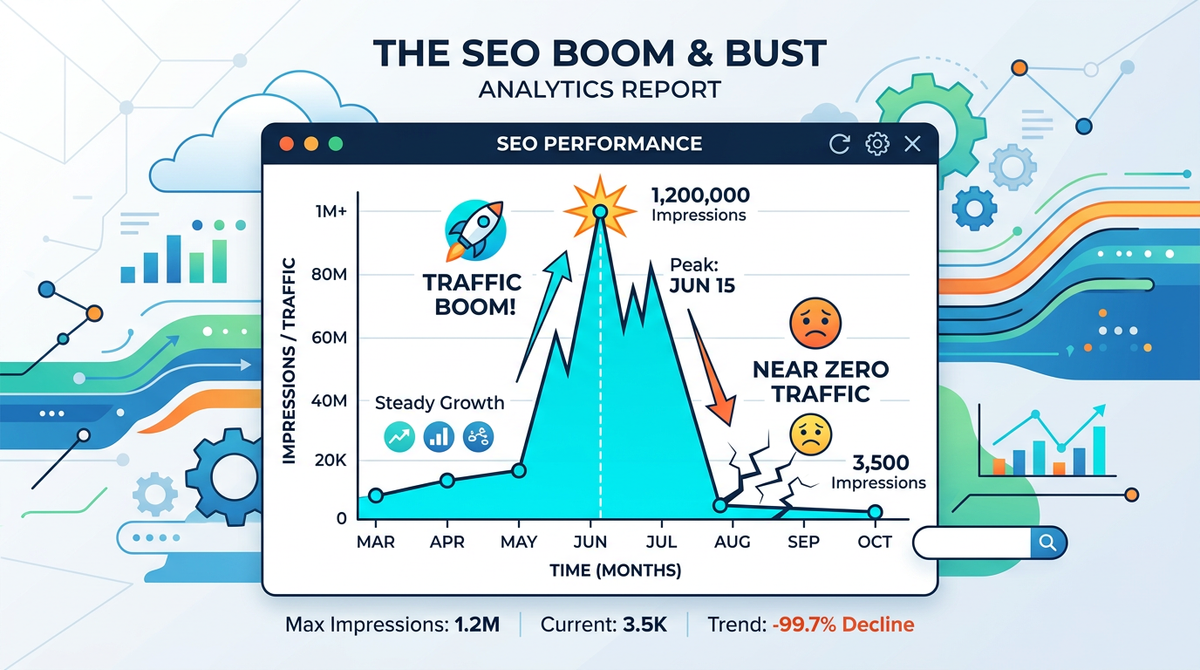
When you publish 3,000 new pages overnight, Google’s initial reaction is discovery. The algorithm crawls your sitemap, finds thousands of new URLs, and temporarily surfaces them in the Search Engine Results Pages (SERPs) to test them. This is the "Boom." Your impressions skyrocket because Google is giving your new pages a trial run.
But this trial period comes with intense evaluation. The algorithm is checking:
- Information Gain: Does this page offer anything unique compared to the rest of the internet?
- User Signals: When users click, do they bounce immediately, or do they find the page helpful?
- Internal Duplication: Are these 3,000 pages just the same template with a different city name?
When the algorithm determines that these pages are thin, repetitive, or unhelpful, the "Bust" happens. Google rapidly de-indexes the URLs or suppresses them deep into page 10 of the SERPs.
Even worse, Authority Dilution kicks in. Every domain has a finite amount of "authority" and crawl budget based on its backlink profile and historical trust. If you have 50 great pages, your authority is concentrated. If you suddenly inject 3,000 thin, low-value pages, your domain authority gets diluted across all of them. The overall quality score of your domain plummets, dragging down your good pages alongside the bad ones. Furthermore, Google gets confused—with hundreds of nearly identical variations, it simply doesn't know what to serve to a client.
Here are the top 5 mistakes that lead to this disaster.
The Top 5 Programmatic SEO Mistakes
Mistake #1: Relying on "Mad Libs" Boilerplate Content

Creating 3,000 pages where the only difference is swapping out "Plumber in Miami" for "Plumber in Orlando" is a recipe for a penalty. Modern search engines use advanced Natural Language Processing (NLP) to detect boilerplate templates instantly. If your programmatic pages lack unique entities, specific local data points, or localized context, the content provides zero value. You aren't doing programmatic SEO; you are just creating doorway pages.
Mistake #2: Overestimating Your Domain's Crawl Budget
Many developers assume that if they build it, Google will crawl it. But a new or medium-sized site simply doesn't have the crawl budget to support thousands of new pages simultaneously. Forcing Googlebot to crawl 3,000 low-value pages wastes your crawl budget, meaning Google might stop crawling your actual, high-quality blog posts and core service pages.
Mistake #3: Ignoring Google's Feedback in GSC
Fighting Google is a losing battle. If Google is throwing your new pages into the "Crawled - currently not indexed" or "Discovered - currently not indexed" buckets, they are explicitly telling you something: your content isn't good enough to be in their index. Many site owners ignore this and just keep resubmitting their sitemap. You must trust what Google is saying about your website.
Mistake #4: Terrible Internal Link Architecture
How are you linking to those 3,000 pages? The most common mistake is generating a massive HTML sitemap or dumping thousands of links into the site footer. This creates a flat, unnatural architecture that confuses crawlers. Worse, it bleeds your precious internal link equity away from your most important money pages and funnels it into low-value programmatic pages.
Mistake #5: Keyword Cannibalization
When generating pages at scale, it is incredibly easy to create hundreds of pages that target the exact same search intent. If you generate pages for "Best Plumber Miami," "Affordable Plumber Miami," and "Top Plumbing Services Miami," Google won't know which one to rank. They will cannibalize each other, and as a result, none of them will rank well.
How to Fix It: The Aggressive Pruning Strategy
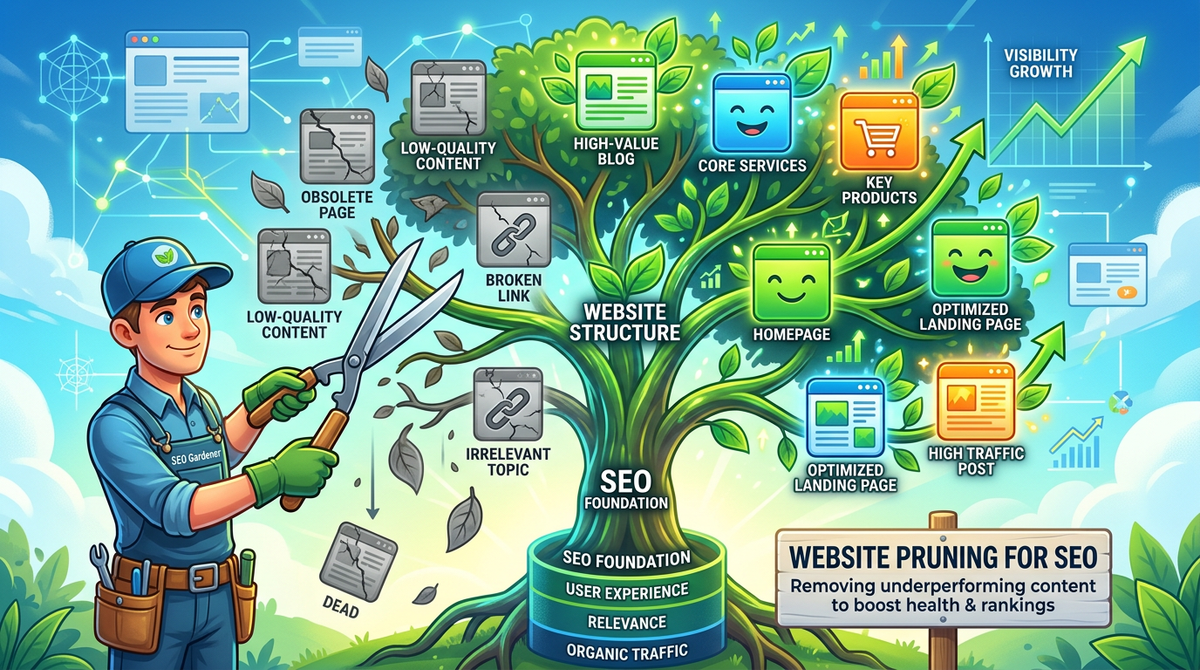
If you are currently experiencing the "Bust" phase, you cannot just wait it out. You need to take decisive, aggressive action to restore your domain's quality score. Here is exactly what we have done to fix this issue in our own projects:
1. Aggressively Remove Unindexed Pages
Open Google Search Console. Look at your "Crawled - currently not indexed" report. If you have programmatic pages sitting in there for weeks, delete them. Aggressively. If Google doesn't want them in the index, keeping them on your site is only dragging down your overall quality score. Return a 410 (Gone) or 404 status code for these URLs.
2. Prune Content That Brings No Value
Even if a programmatic page managed to get indexed, check its performance. Is it actually getting clicks? Does it rank for anything meaningful? If it doesn't rank and doesn't bring value, get rid of it. The right way to handle this is to 301 redirect the URL to a broader, higher-quality hub page (e.g., redirecting 20 highly specific, zero-traffic neighborhood pages into one robust, high-quality City page).
3. Trim Your Internal Links
Stop wasting link equity on bad pages. We meticulously went through our site architecture and trimmed internal links pointing to low-quality programmatic pages. By removing these links, we funneled our link equity back to the core pages that actually deserved to rank.
4. Trust the Algorithm
Just trust what Google is saying about your website, and don't fight it. They know better. If your content doesn't rank, it probably is bad. Accept it, learn from the data, and pivot your strategy toward quality over sheer volume.
Need Professional Help?
Programmatic SEO is not dead, but the era of low-effort, massive-scale spam is over. Doing pSEO correctly in 2026 requires an entity-based approach, clean technical architecture, unique data integration, and precise internal linking.
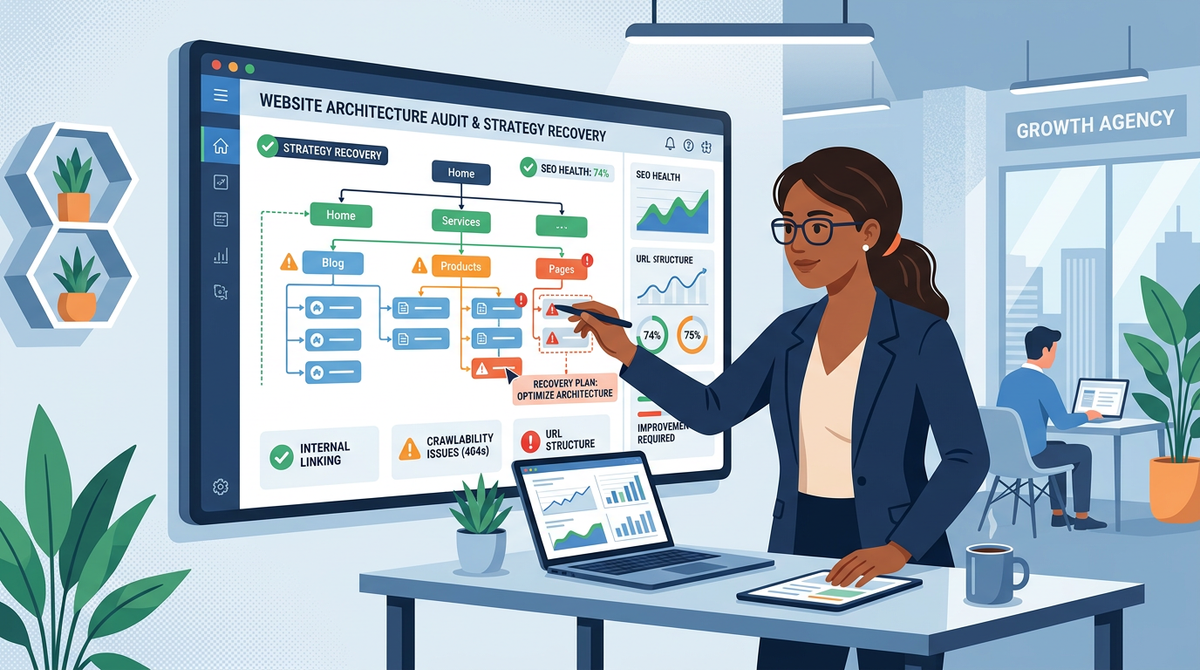
If your website has crashed after a programmatic SEO experiment, recovering your traffic requires a delicate and technical audit. You need to know exactly what to prune, what to redirect, and how to restructure your architecture to regain Google's trust.
Transitioning back to a healthy site is hard, but you don't have to do it alone. If you want assistance and need professional help recovering your search traffic and building a scalable, SEO-safe web architecture, contact us today. Our team of expert web engineers and SEO architects will help you clean up the mess and build a strategy that actually lasts.