
Published October 30, 2026.
ChatGPT ads are open to home service businesses. The early contractor data does not support moving a Google Ads budget over to them. A small, tracked test is the most those numbers support. This is for plumbers, leak detection companies, and restoration owners who are being pitched ads inside ChatGPT.
The short answer
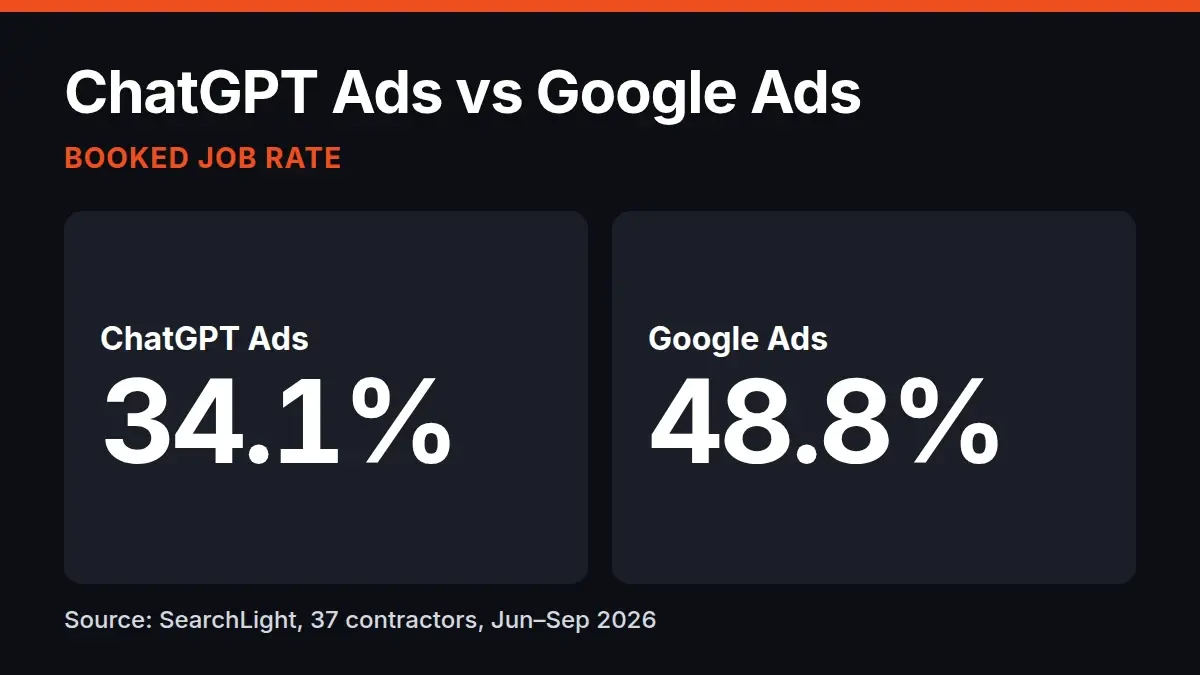
- Booked jobs lag Google Ads. SearchLight followed 37 contractors from June through September 2026. Paid ChatGPT leads booked a job 34.1% of the time. Google Ads leads on those contractors booked at 48.8%.
- Click cost sits near OpenAI's own starting bid. PPC ONE reviewed 24 published international campaigns. Half had a click-through rate below 1.25%. In the 15 campaigns billed in dollars, half paid less than $4.41 per click. OpenAI recommends starting a CPC campaign at a maximum bid of $3–5.
- A settled benchmark does not exist yet. Search Engine Journal reports that advertisers still have very little context for deciding what good performance should look like.
Our recommendation matches SearchLight's verdict: keep your budget in Google for now. The channel is worth testing with tagging in place, not worth moving Google budget to. If you still run a test, cap it at a campaign-total budget of about $175 for one week. That figure is the $25 US minimum across a 7-day period. Judge the test by booked jobs, not by clicks.
How ChatGPT ads work today
As of October 30, 2026, OpenAI's ads site is self-serve. You sign up, open Ads Manager, and create a campaign with a budget and a goal. Ads are clearly labeled and sit separate from ChatGPT's answers.
As of October 30, 2026, OpenAI's Ads Manager guide still calls the tool Ads Manager Beta. Ads appear below ChatGPT responses. OpenAI does not show ads to users on Plus, Pro, or any Business plan, or to accounts identified as belonging to users under 18.
You can bill by Views, Clicks, or Conversions. A conversion-optimized campaign with click billing (oCPC) charges for valid clicks, not conversions. Context hints are not exact-match keywords, and OpenAI says they do not lock in delivery. The guide also supports UTM parameters on the landing page.
What it costs to try
As of October 30, 2026, OpenAI's budget guide sets the standard minimum for the US, in USD, at $25. A daily budget is the average amount you want the campaign to spend per day over a 7-day period. It is a delivery target, not a fixed daily charge. Your maximum daily spend is twice your daily budget. Your maximum 7-day spend is seven times your daily budget.
The Ads Manager guide recommends starting a CPC campaign with a maximum bid of $3–5 per click.
OpenAI's setup guide calls the campaign-total budget the stricter control for total spend. A one-week test at the $25 minimum is about $175, because seven times that daily budget is $175. Put the $175 on the campaign-total budget so the week has a hard cap.
What the early results show
SearchLight compared the same 37 contractors over the same four months, June through September 2026. PPC ONE supplied the same-advertiser row from four head-to-head comparisons.
| Metric | ChatGPT Ads | Google Ads |
|---|---|---|
| Booked jobs | 34.1% | 48.8% |
| Revenue per lead | $654 | $893 |
| Same advertiser | Worse in all 4 | Better in all 4 |
On those 37 contractors, paid ChatGPT leads booked at 34.1%. Google Ads leads booked at 48.8%. Revenue per lead was $654 for paid ChatGPT and $893 for Google Ads. SearchLight's own verdict: "worth testing with tagging in place, not worth moving Google budget to."
PPC ONE looked at 24 published international campaigns. Half had a click-through rate below 1.25%. In the 15 campaigns billed in dollars, half paid less than $4.41 per click. In all four comparisons for the same advertiser, ChatGPT converted worse than Google Ads.
What advertisers are reporting (anecdotal)
These reports are anecdotal. They come from one Reddit thread, not from a study, and they are not a sample you can treat as a benchmark.
One home-services advertiser wrote: "Spent around $30k over 4 weeks with lots of testing, but lead quality never improved. We were getting a lot of really bad calls..."
Another person finished 2 months for a home-services marketplace. The note said click-through rate was under 1% and cost per acquisition was higher than Google search, so they did not see the channel as viable. That second note is a marketplace, not a single contractor.
As of October 30, 2026, Search Engine Journal put the wider picture in the headline "6 Months Into ChatGPT Ads, Advertisers Still Don't Know What 'Good' Looks Like." Advertisers still have very little context for deciding what good performance should look like.
Why local targeting is the sticking point
As of October 30, 2026, OpenAI's setup guide says you can target supported locations such as states or regions, cities, markets, and postal codes where available. A plumber can choose a city or a ZIP code.
The same guide lists a campaign-total budget and a daily budget. The campaign-total budget is the stricter control for total spend. The daily budget is a delivery target.
OpenAI's setup guide lists those location types. It does not list a radius option, and it does not list an ad-schedule option. A radius around the shop is how many service-area businesses think about their map. An ad schedule is how an emergency plumber or a restoration company limits spend to the hours they actually answer. The guide does not list either control.
If you test it, test it like this
- Set a campaign-total budget of about $175 for one week. That is seven times the $25 US daily minimum, held by the stricter total-spend cap.
- Advertise one service in one service area.
- Send the clicks to a dedicated landing page. Tag the link with
utm_source=chatgptandutm_medium=cpc. SearchLight's tagging advice uses that source, and OpenAI supports UTM parameters. - Put a separate tracking number on that page so these calls stay apart from Google calls.
- Judge the week by booked jobs and revenue, not by clicks or by calls. SearchLight suggests giving the channel 60 to 90 days before judging it, so treat one week as a check that the setup and tracking work, not as a verdict.
- Leave Google Ads running unchanged so the test has a baseline.
Landing-page basics for this kind of page are in our guide to contractor website lead generation.
Where ChatGPT fits for home service businesses right now
Paying for a labeled ad under a ChatGPT answer is a different job from being quoted in the answer. This page covers only the paid test. Earning the organic mention is covered in how to rank in AI search and the AI Overview visibility checklist for local businesses. A page-level pass for Google's AI Mode is the Google AI Mode SEO audit for service businesses.
Get a second opinion on your ad budget
Aipress.io runs websites, SEO, and Google Ads for local home-service businesses. See how we run Google Ads for local businesses.