
Best AI Agents for SEO Content Creation: Owner's Guide
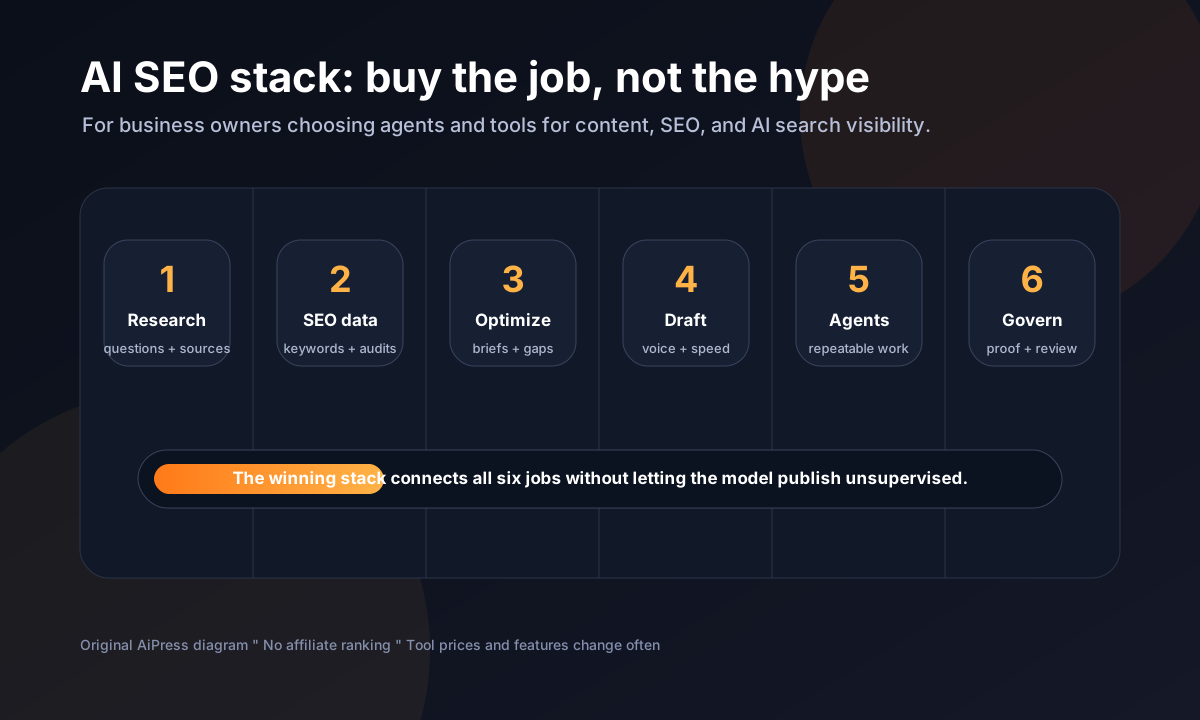 A useful AI SEO stack does six jobs: research, data, optimization, drafting, repeatable execution, and governance.
The best AI agents for SEO content creation are not always the tools with the loudest demos. For a business owner, the better question is simpler: what job are you trying to remove from your desk without lowering the quality of the page?
That distinction matters because "AI SEO tool" now describes at least five different things:
- a chat assistant that helps think and draft
- a research assistant that finds sources
- an SEO platform that knows keywords, competitors, and links
- a content optimizer that compares your page to the search result
- an agentic workspace that can run a repeatable process
- a managed system that combines the above with rules, review, and publishing operations
Buying the wrong one is easy. A business owner buys an AI writer, expects SEO strategy, and gets generic blog posts. A team buys a rank-tracking suite, expects finished content, and gets dashboards nobody acts on. A founder buys a powerful agent, gives it no source material, and watches it produce confident copy that does not match the business.
This guide compares the serious options: ChatGPT, Claude, Perplexity, Cursor, Semrush, Ahrefs, Surfer, Clearscope, Frase, Jasper, Writer, Copy.ai, and managed content-agent systems like the AiPress model.
The short answer: most owners need a stack, not one tool
If you only need a better first draft, buy ChatGPT or Claude. If you need content to rank, add SEO data and an optimization tool. If you need dozens or hundreds of pages, do not start with a writer at all. Start with rules, source material, approval steps, and a system for updates.
Here is the practical owner-first answer:
| Business situation | Best first tool category | Good fits | Why |
|---|---|---|---|
| Solo owner needs help writing pages | General AI assistant | ChatGPT, Claude | Fast drafts, outlines, summaries, FAQs, and rewrites |
| Owner needs better research before publishing | Research assistant | Perplexity, ChatGPT with connectors, Claude with files | Helps collect sources and questions before writing |
| Business has traffic but weak pages | Content optimizer | Surfer, Clearscope, Frase | Finds missing topics, page gaps, and refresh opportunities |
| Business needs SEO visibility reporting | SEO platform | Ahrefs, Semrush | Keyword data, audits, rank tracking, competitors, links |
| Team needs brand-safe content at scale | Marketing AI platform | Jasper, Writer, Copy.ai | Brand voice, workflows, approvals, campaign operations |
| Site needs custom pages, pSEO, or technical content systems | Agentic editor or managed system | Cursor, Claude Code, AiPress | Agents can edit files, run checks, and follow repeatable rules |
The buyer trap is thinking "AI writer" equals "SEO system." It does not. Google says appropriate use of AI is not against its guidelines, but using automation mainly to manipulate rankings is against spam policies. Google also asks whether content adds original value, shows clear sourcing, and leaves the reader satisfied. That means the tool is less important than the process around it.
For more context on the ranking side, read AiPress's AI search and AI-generated content playbook. This article focuses on which tools belong in the operating stack.
Quick picks by tool type
Use this as the plain-English shortlist before getting lost in feature pages.
| Tool | Best for | Starting point to know | Owner warning |
|---|---|---|---|
| ChatGPT Business | General AI work, drafting, analysis, team workspace | $20/user/month annually, 2+ users | Not an SEO data platform by itself |
| Claude Enterprise | Long-context thinking, writing, code, enterprise controls | $20/seat/month annually plus usage, 20-seat minimum | Usage is separate from seat cost |
| Perplexity Enterprise | Fast cited research and team research work | $40/seat/month for Enterprise Pro | Great for research, not a complete publishing system |
| Cursor | Agentic editing, technical SEO, templates, rules, code-backed content systems | Teams at $40/user/month | Best when your site/content lives in files and reviewable code |
| Semrush Content Toolkit | SEO-assisted content creation for small teams | $60/month | Limited SEO-boosted articles unless you buy more credits |
| Ahrefs | SEO data, AI visibility, brand tracking, technical insights | Lite at $129/month; Brand Radar AI from $199/month | Powerful, but needs a person to turn insight into action |
| Surfer | Content optimization and AI visibility checks | 49 EUR/month annually | Content scores can become a distraction if followed blindly |
| Clearscope | Clean editorial optimization and prompt tracking | $129/month | Premium for low-volume teams unless refresh work is consistent |
| Frase | Lower-cost briefs, optimization, and AI visibility features | Starter around $39/month annually | Check article and audit limits before scaling |
| Jasper | Marketing campaign content and brand voice workflows | Pro at $59/month annually | Expensive if you only need basic AI writing |
| Writer | Enterprise governance and compliant agent workflows | Custom enterprise; Starter exists for smaller use | Strong fit when brand/legal control matters |
| Copy.ai | GTM workflow automation | Chat at $29/month; workflow tiers start much higher | The real workflow product is not the cheap chat tier |
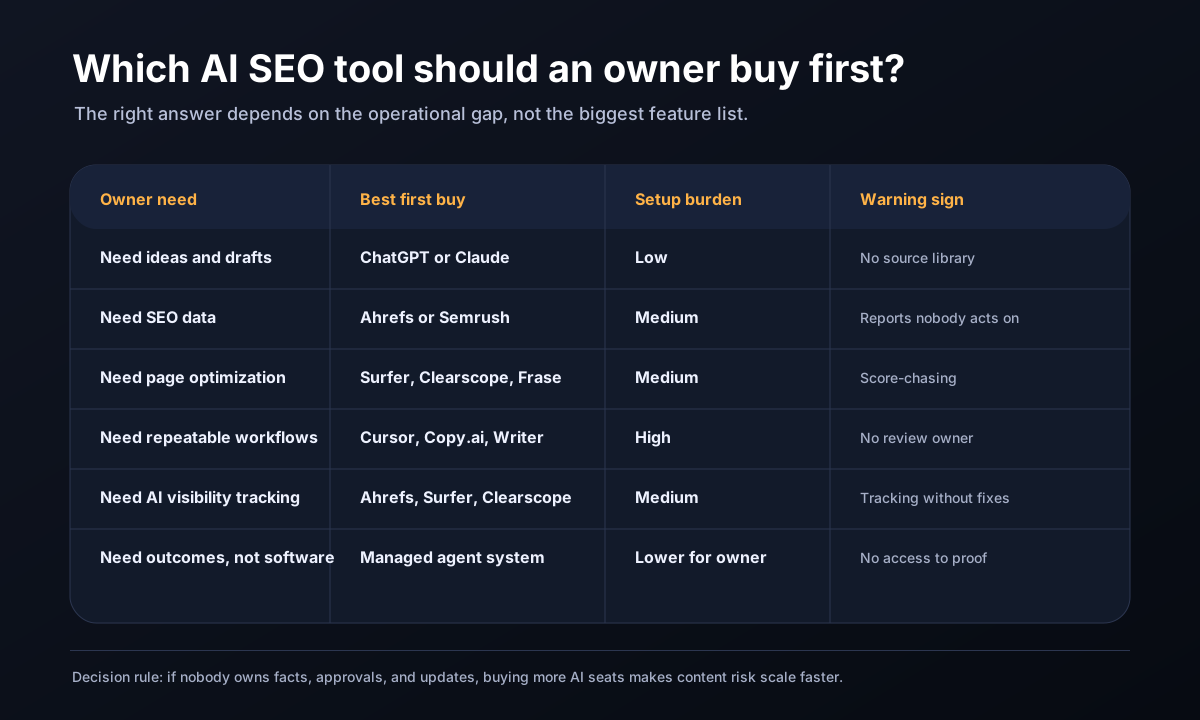 The first purchase should solve the constraint your business actually has: source quality, SEO data, optimization, repeatability, or governance.
General AI assistants: ChatGPT, Claude, Gemini, and Perplexity
General assistants are the easiest tools to start with because they help almost every owner immediately. They can summarize customer reviews, turn a service description into an outline, draft a page, compare two versions of copy, and create FAQ candidates.
They are also the easiest tools to misuse.
ChatGPT is the broad team workspace
ChatGPT Business is a strong default for small teams because it combines chat, file work, analysis, connectors, and Codex access in one workspace. OpenAI lists Business at $20 per user per month when billed annually, with a two-user minimum, and says business data is not used for training by default.
For owners, the practical value is not "write me a blog post." It is:
- summarize call notes into service-page ideas
- rewrite old copy without losing the offer
- compare competitor pages and identify missing proof
- draft meta titles and descriptions from a finished page
- create first-pass briefs for a human editor
Use ChatGPT when the team needs one flexible AI workspace across sales, operations, content, and light technical work.
Claude is strong for long-form thinking and careful prose
Claude is often excellent for longer documents, rewriting complex material, and keeping tone steady across a longer draft. Anthropic's Enterprise page lists Claude chat, Claude Code, Claude Cowork, connectors, SSO, SCIM, audit logs, and enterprise controls, with seat pricing separated from usage.
That matters for business owners because Claude can be used both as a writing assistant and as a technical assistant. The same family of tools can help a team reason through a content brief, review a long service guide, or support code-backed site work.
Use Claude when your content requires nuance: professional services, regulated topics, long decision guides, complex B2B pages, or careful brand voice.
Perplexity is a research accelerator
Perplexity Enterprise is closer to a research assistant than a writing platform. Its value is quick answers with source citations, team controls, file and app search, and premium data sources on paid plans. Perplexity lists Enterprise Pro at $40 per seat per month and Enterprise Max at $325 per seat per month.
For SEO content, Perplexity is useful before drafting:
- collect current explanations of a topic
- find primary sources and industry references
- identify common buyer questions
- compare how different sources explain the same issue
Do not treat Perplexity's answer as the final page. Treat it as a research pass that helps your editor find better sources faster.
Where Gemini fits
Gemini is important because it sits close to Google Workspace and Google's broader AI ecosystem. For owners already deep in Google Docs, Gmail, Sheets, and Drive, Gemini can be a convenient assistant for summarizing, drafting, and organizing internal material.
The reason it is not a standalone recommendation here is simple: SEO success depends on how the page is researched, edited, linked, updated, and measured. Gemini can help with pieces of that work. It does not replace a content operating model.
SEO data and optimization platforms: Semrush, Ahrefs, Surfer, Clearscope, and Frase
If general assistants help you think and write, SEO platforms help you decide what deserves attention.
This is where many owners should spend before they hire another writer. A better draft of the wrong topic is still the wrong page.
Semrush is good when you want an easier content workflow
Semrush Content Toolkit is built for content creation using Semrush data. The official page lists it at $60/month with unlimited standard articles, five SEO-boosted articles per month, topic discovery, SEO briefs, content optimization, AI writing tools, AI image generation, brand voices, Google Docs transfer, and WordPress publishing.
That makes it attractive for owners who want a simpler path from topic to draft without buying the full SEO-suite setup first.
Best fit:
- service businesses publishing a few serious pages per month
- small teams that need topic ideas and briefs
- owners who want SEO guidance inside the writing flow
Watchout: the five SEO-boosted article limit matters. If you publish or refresh heavily, model your monthly output before assuming the plan is enough.
Ahrefs is good when data quality and AI visibility matter
Ahrefs AI now frames the product around search, AI answers, reporting, brand tracking, technical SEO, and localization. Ahrefs Brand Radar tracks visibility across AI answers, YouTube, and Reddit, including AI Overviews, AI Mode, ChatGPT, Perplexity, Microsoft Copilot, and Gemini.
Ahrefs is a strong fit when the owner wants to know:
- which pages already have opportunity
- where competitors are winning links and visibility
- what questions AI systems associate with the brand
- what technical issues are holding the site back
- where refresh work is more valuable than new content
Best fit:
- SEO-driven businesses with an existing site
- agencies and in-house teams that know how to act on data
- owners who care about both Google visibility and AI-answer visibility
Watchout: Ahrefs is not magic. It will show you where the opportunity is. Someone still has to turn the finding into a better page.
Surfer is good for optimizing the page in front of you
Surfer is strongest when you already know the target topic and need a clearer content brief or optimization pass. Its pricing page lists content scoring, AI writing assistance, Content Audit, Topical Map, AI visibility tracking, prompt tracking, and integrations with tools like WordPress and Google Docs.
Surfer is useful when:
- a page is close but underperforming
- your writer needs clearer topical coverage targets
- you want to refresh content without starting over
- you need a practical score that non-SEO team members can understand
Watchout: do not let the score become the strategy. If every competitor page is shallow, copying their topical pattern more precisely still produces a shallow page.
Clearscope is good for editorial teams that need clarity
Clearscope is less flashy than some AI writing platforms, but it is clean and editorially friendly. Its pricing page lists Essentials at $129/month, Business at $399/month, unlimited users and projects, prompt tracking, content recommendations, and AI search visibility features.
Best fit:
- teams with multiple writers and editors
- businesses that refresh important pages often
- owners who want a cleaner editorial experience than a heavyweight SEO dashboard
Watchout: at low volume, premium optimization tools can become shelfware. Buy Clearscope when you have a repeatable content or refresh cadence.
Frase is a lower-cost path into briefs and AI search visibility
Frase is appealing for smaller teams because it combines research, briefs, scoring, AI visibility, audits, and publishing options at a lower entry price than many premium tools. Its pricing page describes Starter with one seat, one site, ten articles, audit pages, SEO/GEO scores, and AI Visibility on ChatGPT and Google AI, with higher tiers adding more sites, AI platforms, and workflow features.
Best fit:
- solo operators and small teams
- owners testing a more systematic content process
- businesses that need briefs and scoring but cannot justify a larger suite yet
Watchout: article, audit, and prompt limits matter. The cheaper plan is only cheaper if the limits match your real publishing rhythm.
Agentic editors and workflow tools: Cursor, Jasper, Writer, and Copy.ai
An AI agent is different from a text generator. It can follow a process, use tools, edit files, apply rules, and sometimes run checks. That makes agents powerful for SEO systems because content is not just prose. It is page structure, internal links, images, metadata, templates, performance, refresh dates, and technical QA.
AiPress already has a deeper plain-English explainer on Cursor rules, agents, and skills. The short version for owners: agents are most valuable when the task has repeatable rules and a reviewable output.
Cursor is for code-backed SEO operations
Cursor is not a classic marketing tool. It is an AI code editor with agents, skills, rules, Cloud Agents, privacy controls, and team administration. Cursor lists Teams at $40 per user per month, with features like team marketplace for internal rules, skills and plugins, Bugbot, Cloud Agents, usage analytics, team-wide privacy mode, and SAML/OIDC SSO.
Why should a business owner care?
Because many serious SEO improvements live in the site itself:
- landing-page templates
- content collections
- page-generation logic
- metadata rules
- internal-link components
- speed fixes
- redirect maps
- content QA checks
- programmatic page systems
If your site is modern, file-based, or custom-built, an agentic editor can help maintain the system behind the content. That is the difference between writing one article and improving the machine that creates, reviews, and updates many pages.
This is also where AiPress's programmatic SEO with AI approach fits: templates, data, rules, review, and content quality need to work together.
Jasper is for marketing teams that want campaign output
Jasper is best understood as a marketing content platform, not just a chatbot. Its public pricing lists Pro at $59/month annually or $69/month monthly, with Business on custom pricing. Jasper's higher-end positioning is around brand voice, campaign collaboration, agents, governance, and scaled marketing execution.
Best fit:
- marketing teams producing campaigns across channels
- companies that need brand voice tools and reusable marketing assets
- agencies that want a familiar content workspace for multiple brands
Watchout: if you only need a few SEO articles per month, Jasper may be more platform than you need.
Writer is for enterprise governance
Writer is built around controlled, compliant, brand-safe work. Its Enterprise page emphasizes agentic workflows, approvals, admin controls, Knowledge Graph grounding, brand and voice profiles, governance, observability, auditability, and priority support.
Best fit:
- regulated or brand-sensitive companies
- large marketing teams with legal or compliance review
- organizations where an off-brand or unsupported claim is expensive
Watchout: Writer's strength is governance. If your team does not already have approved messaging, source material, and ownership, a governance platform will expose that gap rather than solve it automatically.
Copy.ai is for GTM workflow automation
Copy.ai has moved far beyond "write this paragraph." Its pricing page splits low-cost Chat from much higher GTM workflow plans. Chat is listed at $29/month or $24/month annually for five seats, while workflow tiers start at Growth: $1,000/month billed annually for 75 seats and 20K workflow credits per month.
Best fit:
- sales and marketing teams automating repeatable GTM tasks
- companies that want workflows tied to CRM, enrichment, outreach, or campaign operations
- teams with enough volume to justify workflow credits
Watchout: the cheap chat tier is not the same thing as the full workflow platform. Owners should decide whether they need chat assistance or real automation before comparing prices.
Where managed content-agent systems fit
There is another option: do not assemble the whole stack yourself.
A managed content-agent system combines the tool categories into one process:
- source material from your existing site, calls, offers, reviews, and case studies
- keyword and content opportunity research
- page templates and reusable rules
- AI-assisted drafting
- human review for facts, voice, and business fit
- publishing support
- refresh and monitoring logic
That is the model behind AiPress's AI Websites work: the site, content agents, and SEO system are treated as one operating environment rather than disconnected subscriptions.
For an owner, this is often the better route when:
- the business does not have an in-house SEO operator
- the site needs technical changes, not just copy
- pages need to be generated or refreshed at scale
- content must stay tied to services, locations, proof, and conversion paths
- the cost of managing five tools is higher than the cost of an integrated system
The tradeoff is control. A self-managed stack gives your team more direct ownership. A managed system gives you fewer dashboards and a stronger chance that the work actually ships.
Recommended stacks by business stage
Do not buy everything. Buy the smallest stack that can produce a better page and a better decision.
Stage 1: Owner-led content, under about $300/month
Use:
- ChatGPT or Claude for drafting and analysis
- Frase or Semrush Content Toolkit for briefs and optimization
- Google Search Console and Bing Webmaster Tools for basic performance signals
This stack is enough for a small business publishing one or two strong pages per month. The owner still needs to supply proof: services, pricing caveats, photos, FAQs, customer objections, and review language.
Do not use this stack for mass publishing. Use it for learning what a good AI-assisted page should look like.
Stage 2: Serious content program, about $300-$1,000/month
Use:
- ChatGPT Business or Claude for team AI work
- Ahrefs or Semrush for SEO data
- Surfer, Clearscope, or Frase for page optimization
- a documented review process
This stack fits a business that already sees organic traffic as a real growth channel. It works best when one person owns the content calendar and another person can approve factual claims.
The key shift at this stage is refresh work. You should not only publish new pages. You should improve pages that already earn impressions, merge weak overlap, and update content when the business changes.
Stage 3: Multi-location, multi-service, or programmatic SEO
Use:
- SEO data platform for opportunity mapping
- content optimizer for representative pages
- agentic editor or managed system for templates, content rules, and QA
- human approval for proof and claims
This is where many businesses should stop thinking "blog" and start thinking "page operations." A location-service matrix, comparison library, glossary, or product catalog cannot be safely managed as one-off prompts.
The right model is closer to AiPress's AI content agent training checklist: teach the system the business, give it approved proof, define banned claims, and review by pattern.
Stage 4: Advanced AI search and brand visibility
Use:
- Ahrefs Brand Radar, Surfer AI visibility, Clearscope prompt tracking, or a specialized AI visibility product
- source-building work on third-party sites, not only your own pages
- refresh rules for pages that should be cited by AI answers
- a named owner for AI visibility reporting
At this stage, the question changes from "Did the page rank?" to "Does the market, Google, ChatGPT, Perplexity, Gemini, and Copilot understand why we should be recommended?"
That is not only a content problem. It is a brand, site architecture, technical, and proof problem.
The advanced operating model: how to keep AI content from becoming thin content
The advanced section is not about buying a more expensive tool. It is about adding rules that prevent speed from turning into risk.
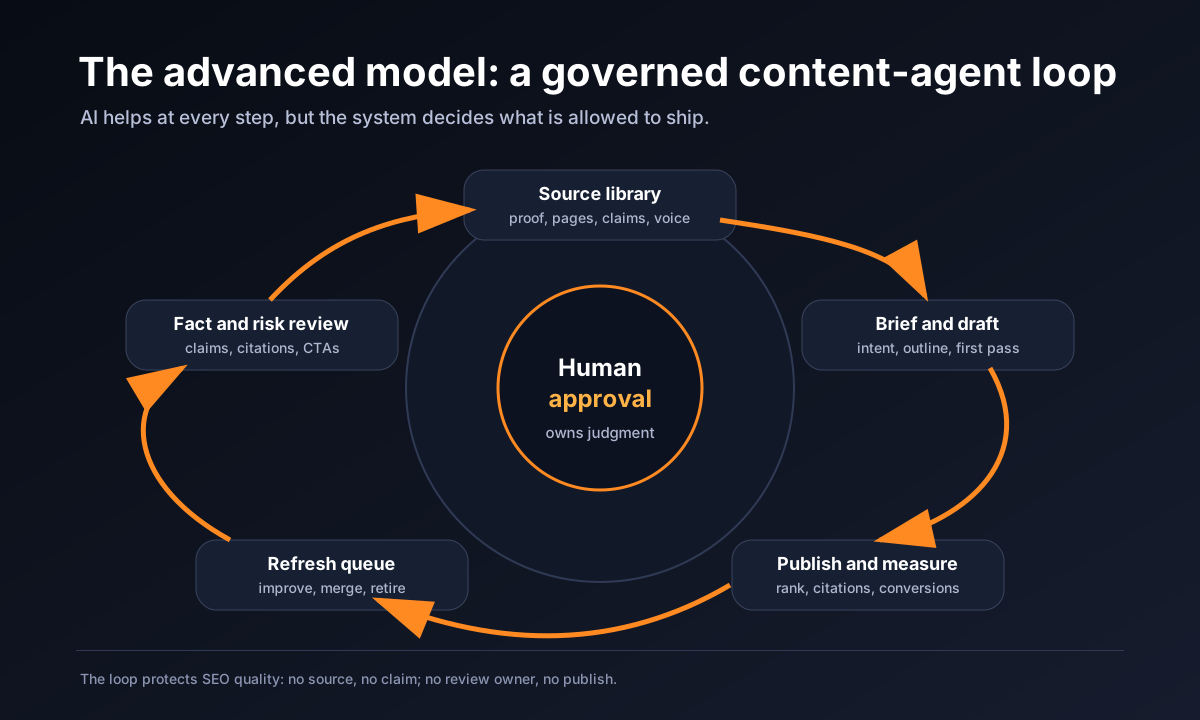 The advanced model is a loop: source library, brief, draft, review, publish, measure, and refresh.
Use this five-part operating model:
1. Build a source library before prompts
Your AI system needs approved inputs:
- service descriptions
- product details
- location rules
- case studies
- screenshots or photos
- customer questions
- offers and CTAs
- proof you are allowed to use
- claims you are not allowed to make
If the source library is weak, the model will fill gaps with internet-average copy.
2. Separate drafting from approval
Let the AI draft. Do not let it approve itself.
Every important page should have at least three checks:
- Does the page answer the search intent?
- Does every meaningful claim have a source?
- Does the CTA match what the business actually wants the reader to do?
That is the difference between AI-assisted content and scaled content abuse.
3. Use SEO scores as inputs, not commands
Surfer, Clearscope, Frase, Semrush, and Ahrefs can all surface useful gaps. But a score is a signal, not a strategy.
Ignore a recommendation when it would make the page worse for the reader. Add the missing topic when it answers a real question. The owner or editor still owns judgment.
4. Track outcomes after publishing
At minimum, review:
- impressions and clicks
- ranking movement
- conversion events
- AI visibility or citation signals where available
- pages that earn impressions but low clicks
- pages that attract traffic but no leads
The best AI content stack learns from the live site. It does not stop at "draft approved."
5. Refresh, merge, or retire pages
AI makes it easy to create too many pages. That is why the refresh queue matters.
Some pages deserve expansion. Some should merge into a stronger guide. Some should be retired. A serious content system gives the owner a way to say no.
Buying checklist: ask these questions before you subscribe
Before you buy any AI SEO tool, answer these questions:
- What job will this replace or improve? Drafting, research, optimization, reporting, technical work, or governance?
- Who owns the final output? Name the person, not the department.
- What source material will the tool use? If the answer is "the internet," expect generic copy.
- How will claims be checked? Especially pricing, performance, legal, health, finance, and comparison claims.
- How many pages per month will you actually publish or refresh? Match the plan limits to the real number.
- What happens after publishing? Rank tracking, Search Console review, AI visibility checks, refresh queue, or nothing?
- What would make the tool a failure? Define the exit condition before the annual plan renews.
The owner version is even shorter:
Do not buy an AI SEO tool unless you know what page, process, or decision it will improve this month.
Final recommendations
If you want the simplest starting point, use ChatGPT or Claude plus a lightweight SEO workflow. If your site already has traffic, add Ahrefs or Semrush before hiring more writers. If pages underperform because they are incomplete, add Surfer, Clearscope, or Frase. If your content lives inside a custom site or programmatic system, consider Cursor or a managed agent workflow. If brand, legal, or compliance risk is high, evaluate Writer or an enterprise-grade marketing platform before scaling output.
If you want the stack designed and operated with your site, templates, and content rules in mind, start with AiPress's planning flow. The right answer may be one tool. More often, it is a governed system that prevents good AI from becoming bad SEO at scale.
FAQ
What is the best AI tool for SEO content creation?
For most business owners, the best first tool is ChatGPT or Claude for drafting plus Semrush, Ahrefs, Surfer, Clearscope, or Frase for SEO guidance. If you need scale, add a governed agent workflow instead of relying on prompts alone.
Can AI-written content rank on Google?
Yes, if it is helpful, original, accurate, and people-first. Google says appropriate AI use is not against its guidelines. The risk is using automation to mass-produce low-value pages mainly to manipulate rankings.
Is Cursor an SEO tool?
Cursor is not a traditional SEO suite. It is useful for SEO when the work involves site files, templates, technical fixes, content collections, internal-link components, or repeatable agent instructions.
Do I need Surfer, Clearscope, or Frase if I already use ChatGPT?
Usually yes if organic search matters. ChatGPT can draft and reason, but these tools compare content against search and AI visibility patterns in ways a general assistant does not replace.
Should a small business use Jasper, Writer, or Copy.ai?
Use them when you need marketing workflows, brand governance, or GTM automation. If you only need occasional blog drafts, they may be more expensive than necessary.
What is the biggest mistake owners make with AI SEO tools?
They buy a writing tool before building a source library and review process. AI can write quickly, but without business proof, approved claims, and clear CTAs, it scales generic content.
How many AI SEO tools should one business use?
Start with two or three: one assistant, one SEO data or optimization tool, and one clear review process. Add more only when the bottleneck is obvious.