
AI Content Agent Training Checklist: What Your Site Must Teach It
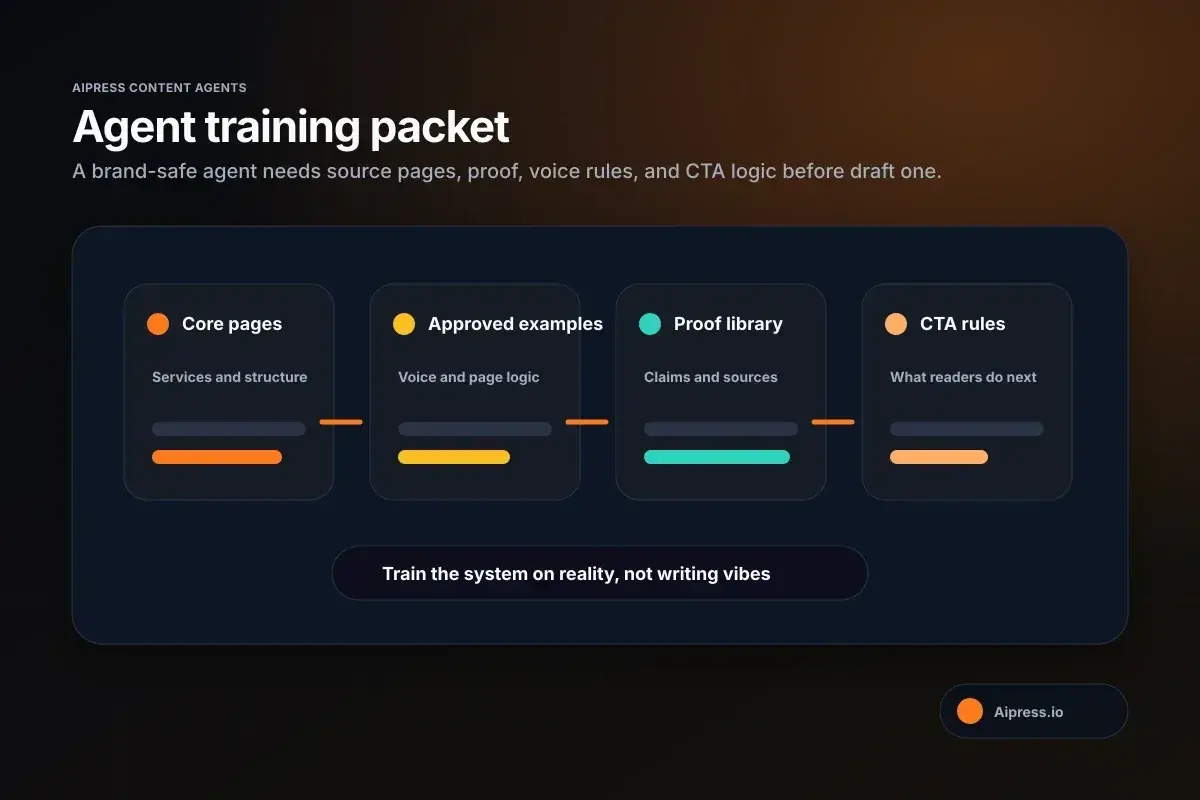
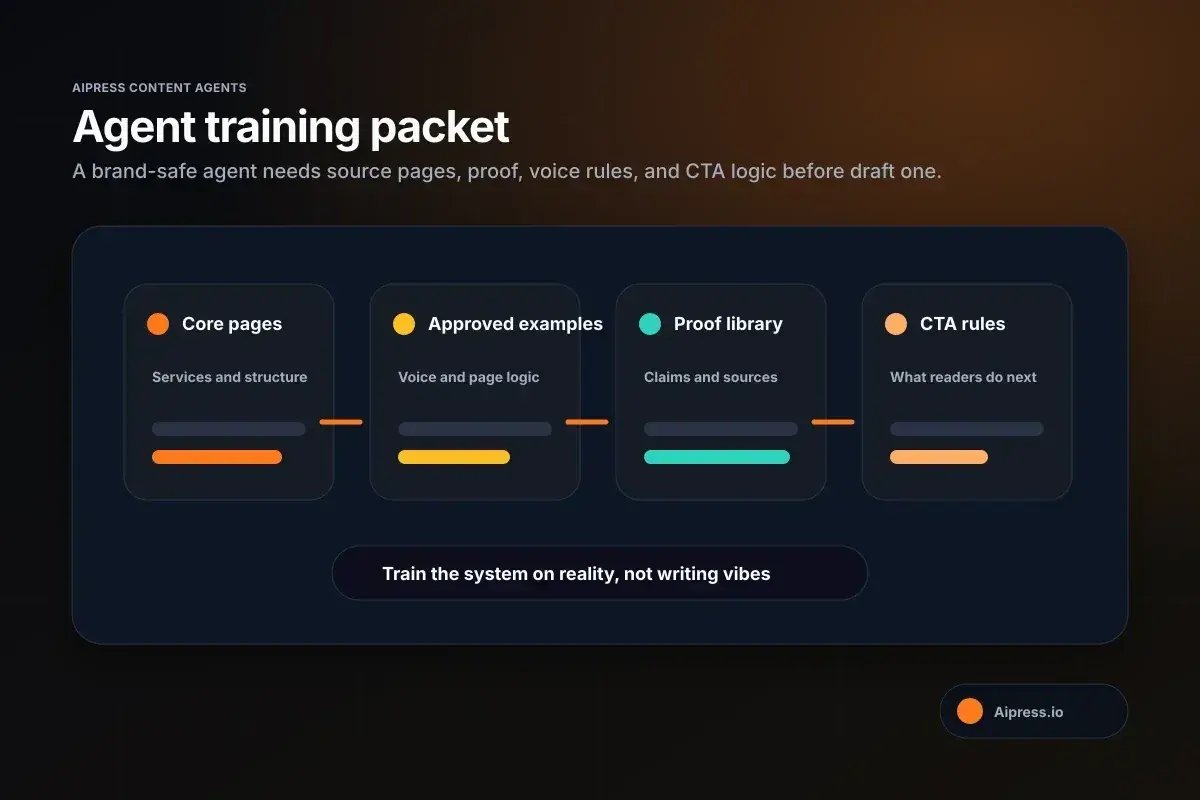 A useful content agent needs a training packet: core pages, approved examples, proof, and CTA rules before it writes at scale.
An AI content agent training checklist matters because a generic model does not know your real services, your acceptable claims, your internal proof, your geography, or the way your team wants a page to sell. Left alone, it will often produce copy that sounds polished and still misses the parts that make a page trustworthy.
That is the real shift from "AI writing" to "AI content operations." The prompt is not the system. The system is the inputs, the guardrails, the review path, and the publishing rules around the model.
AiPress makes that distinction directly on its own site: the platform is framed around content agents that learn your site, plus the website and SEO infrastructure needed to create, optimize, and maintain pages at scale. That is a much more useful mental model than treating AI like an autopublish slot machine.
Generic AI writers fail because they do not know your business
If you ask a model to "write a service page" with no real training context, it will usually default to internet-average language:
- broad promises
- soft, generic benefits
- weak differentiation
- no respect for your approval boundaries
That is exactly the pattern Google warns against in its people-first content guidance. The problem is not that automation exists. In Google's guidance about AI-generated content, the company is explicit that it focuses on quality, not the mere use of AI. The problem starts when automation is used to publish content that adds little value or exists mainly to chase rankings.
That is why AiPress's positioning is more useful than the usual "write faster with AI" pitch. On the homepage, the promise is not just draft generation. It is an operating model where agents learn your site and where the surrounding SEO system can maintain hundreds or thousands of pages without pretending each page should be written from scratch by hand.
The practical takeaway is simple:
Your agent should not be trained to sound smart. It should be trained to stay inside your business reality.
That means feeding it:
- the services you actually sell
- the audiences you actually serve
- the proof you are allowed to use
- the pages you want it to support
- the claims it must never invent
Without that, "brand voice" is usually just a thin rewrite layer on top of unreliable content behavior.
The source material your AI content agent actually needs
AiPress's AI Websites flow is a good starting model because it treats the system like an input problem first. The site says teams can start from an existing URL, uploaded content, or a business description, then analyze structure and content before generation begins.
That is the right order. Before your agent writes one new page, build the training packet below.
| Feed the agent this | Why it matters | What breaks when it is missing |
|---|---|---|
| Core site pages and service hubs | Teaches the system what the business actually offers and how the site is organized | The agent drifts into generic category copy |
| Best existing pages and approved examples | Gives it real voice patterns, structure, and conversion logic | Output sounds plausible but not recognizably yours |
| Proof library: case studies, screenshots, data sources, approved stats | Keeps claims grounded and reusable | It invents proof or leans on vague superlatives |
| Entity map: locations, audiences, product/service variants, internal terms | Helps the model keep relationships straight across many pages | Pages blur markets, offerings, or local details |
| Use/avoid language list | Turns "brand voice" into usable instructions | Tone becomes inconsistent across drafts |
| CTA and routing rules | Keeps conversion behavior aligned with how your team actually sells | Pages end with the wrong ask, or no real next step |
| Review and escalation rules | Decides what can publish, what needs review, and what is blocked | Risky copy slips through because nobody owns the final check |
In other words, your agent does not only need writing examples. It needs operational context.
That matters even more if you want to scale beyond a handful of blog posts. AiPress's Programmatic SEO with AI page describes programmatic work as defining templates, data, and rules. That framing is useful because it prevents a common failure mode: teams give the model a style guide, but never give it the structured inputs that keep page sets consistent and useful.
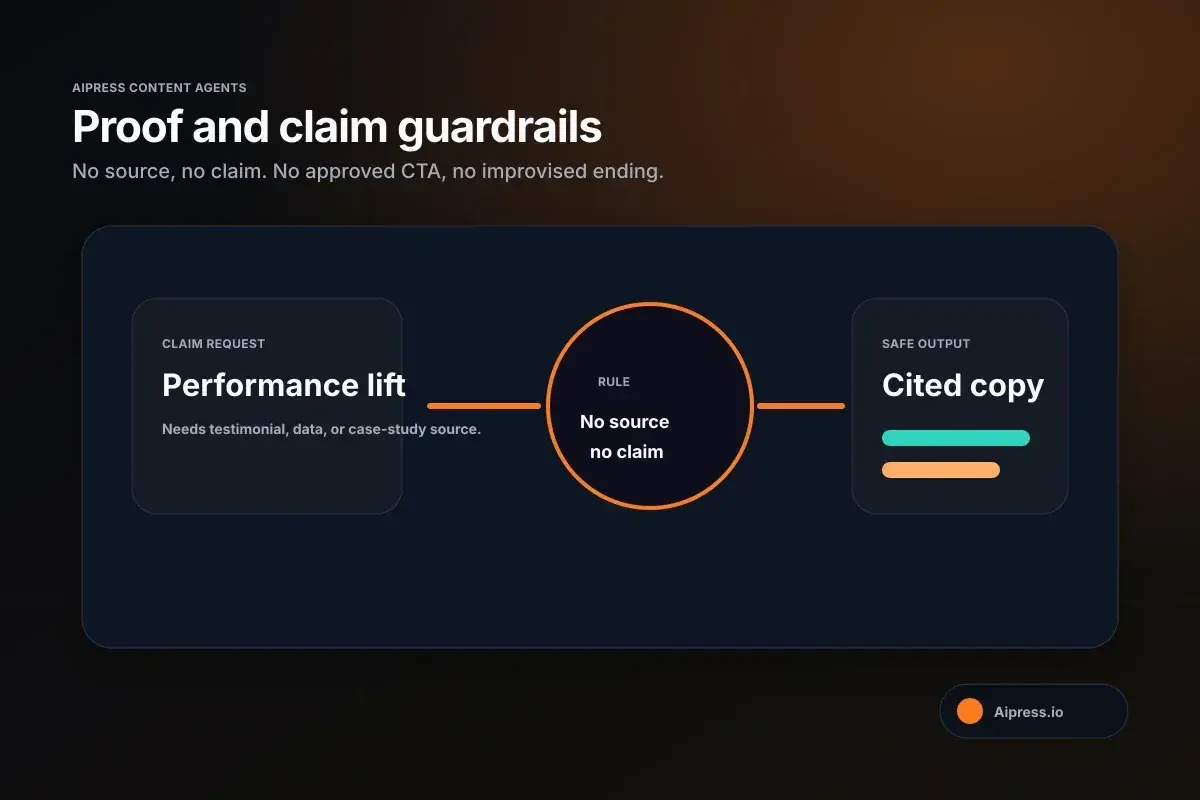 A useful AI workflow starts with source material and claim rules, not just a prompt that says "make it sound on-brand."
Guardrails for claims, citations, and CTA behavior
This is where most AI content systems get exposed.
If your agent can draft quickly but cannot tell the difference between:
- a verified claim and a marketing wish
- a safe summary and a risky overstatement
- a helpful CTA and an off-brand hard sell
then you do not have a content engine. You have a liability multiplier.
Google's spam policies are blunt on this point: scaled content abuse is about generating many pages primarily to manipulate rankings rather than help users, no matter how the content is created. Google's people-first guidance goes further by asking whether the page offers original information, substantial value, clear sourcing, and a satisfying result for the reader.
That gives you a practical guardrail stack:
1. Claims must be tied to approved proof
Do not let the agent decide whether a testimonial, performance claim, pricing statement, or credential is "probably fine." Give it a source library and a rule:
No source, no claim.
2. The model needs a clear "Who, How, Why" frame
Google recommends evaluating content in terms of who created it, how it was created, and why it was created. That is not abstract SEO advice. It is a useful workflow design rule.
For AI-assisted publishing, define:
- who owns the final judgment
- how automation is being used in the process
- why this page exists for the reader, not just the keyword map
3. CTA behavior should be trained, not improvised
One of the easiest ways to spot untrained AI copy is the ending. A page that should guide a user toward a consultation, estimate, or demo suddenly ends with a generic "contact us today" line that could belong to any business.
Train the agent on:
- which offer belongs to which page type
- what the soft vs. hard CTA should be
- which internal pages are the right next click
- which promises are not allowed in a call to action
4. Your banned list should be explicit
Do not assume the model will infer what is unacceptable. Maintain an actual blocklist for:
- prohibited claims
- outdated offers
- unsupported comparisons
- risky legal, financial, or medical phrasing
- off-brand filler phrases your team never wants to see again
That last point sounds small. It is not. Brand drift usually starts with repeated low-grade phrases long before it becomes a factual problem.
Review loops are the difference between scale and spam
AiPress's own AI Websites page says the review stage includes previewing every page, comparing to the old site, requesting changes, and verifying accuracy before launch. That is exactly the kind of workflow boundary teams should copy.
Why? Because a review loop turns AI from a publishing shortcut into a controlled production system.
NIST's Generative AI Profile exists for the same reason. It is designed to help organizations incorporate trustworthiness into the design, development, use, and evaluation of generative AI. In the associated AI 600-1 profile, NIST highlights four especially relevant concerns: governance, content provenance, pre-deployment testing, and incident disclosure.
That is a strong checklist for content teams too.
A practical approval loop
Before any page publishes, make sure your process includes:
- Draft pass: structure, angle, search intent, and internal links
- Fact pass: claims checked against the proof library and allowed sources
- Voice pass: use/avoid language, CTA behavior, tone, and audience fit
- Risk pass: anything regulated, sensitive, or unusually assertive goes to a human reviewer
- Sampling pass: if you are generating page sets, review patterns and outliers before bulk publishing
This is also where AiPress's quality-at-scale formula is useful: AI Draft + Human Polish + Unique Insight. Even if you do not use the phrase internally, the operating idea is correct. The model can accelerate the first 70 percent. It should not own the last 30 percent by itself.
Where this fits into programmatic SEO and AI website operations
This is the part teams often miss: a trained AI content agent becomes more valuable as your publishing system gets larger.
On AiPress's programmatic SEO pages, the goal is not simply "more pages." It is a system that can generate unique pages, support structured data, and maintain content across large page sets. That only works when the agent knows what must stay consistent and what must vary.
 Scale is only useful when stable rules, structured inputs, and editorial judgment keep page sets from collapsing into thin templates.
For most teams, that means separating content into three layers:
Stable layer
These are the rules that should rarely change:
- voice principles
- banned claims
- author/reviewer policy
- CTA logic
- taxonomy and internal-link destinations
Structured layer
These are the inputs that change by page type:
- location data
- product or service variables
- pricing sources
- proof blocks
- FAQs and objections
Editorial layer
This is where human judgment still wins:
- new angles
- contrarian takes
- subject-matter nuance
- risk decisions
- what deserves to exist as a page at all
That last point matters because Google is not asking whether your agent can generate 500 URLs. It is asking whether those 500 URLs help readers. If your system creates pages that leave people searching again for a better answer, you are building the wrong thing faster.
A training checklist you can use with your team
If you want one page to bring into a working session, use this:
Before you let the agent draft
- Define the audience for the page set
- Define the page goal and CTA
- Load approved source pages, proof, and examples
- Add use/avoid language for tone and claims
- Specify what the agent must cite, link to, or leave out
Before you let the agent publish
- Confirm the draft matches the page's real search intent
- Confirm every important claim maps to a valid source
- Confirm internal links go to the right hubs or money pages
- Confirm the ending CTA matches the business workflow
- Confirm a human reviewer owns the final yes/no
Before you let the system scale
- Test several page patterns, not just one successful draft
- Review outliers and thin outputs separately
- Track where the agent keeps drifting
- Update the training packet when offers, language, or proof changes
- Kill weak page types instead of defending them with more prompts
That last rule saves a lot of teams from months of bad scale. If a page pattern is weak, the answer is usually not "generate better." It is "change the page logic."
FAQ
Is AI-assisted content against Google's rules?
No. Google says the issue is not whether AI helped produce the content. The issue is whether the content is useful, original, and made for people rather than for ranking manipulation. That is why the workflow around the model matters so much.
How many examples should I give an AI content agent?
Enough to teach the system what "good" looks like in your business. In practice, that usually means your core service or product pages, strong past articles, approved proof sources, and clear use/avoid rules. A handful of strong examples plus structured rules usually beats a giant pile of uncurated content.
Can an AI content agent publish directly?
Only if the risk is low and the rules are extremely clear. For most commercial sites, a human approval step is still the safer default, especially for factual claims, conversion pages, or large-scale publishing.
What changes when you run programmatic SEO?
The importance of governance goes up fast. At small scale, one bad page is an editing problem. At large scale, one bad pattern becomes a sitewide quality problem. That is why templates, data, rules, provenance, and sampling matter before you expand.
If you want the system, not just the prompt
An AI content agent should make your site more consistent, more useful, and easier to grow. It should not turn your publishing process into a faster version of guesswork.
If you want to see what that system looks like in practice, start with AiPress's AI Websites, review the Programmatic SEO with AI framework, and use the preview flow on Get Started to see how the site itself handles structured inputs before a build goes live.
 The last step before scale is not another prompt. It is an approval loop where a human owns the final yes or no.
The real advantage is not that AI can write faster. It is that a trained system can help your team maintain standards while the publishing surface gets larger.
Short disclaimer: AI-assisted publishing still needs human review, especially for factual, regulated, or high-stakes claims. Confirm implementation details and policy-sensitive copy on the official site before you scale it.