
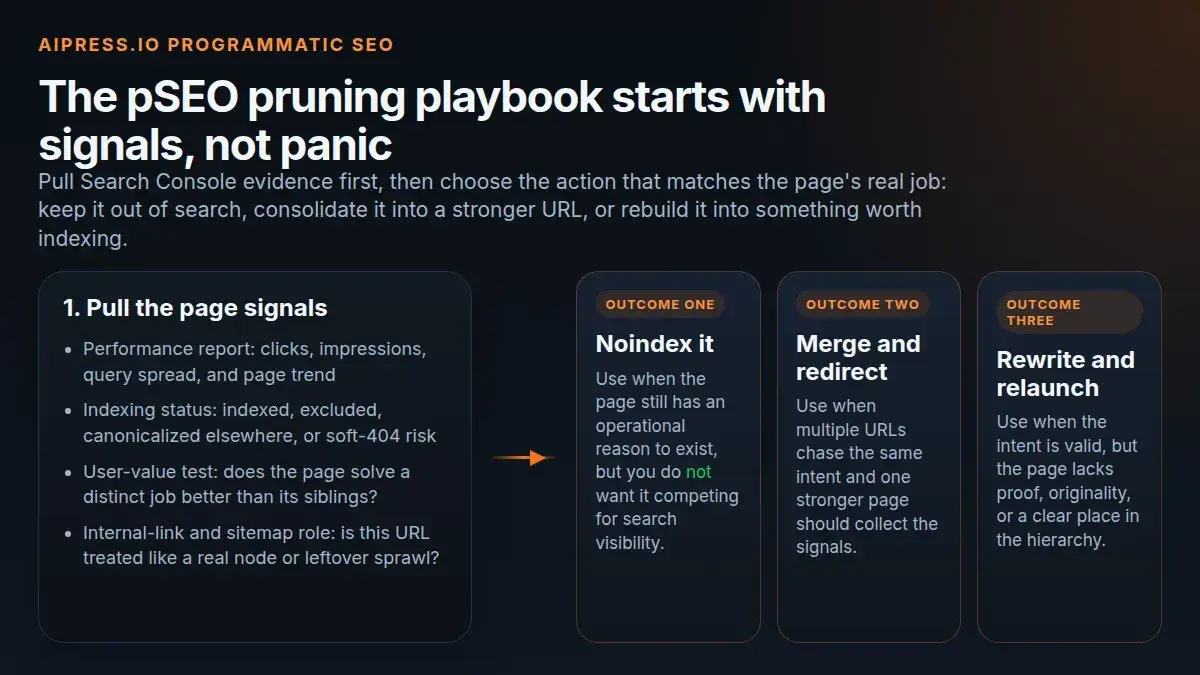
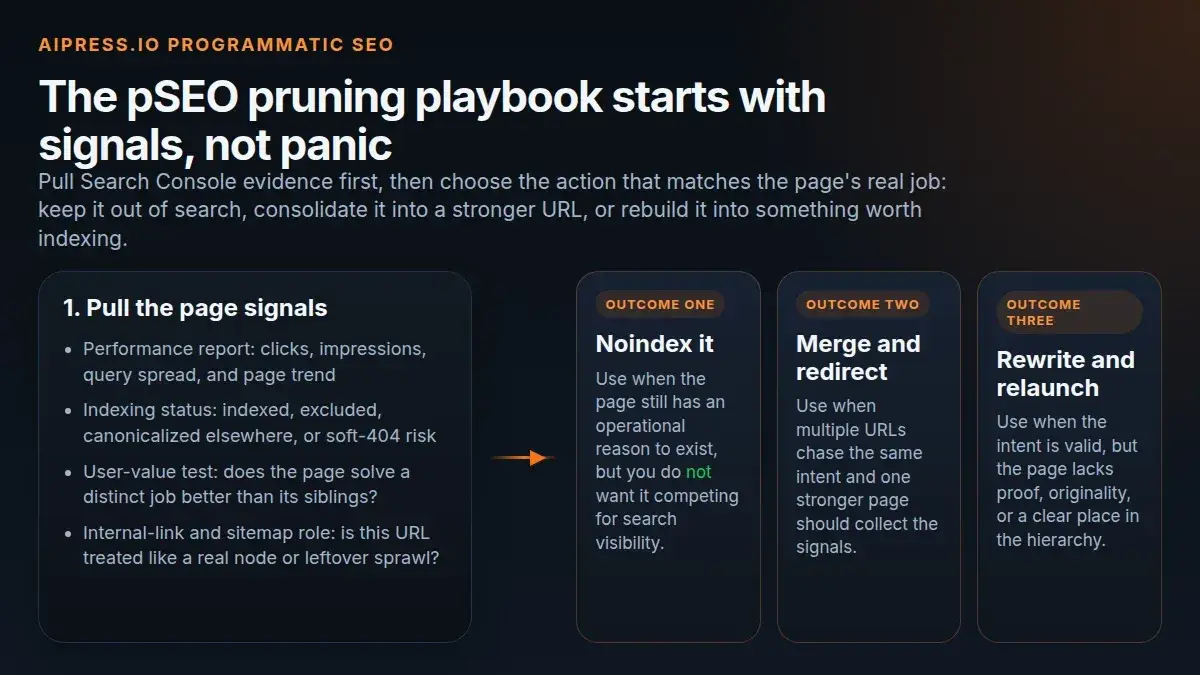
 A useful pruning workflow starts with signals, then chooses the action that matches the page's real job instead of deleting URLs on instinct.
A good programmatic SEO pruning process is not a mass-delete project. It is a decision system for weak URLs. Some pages still help users, but should stop competing in search. Some pages are duplicating a stronger sibling and need to consolidate their signals. Some pages still target a valid query, yet fail because the page itself is thin, generic, or poorly linked.
That is why the first job is not "cut the losers." The first job is to decide what kind of loser you are looking at. Google's documentation gives enough guidance to make that decision without falling back on folklore. The relevant pieces live in Search Console, Google's guidance on canonicalization, noindex, redirects, and helpful, reliable, people-first content.
Use those rules together and the cleanup question becomes much clearer:
- keep the page live but out of search
- merge it into a better page and redirect the old URL
- rewrite it because the intent is still worth owning
The mistake is treating those as the same action. They are not.
Why weak pSEO pages become operating debt
Weak programmatic pages are expensive even when nobody complains about them.
Google's canonicalization guidance says site owners often specify canonicals to consolidate signals, simplify tracking metrics, and avoid spending crawling time on duplicate pages. That matters because a weak page rarely fails in isolation. It usually sits inside a family of similar URLs that all compete for the same job. The team thinks it has broader coverage. The site actually has fuzzier ownership of intent.
That fuzziness creates three kinds of debt.
First, it creates measurement debt. If five nearby URLs all nibble at the same topic, your reporting becomes noisy. You stop seeing which page should actually own the query. Instead of one strong page with a stable trajectory, you get scattered impressions and weak conclusions.
Second, it creates hierarchy debt. A page family that keeps publishing close variants trains the site to contradict itself. One URL wants to be the canonical answer. Another wants to be the "optimized" version. A third exists because a generator could create it. None of that helps a user understand where to land.
Third, it creates editorial debt. Google's helpful content guidance asks whether content offers original information, serves a real audience, and leaves the reader satisfied enough to stop searching. That is a brutal test for programmatic pages. If the page only changes a token and adds no new proof, it is not just underperforming. It is under-defined.
This is the real reason pruning matters. The goal is not to make a spreadsheet smaller. The goal is to make each surviving URL easier to justify.
The signals to pull before you touch a URL
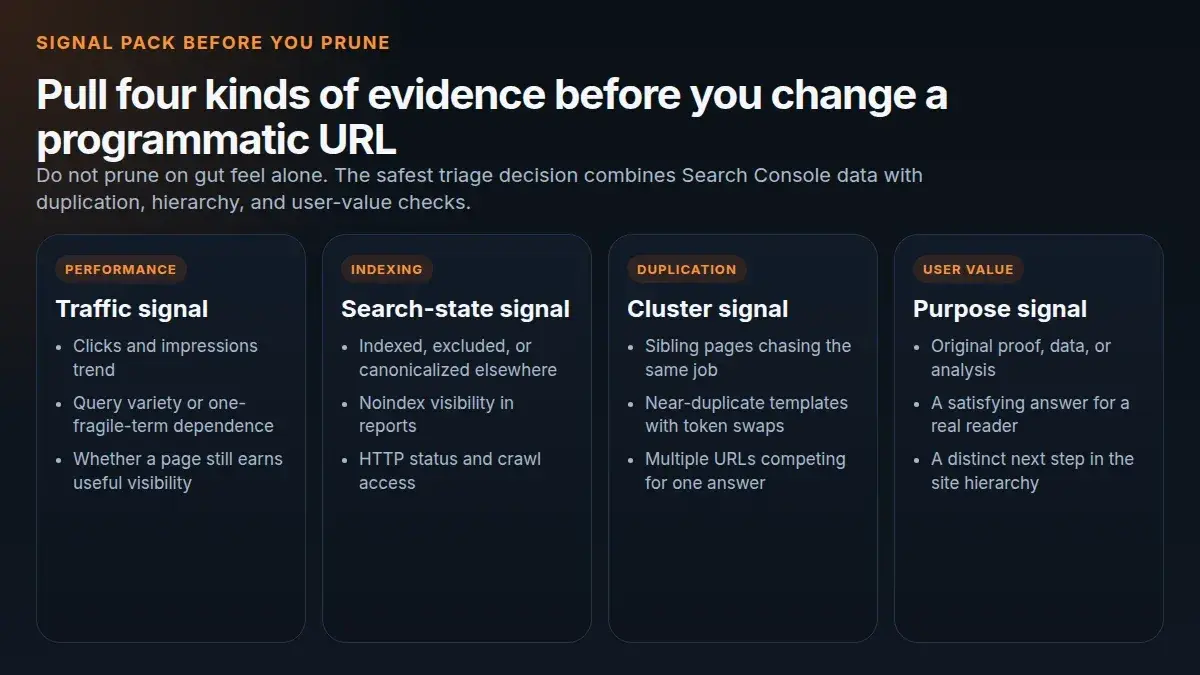 Do not prune from one metric alone. A good decision combines traffic, indexing state, duplication, and reader value.
Before you change a single URL, pull four kinds of evidence.
| Signal type | What to check | What it usually tells you |
|---|---|---|
| Performance | Clicks, impressions, query spread, and trend in the Search performance report | Whether the page still earns meaningful visibility or is living on one weak query |
| Indexing | Index Coverage, exclusions, and URL Inspection details | Whether Google can access, index, and interpret the page the way you think it can |
| Duplication | Nearby siblings, internal-link overlap, and canonical ownership | Whether the URL deserves to exist separately or is just splitting a better page's signals |
| User value | Original proof, specificity, and next-step clarity | Whether the page actually solves a distinct job for a real reader |
Google's Search Console guide is clear about what the core reports do. The Index Coverage report shows the pages Google indexed or tried to index, while the Search performance report shows traffic through clicks, impressions, and breakdowns by page, query, and country. That combination is useful because it prevents lazy cleanup decisions.
A page with low clicks but stable impressions may still deserve a rewrite. A page with no impressions, heavy sibling overlap, and no distinct job may deserve consolidation. A page that still matters operationally but adds nothing to search may deserve noindex.
You also need one technical check before doing anything dramatic. Google's technical requirements say a page becomes eligible for Search when Googlebot is not blocked, the page returns HTTP 200, and the page has indexable content. If a page fails one of those basics, you may be looking at a technical problem rather than a content problem. Do not label everything a "quality issue" when the URL is inaccessible, broken, or excluded by design.
The final filter is the reader test. Ask the helpful-content questions in plain English:
- Does this page provide anything original?
- Does it answer a real question better than its siblings?
- Would a reader leave with enough clarity to take the next step?
If the answer is no, the page does not need more excuses. It needs a different decision.
When noindex is the right call
Noindex is right when the page still has a reason to exist, but not a reason to compete in Google Search.
Google's noindex documentation says the rule can be set with a meta tag or HTTP response header, and that Google drops the page from Search when it crawls the page and sees that rule. The two details many teams miss are the important ones:
- the page must still be accessible to the crawler
- the page cannot be blocked by
robots.txt, or Google may never see thenoindex
That makes noindex useful for pages that are operationally valid but search-irrelevant. Examples include utility pages, internal-reference pages that still need to resolve publicly, temporary support content, or low-value slices that are helpful inside the product or site flow but weak as search destinations.
What noindex is not for is canonical cleanup. Google's canonicalization guidance explicitly says it does not recommend using noindex to prevent canonical selection within one site, because the page is blocked from Search entirely and rel="canonical" is the preferred solution for that scenario.
So if two pages chase the same user need, noindex is usually the wrong instinct. You are not solving duplication. You are only hiding one duplicate while leaving the cluster logic unclear.
Use noindex when the page should remain live but not indexed. If the page should not exist as a separate search result at all, keep reading.
When to merge and redirect instead
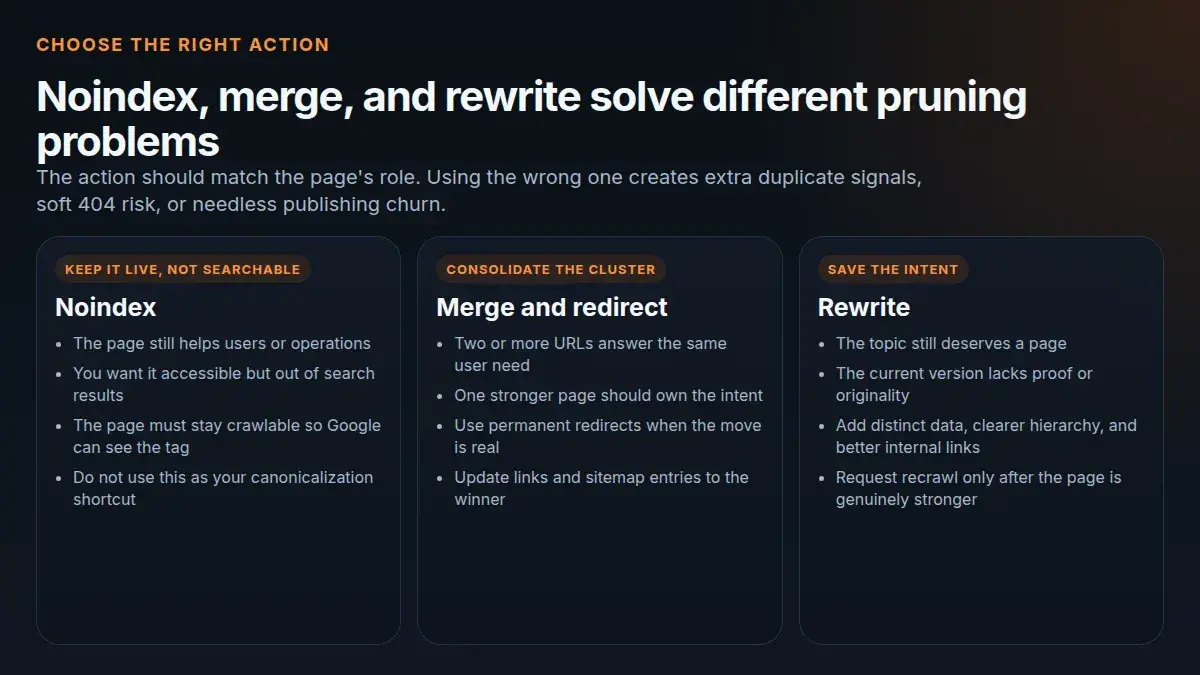 Merge and redirect when one stronger URL should own the intent and the weaker page no longer deserves separate search visibility.
Merge and redirect when multiple URLs answer the same user need and one page should become the clear owner.
Google's redirect guidance says permanent redirects are a signal that the redirect target should become canonical, and that 301 or 308 redirects are the best choice when a move is permanent. Google's canonicalization doc makes the same point from another angle: redirects are a strong canonical signal, rel="canonical" is also strong, and sitemap inclusion is weaker.
In practice, that means a merge is the right move when:
- two pages are competing for nearly identical intent
- one page already has the better proof or stronger links
- the weaker page adds no distinct value that a rewrite would save
- you want both users and search engines sent to the stronger answer
This is where teams often make the homepage mistake. They remove a weak URL and redirect it to a broad top-level page because it is easy. That may be administratively tidy, but it is usually conceptually lazy. Google's old but still useful guidance on 404s, 301s, and 410s says the right question is whether the content moved somewhere relevant. If it did, 301 the old URL to that relevant replacement. If it did not, do not pretend that the homepage solves the same need.
The merge workflow should be operational, not theoretical:
- decide which URL wins
- move the best proof, links, or sections into that winner
- apply the permanent redirect
- update internal links to point at the canonical page
- remove stale sitemap references to the retired URL
That last step matters more than many teams think. If your internal links still point to the loser, your site is arguing with your redirect map.
When a rewrite deserves another chance
A rewrite deserves another chance when the intent is still worth owning and the current page is simply too weak to carry it.
This is the category people skip because rewriting is harder than pruning. But some underperforming pages are not duplicates or operational leftovers. They are just bad pages.
The technical side tells you whether the URL can be found and indexed. The helpful-content side tells you whether the page deserves to be. Google's helpful content guidance asks whether the page provides original information, meaningful analysis, and a satisfying experience. That is the rewrite bar.
Give a page another chance when most of these are true:
- the query still matches your business and hierarchy
- the page shows some demand through impressions or recurring related queries
- there is no stronger sibling that should absorb it
- the page can be improved with real proof, data, comparisons, or clearer next steps
Rewriting is not swapping adjectives. It is changing the page's usefulness.
For a pSEO page, that usually means adding something the template skipped:
- distinct local proof
- a clearer page job
- better internal-link context
- unique data or examples
- a tighter CTA that matches the page's role
If the intent still matters, rewriting is often the highest-value move because it preserves the topic while fixing the weakness that made the page disposable.
Governance rules after cleanup
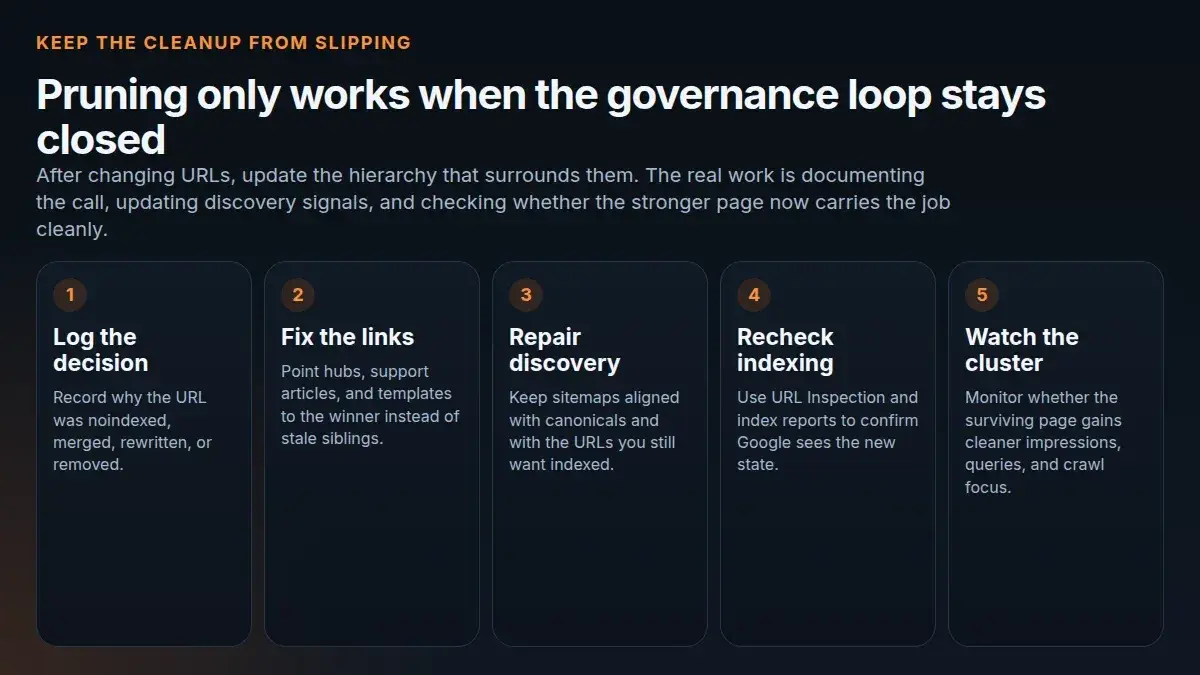 Cleanup works only when the surrounding hierarchy changes too: links, sitemap signals, and monitoring all need to reflect the new winner.
Pruning is not finished when the status code changes.
The surviving page family has to become easier to understand afterward. Google's canonicalization guidance recommends linking internally to the canonical URL you want Google to understand. Google's Search Console documentation says sitemaps can help discovery and the Index Coverage report helps you monitor indexing outcomes. That gives you a practical post-cleanup checklist:
- log why each URL was noindexed, merged, rewritten, or removed
- point hubs and support articles to the surviving canonical
- keep sitemaps aligned with the URLs you still want indexed
- use URL Inspection or the index reports to confirm Google sees the new state
- review whether the surviving page now owns the intent more cleanly
This is also where AiPress's own cluster fits. The Programmatic SEO with AI page, the Google Search Console not indexed guide, and the multi-location sitemap strategy guide all point toward the same principle: governed scale beats page-count theater.
That principle matters because pruning is not just about removing losers. It is about deciding which URLs deserve more support. If you cut pages without promoting stronger replacements, the site stays muddy. If you prune weak pages and strengthen the winners, the hierarchy gets easier for both readers and search systems to trust.
If your team is working through that kind of cleanup on a large local or programmatic footprint, Plan My AI Website is the right next step. The hard part is rarely publishing more URLs. It is building a page system that knows which ones deserve to survive.
FAQ
Should every low-impression programmatic page be pruned?
No. Low impressions are a clue, not a verdict. A page may still deserve a rewrite, better internal links, or a stronger proof layer if the intent matters and the hierarchy is sound.
Is noindex the same as blocking a page in robots.txt?
No. Google's noindex documentation says the crawler has to reach the page to see the rule. If the URL is blocked by robots.txt, Google may never see the noindex and the page can still appear in results.
When should I return 404 or 410 instead of 301?
Use 301 when the content moved to a new relevant URL that satisfies the same need. Use 404 or 410 when the content is gone and there is no page on your site that fills that same user need. Google says it treats 410 the same as 404.
Does pruning guarantee a traffic recovery?
No. Google does not guarantee indexing, and pruning cannot compensate for a weak site purpose or low-value content strategy. Cleanup works best when it removes confusion and helps the surviving pages become more useful, more original, and more clearly owned.
This article is educational, not legal or platform-policy advice. Search behavior, Search Console reporting, and your site's architecture can change, so confirm important cleanup decisions against the latest official documentation before shipping them at scale.