
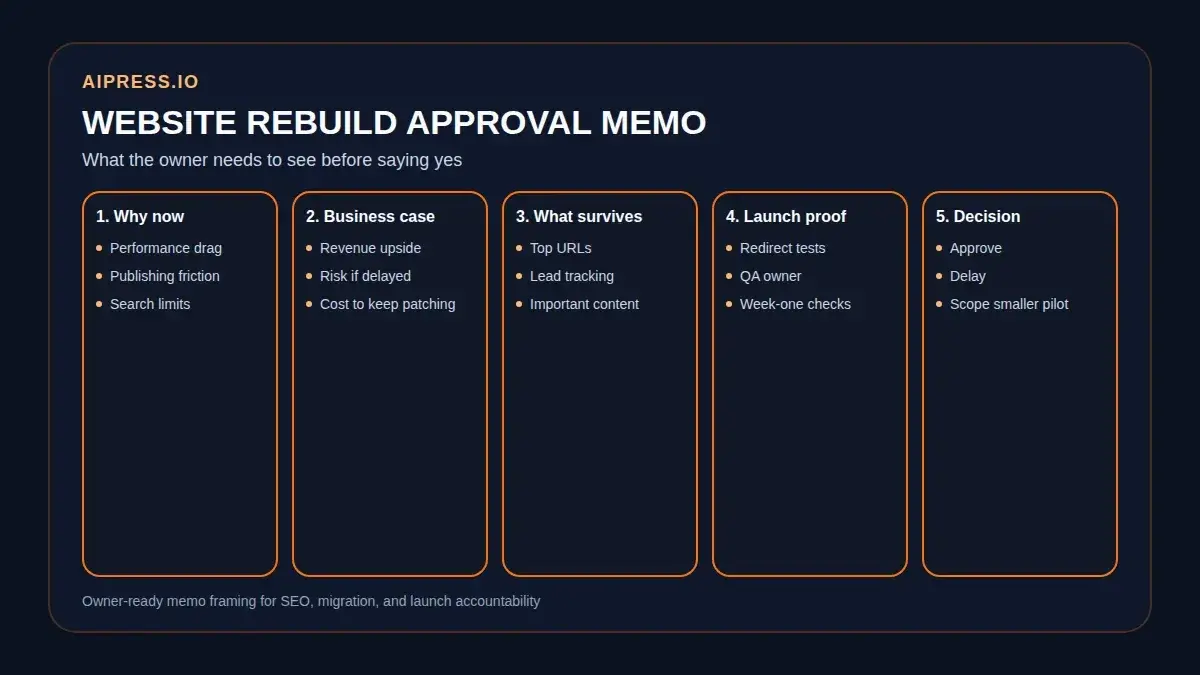
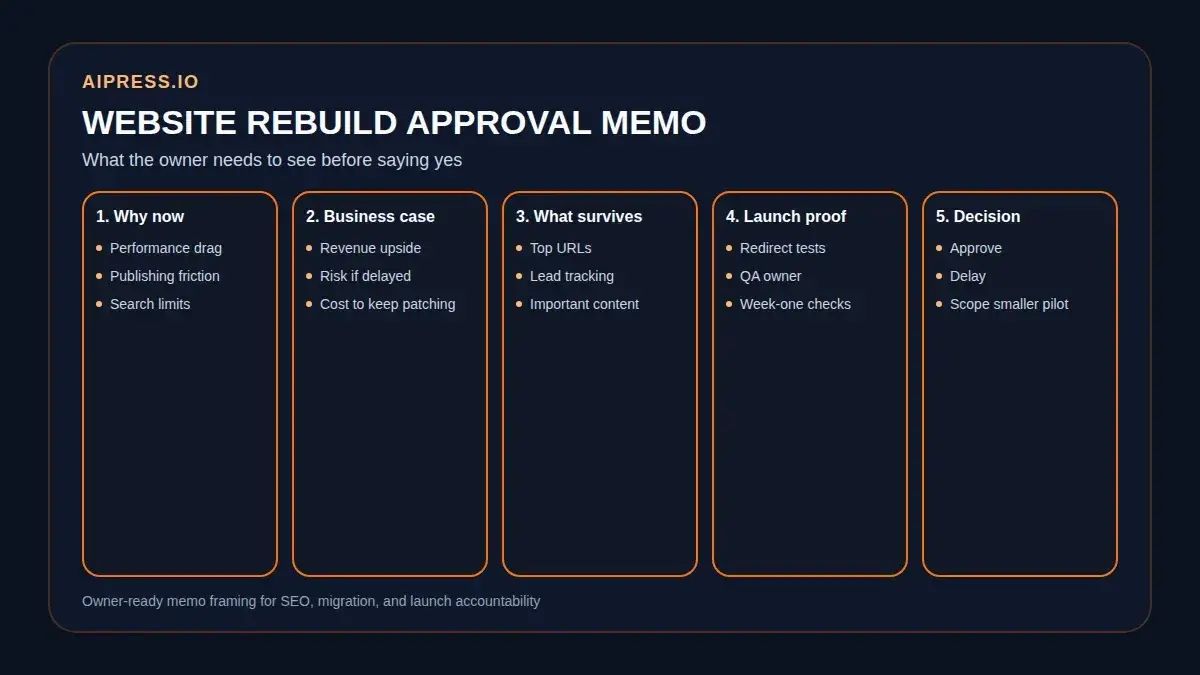
 Owners do not approve a rebuild because the mockup looks nicer. They approve it when the memo explains what changes, what stays safe, and how the team will know the launch worked.
A strong website rebuild approval memo should make the project easier to trust, not merely easier to admire. That is the difference between a redesign request that stalls in the owner's inbox and a rebuild plan that gets approved with confidence.
Most owners are not resisting a rebuild because they love the old platform. They are resisting uncertainty. They want to know whether the team is fixing a real growth problem, whether important pages and lead paths will survive the move, and whether anyone will be accountable when the new site launches.
That is why the best memo is not a mood board. It is a short business case with operating proof.
AiPress already frames AI website migration around a practical promise: keep the content and search equity that still matter, remove the platform drag that slows performance and publishing, and use the rebuild as a foundation for better page systems. Google makes the same conversation more concrete from the other side. Its site-move guidance recommends changing one thing at a time when possible, verifying the right properties, testing redirects, and monitoring both old and new traffic during the move.
Put those ideas together and the owner's question becomes much clearer:
What exactly are we approving, what exactly are we preserving, and how will we prove the rebuild worked?
Why owners push back on website rebuilds
Owners rarely see a rebuild the way marketers, SEOs, or developers do.
The internal team often sees:
- a slow site that is expensive to patch
- a fragile publishing workflow
- design constraints that block better landing pages
- local or programmatic content that cannot scale cleanly
The owner often sees something else:
- a site that still brings in leads
- a project with real cost and timing risk
- a chance to lose rankings, URLs, or reporting continuity
- another technical initiative that may create more meetings than outcomes
That skepticism is healthy. A site can be annoying for the team and still be commercially useful. If the rebuild memo does not explain why the current stack is now the bottleneck, the owner is right to push back.
Google's guidance also supports that caution. In its Search Console Help article for the Change of Address tool, Google warns that combining a site move with a redesign and a new URL structure can lead to more traffic loss because Google has to relearn more at once. That is the sort of detail owners hate discovering after they have already approved the budget.
So the memo has to do three jobs at once:
- show the current cost of staying put
- show the safeguards that protect what already works
- show the proof plan for launch and the first week after
If the memo can do those three things in plain language, the rebuild stops looking like a gamble and starts looking like a managed business decision.
What the approval memo needs to prove
The cleanest memo proves four layers of trust. If even one layer is fuzzy, the owner is likely to ask for more delay, more revisions, or a smaller pilot instead of a full approval.
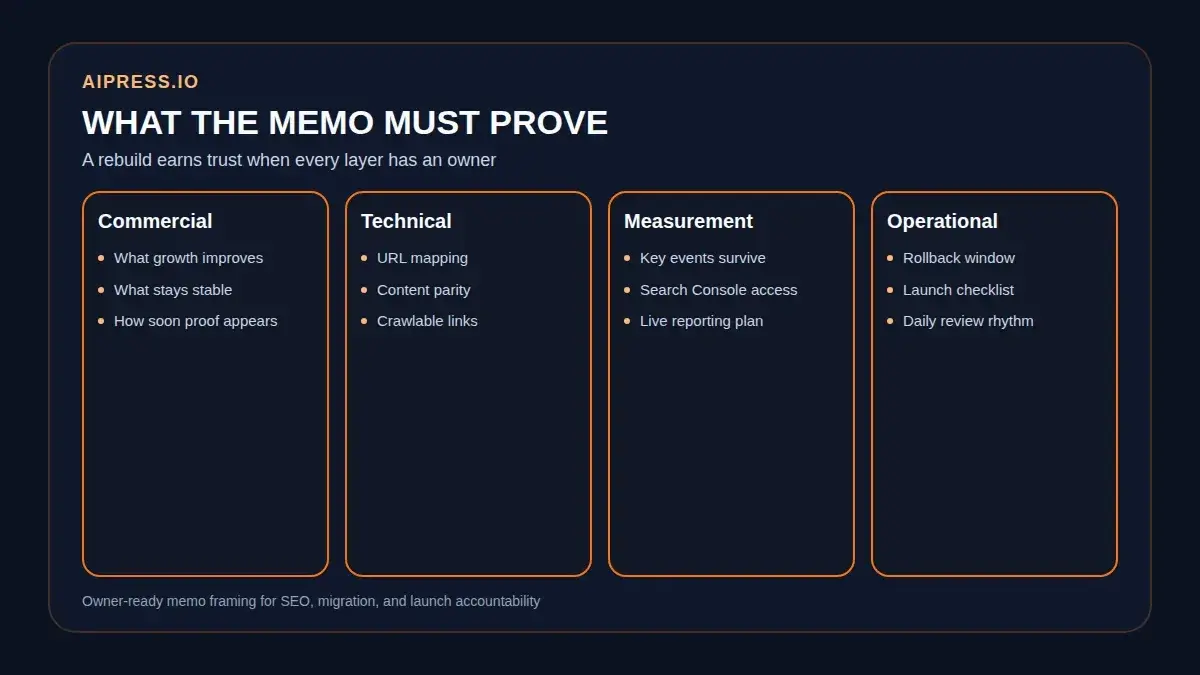 A rebuild earns trust when the commercial case, technical controls, measurement plan, and operating owners are all visible on one page.
| Proof layer | What the owner should see | Why it matters |
|---|---|---|
| Commercial | Why the current site is slowing growth or increasing operating cost | A rebuild is easier to approve when it solves a business problem, not just a design preference |
| Technical | Which URLs, page types, and redirects will be preserved or mapped | This lowers the fear of search losses and broken pages |
| Measurement | Which lead actions, reports, and baselines will survive the change | A faster site is not enough if the team cannot prove that qualified actions still happen |
| Operational | Who owns pre-launch QA, launch-day checks, and week-one monitoring | Owners approve teams, not only plans |
Notice what is missing from that table: hype.
The best memo does not promise “10x results” or guaranteed ranking lifts. It shows the owner how the team will reduce risk and how it will recognize success early.
That distinction matters for AiPress-style rebuilds. The public AI websites page emphasizes analysis, generation, review, and approval before launch. That is a more useful approval story than “we can build it fast.” Fast is helpful. Reviewability is what makes the project safer to approve.
The five sections every rebuild memo should include
If your team needs a simple working structure, use these five sections. They are short enough for an owner to read in one sitting, but specific enough that the implementation team cannot hide behind vague language.
1. The business reason for the rebuild now
Start with the constraint the owner already feels.
Do not write, “Our website needs modernization.”
Write something closer to this:
- the current platform slows down new page publishing
- important landing pages are harder to improve than they should be
- the stack adds maintenance or plugin debt without creating new demand
- the next growth plan requires cleaner templates, faster pages, or easier content operations
AiPress's migration page is useful here because it frames migration as the right move when the site still has equity but the platform is holding back performance, publishing, or search growth. That is the correct tone. You are not discarding the old site because it is worthless. You are protecting what works while removing the drag around it.
2. What the business is protecting
Owners become much easier to win over when they see a preservation list instead of a reinvention speech.
That list should name:
- the highest-value URLs
- the page families that currently generate leads
- the content that must migrate intact
- the internal links that support key pages
- the redirect logic for any URLs that do change
This is also where you calm a common fear with specific evidence. Google's site-move documentation says that permanent redirects such as 301s do not cause a loss in PageRank. That does not mean every migration is risk-free. It does mean the rebuild memo should focus less on folklore and more on whether the redirect map is accurate and complete.
3. The change-control rules
The owner needs to know which risks are being reduced by process, not by optimism.
Google recommends changing one thing at a time during a move when possible. That guidance is helpful because it turns a messy rebuild into a decision about scope. Are you changing only the platform? Platform plus templates? Platform plus domain? Platform plus every URL pattern?
When the answer is “everything,” the owner should see that risk named plainly.
This is also the place for one of the most useful migration caveats in Google's documentation: the Change of Address tool is for moves from one domain or subdomain to another, after the move and redirects are already in place. It is not the default answer for same-domain path changes, http to https, or switching between www and non-www on the same domain. That single clarification keeps teams from overcomplicating a rebuild that only needs redirect discipline and clean sitemap handling.
4. The measurement continuity plan
Many approval memos say “tracking will be preserved.” That sentence is too weak to be useful.
The memo should instead name the exact actions that matter and make someone accountable for proving they still work after launch. For most lead-generation sites, that means naming four or five actions that the owner actually cares about:
- consultation request
- quote request
- booked demo
- tracked phone call
- contact form completion
That is enough detail for approval. The implementation checklist belongs on the operating side of the cluster. Our AI website migration analytics plan already covers the deeper workflow around baselines, key events, Search Console continuity, and launch-week reporting. This memo should stay one level higher: which actions matter, who checks them, and when the owner sees the first proof.
5. The approval choice itself
End the memo with a real decision, not with endless ambiguity.
The owner should be able to choose one of three paths:
- approve the full rebuild now
- approve a smaller pilot or limited page set first
- delay approval until one missing proof item is supplied
That structure is more persuasive than a hard sell because it respects risk without pretending the cost of delay is zero.
What has to survive the rebuild
The most useful approval memos do not treat “preservation” as one bullet. They break it into assets that can be named, tested, and assigned.
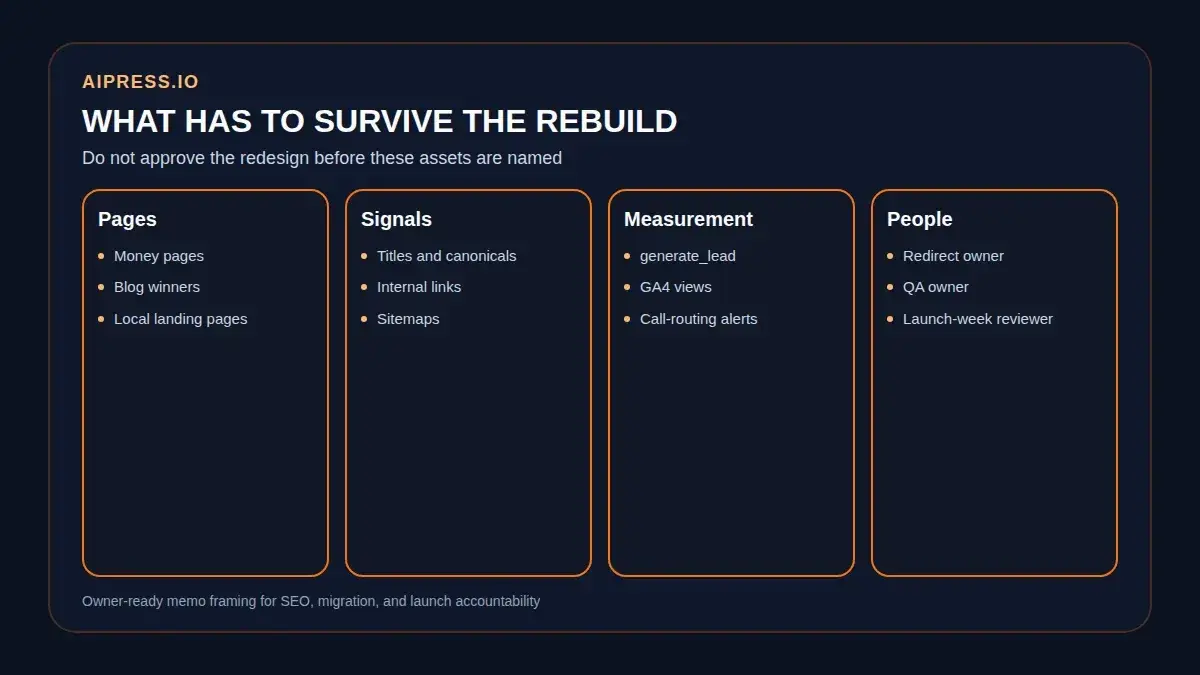 The safest rebuilds name the pages, signals, reports, and people that cannot disappear during the changeover.
Pages that already matter
AiPress's own website migration SEO checklist says teams should export all URLs from Google Search Console and export baseline organic traffic data before migration. That is not clerical work. It is how the owner sees which pages are important enough to protect.
At minimum, the memo should identify:
- top revenue pages
- organic winners
- local or service pages that support the sales process
- evergreen posts that attract qualified traffic
If those URLs are not named before approval, the rebuild is operating on memory instead of evidence.
Search signals that support those pages
The second preservation list is smaller but just as important:
- titles and descriptions
- canonicals
- sitemap coverage
- internal links that push authority toward key pages
The owner does not need every implementation detail, but they do need to know that the rebuild is preserving the page's meaning and route through the site, not just its visual shell.
Google's site-move documentation is especially useful here because it tells teams to verify both the old and new properties in Search Console, keep the chosen verification method working after the move, and submit the new sitemap so Google can learn the new URLs faster. Those are concrete proof items, not abstract “SEO best practices.”
Lead tracking and reporting logic
This is the part that most approval memos under-explain.
If the old site tracks a completed form, booked call, or quote request, the new site should not come back with a totally different reporting story unless the memo says so.
That makes the owner's review much easier. Instead of hearing “analytics is installed,” they can ask:
- Which lead actions are being verified?
- Who is checking them?
- What report will we use on day one?
Those are the right questions because a rebuild is not successful when the page loads. It is successful when the business action still fires and the team can prove it.
People and accountability
Do not let the memo hide ownership inside a generic project plan.
The owner should see named responsibility for:
- the redirect map
- the page-content verification pass
- the live tracking checks
- the week-one review rhythm
This is where a rebuild starts looking like a controlled operating project instead of an open-ended creative exercise.
How to show launch-week accountability
Approval gets easier when the owner can picture the first week after launch before the site even changes.
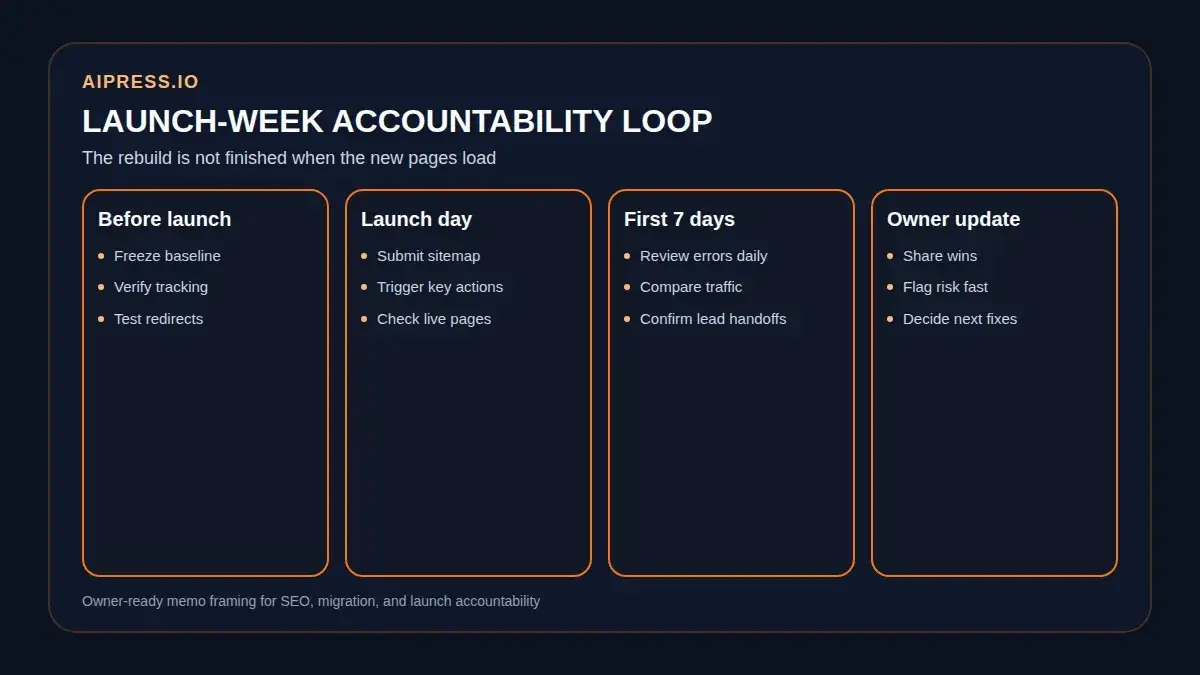 Launch week is where the team proves the rebuild preserved traffic paths, lead actions, and reporting trust.
The owner does not need the full implementation checklist on this page. They need the reporting cadence:
- Before launch: confirm the baseline, the preserved page list, and who owns sign-off
- Launch day: confirm the live pages load, the lead actions fire, and the first status update goes out
- First 7 days: send a short daily readout on page health, lead-path integrity, and any issues that need escalation
That is the accountability loop that makes a rebuild easier to approve. The team is not asking the owner to “trust the experts.” The team is showing what it will observe, when it will report, and how it will react. For the deeper operating checklist behind that cadence, use the analytics-plan article rather than turning this page into a second launch workbook.
Questions the owner should ask before approving the rebuild
If you want the simplest possible approval filter, end the memo with these questions:
- Which current pages are too important to lose or rewrite carelessly?
- What is the measurable business reason for rebuilding now instead of patching the current site again?
- Which URLs will stay the same, and which ones will redirect?
- Does this project include a domain or subdomain move, or only a platform and template change?
- Which lead actions must still fire on day one?
- Who is responsible for pre-launch QA, launch-day checks, and week-one review?
- What is the rollback window if a critical path breaks?
- What will we show the owner one week after launch to prove the project is working?
If your current rebuild request cannot answer those questions yet, the owner is not the blocker. The memo is.
That is also why the best first step is often a scoped planning exercise instead of a rushed redesign pitch. If your team is using a homepage preview as an approval input, run it through our homepage preview checklist before you approve a website migration. The preview is most useful when it sharpens the memo, not when it becomes a second approval page that competes with it.
For teams that already know the current platform is the bottleneck, the next step is to frame the project the way an owner needs to see it: what growth friction is being removed, what business assets are protected, and how the launch will be judged. That is the real job of a rebuild memo, and it is why the strongest rebuilds start with operational clarity long before launch day.
This article is educational, not legal or platform-policy advice. Search behavior, analytics interfaces, and migration requirements can change, so confirm important rebuild decisions against the latest official documentation before launch.