
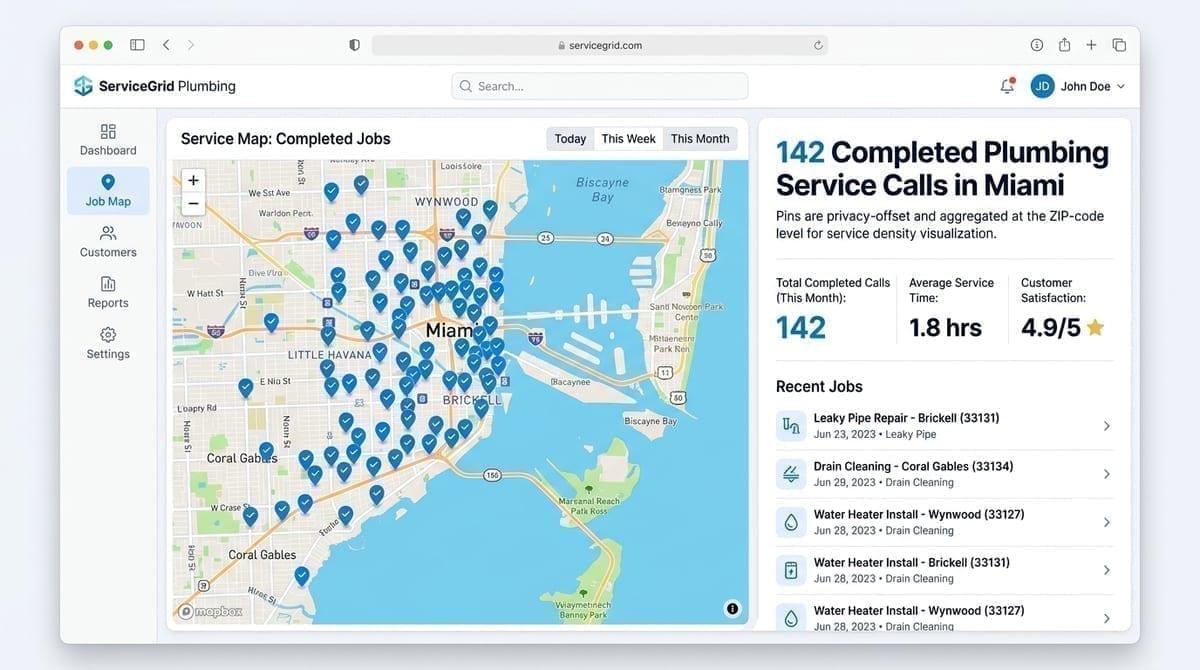
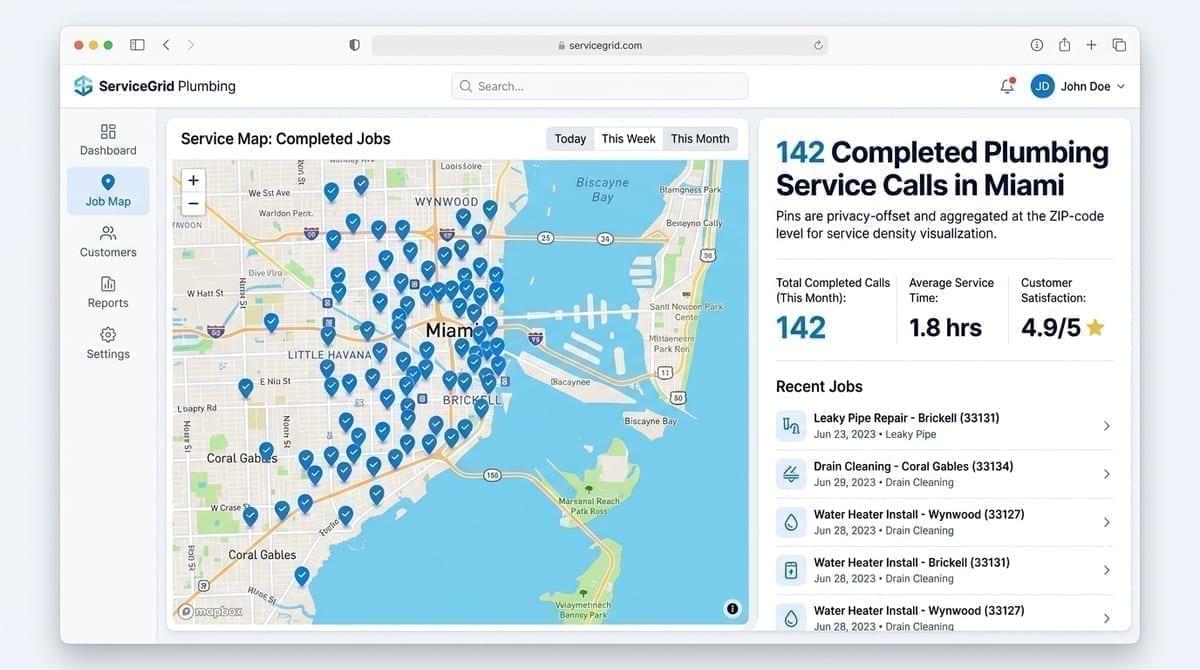
 AI SEO for plumbers only works when the money page already proves speed, trust, and a one-tap call path before you scale more URLs. A job map is one way to show that proof in a real market.
AI SEO for plumbers is not a new vertical to invent. It is a tighter operating system around the pages that already have to win emergency and planned plumbing searches.
AiPress already frames that system on AI Websites for Plumbers: emergency-first layout, tap-to-call, trust badges, service-area architecture, and job-map proof without thin city templates. This article is the supporting checklist for that page. Use it before you ask a content or programmatic workflow to invent more URLs.
This is not a replacement for a full local SEO program. For Google Business Profile, reviews, and map-pack basics, use the local SEO guide for plumbers. The job here is narrower: what the service page must prove before another city URL is worth publishing.
Google's helpful-content guidance still applies: each page should serve a real audience and leave a clear result. For plumbing, that audience is often a homeowner on a phone with standing water, no hot water, or a sewer backup—not a reader browsing an essay.
What "AI SEO for plumbers" should mean in practice
Treat the phrase as three jobs on one site:
- Conversion UX for panic and planning modes. Emergency visitors need license proof, after-hours framing, and a thumb-sized call path. Planning visitors need clear service scope and proof without slideshow bloat.
- Service + city architecture without thin pages. Drain cleaning, water heaters, leak detection, sewer, and repipes need distinct service intent; city pages need local proof, not a swapped city name.
- Review gates before publish. Preview the page, check accuracy against the business, and hold weak templates. AiPress's Programmatic SEO with AI page states the rule directly: pages that do not pass review should not publish.
If a draft only swaps keywords into a template, it is not AI SEO. It is scaled thin content.
The money-page checklist before you scale
Use this against AI Websites for Plumbers and your live plumbing site:
| Check | Pass signal | Fail signal |
|---|---|---|
| Emergency CTA | Sticky mobile tap-to-call on service and city pages | Phone buried in a menu or footer-only |
| Trust strip | License, insured, reviews near the CTA | Trust details only on About |
| Service intent | Separate pages for high-ticket services people actually search | One homepage paragraph for every trade line |
| City proof | Unique local angle or job proof per market | Boilerplate with the city name replaced |
| Speed | Lean mobile landing for emergency terms | Heavy sliders and unoptimized galleries |
| Schema / NAP | Hours, phone, and service area match Google Business Profile | Conflicting hours or invented service areas |
The plumber page already includes an after-hours conversion checklist: sticky click-to-call, dispatch messaging, emergency vs scheduled routing, a trust strip, photo or map proof near the CTA, an SMS option, a confirmation step, and mobile speed. Run that list before you create another neighborhood URL.
How support articles should feed the plumber page
Support content should answer a narrower question and send the reader back to the money page or a clear service CTA.
Good support roles:
- objection handling — why a slow site loses emergency jobs
- architecture — when a city page deserves unique proof vs a merge
- operations — what dispatch needs on the thank-you / confirmation path
- measurement — which Search Console queries belong to the plumber landing vs a blog post
Weak support roles:
- another generic "local SEO tips" post with no plumbing CTA
- a new city page that repeats the same three sentences
- a vertical you do not actually serve
The Miami plumbing case study is the right mental model for depth: a tiered city architecture where higher-volume markets get deeper content and more internal links, and smaller markets get baseline coverage. The plumber page's service-area matrix makes the same split. Primary metros can support hubs; secondary towns should get fewer page types, not a copied template.
When not to publish another plumber URL
Hold or refresh instead of publishing when:
- Search Console already shows impressions for the query family on an existing service or city page
- the only "new" idea is a synonym of an existing H1
- you cannot name the proof asset (license detail, job count, review theme, local housing stock note)
- the page would compete with AI Websites for Plumbers for the same commercial intent without adding a new job-to-be-done
That last point is the publishing rule: deepen the plumber system you already sell before you open another vertical.
Practical next step
- Open AI Websites for Plumbers and score your current site against the emergency and service-area sections.
- Fix the failing money-page checks before generating more programmatic pages.
- Only then use AI-assisted drafting inside templates that already passed review.
If you want the broader programmatic rules behind that workflow, read AiPress on Programmatic SEO with AI, then return to the plumber page as the commercial destination.
This article is educational, not legal or platform-policy advice. Confirm licensing claims, hours, and service-area statements against your own business records before publishing.