
AI Content Brief Checklist Before You Scale
 AiPress now leads with content agents trained on your site and SEO systems that can maintain hundreds or thousands of pages. That only works when the brief gives the agent something real to learn from.
This AI content brief checklist is for teams that want to move faster with a content agent, not publish 100 pages that all sound vaguely correct and none sound like the business. The problem is usually not the model. It is the missing brief.
If the only input is "here is our website, write more pages," the agent will fill the gaps on its own. That is when brand voice drifts, proof disappears, internal links get sloppy, and page sets start looking dangerously similar. A better system starts with a source-of-truth pack, a small first batch, and a review workflow that is strict before it is scalable.
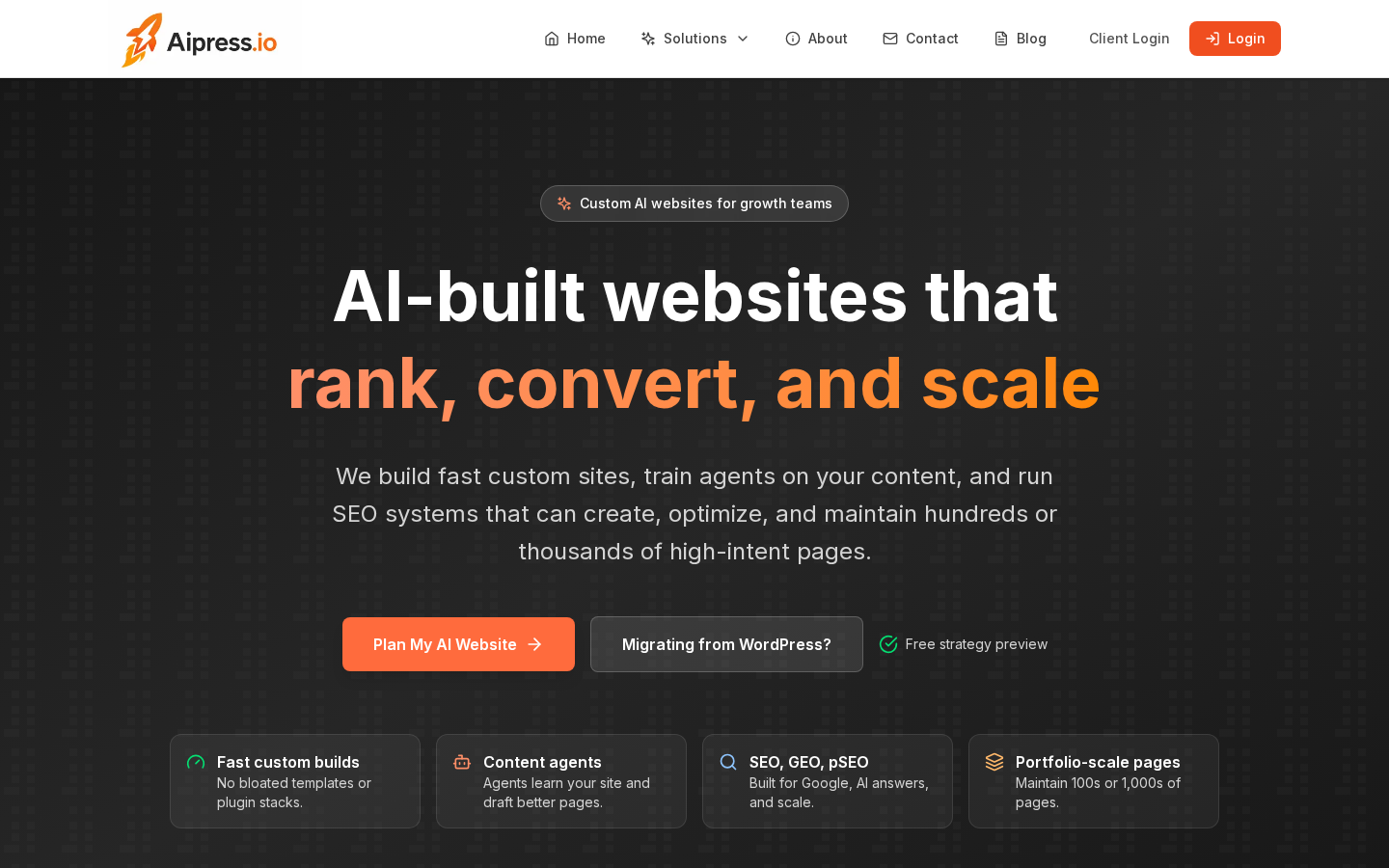
AiPress now positions itself around fast custom sites, content agents trained on client material, and SEO systems built for scale on its homepage and programmatic SEO page. That makes the briefing question more important, not less: before an agent drafts at scale, what exactly should it be trained on, what should it never invent, and what has to be approved by a human every time?
Why an AI content agent needs a source of truth
The fastest way to get generic AI content is to mistake a prompt for a brief.
AiPress says its agents learn your site and draft better pages. That promise only holds if the site gives the agent enough signal to separate what is core from what is incidental. A homepage can show tone and positioning. It cannot fully explain which claims are approved, which offers are secondary, which locations are active, which proof is current, or which pages are supposed to convert versus educate.
That is why a source of truth matters. It tells the agent:
- which facts are approved and current
- which pages or sections define the business in its own words
- which claims need a citation, screenshot, or explicit caveat
- which internal pages should be linked as hubs, services, or next steps
- which pages should never be produced from a loose template
Without that layer, AI output tends to flatten the business into averages. The copy may read cleanly, but it starts sounding like every other site in the category because the agent is guessing at distinctions instead of being briefed on them.
AiPress's quality-at-scale page makes the same point in operational terms: scale only works when AI draft, human polish, and unique insight all stay in the loop. The brief is where that unique insight starts.
What belongs in the brief before the first draft
The easiest way to think about the brief is simple: if a human editor would need the information to write the page well, the agent needs it too.
| Brief component | Why it matters before scale |
|---|---|
| Approved source pages | Gives the agent a clear hierarchy of what to trust first, instead of treating every page on the site as equally current. |
| Offer and audience map | Keeps pages aligned to the right buyer problem, not a generic industry summary. |
| Proof and restrictions | Prevents the model from stretching testimonials, rankings, timelines, or technical claims past what the business can actually support. |
| Internal link targets | Stops random linking and keeps new pages connected to the right hub, service, and CTA paths. |
| Page type and intent | Tells the agent whether the page is a service page, a local support page, a comparison, or an educational article. |
| Review owner | Makes it clear who can approve facts, voice, compliance language, and publish readiness. |
The production brief should also include the materials that are easy to skip when everyone is in a hurry:
- current byline and author expectations
- preferred CTA language
- banned or risky claims
- required disclaimers
- examples of pages that should be copied structurally and examples that should not
AiPress's get-started page only asks for an email and website URL for a preview, which makes sense for an early demo. A production content workflow needs much more than that. A URL is enough to show what the site looks like. It is not enough to tell an agent what the business is willing to stand behind in public.
 The programmatic SEO page explains how scale works through templates, data, and rules. The brief is where those rules become specific enough to protect quality.
How Google's guidance changes the briefing standard
This is the part many teams miss. The brief is not just an internal ops document. It is also your first defense against search-quality problems.
In Google's helpful, reliable, people-first content guidance, the self-check is not "Did you use AI?" It is whether the page adds original information, substantial value, clear sourcing, and enough expertise or experience that a reader can trust it. Google also urges publishers to think in terms of "Who, How, and Why" when content is created.
That changes the briefing standard immediately.
Your brief cannot stop at keyword plus title. It should answer:
- Who is responsible for the page's knowledge and approvals?
- How is the draft being produced and reviewed?
- Why does this page deserve to exist for a real reader, not just for coverage?
Google's guidance about AI-generated content is equally clear: appropriate use of AI is not against the guidelines, and Google focuses on quality over the production method. But the spam policy on scaled content abuse warns against generating many pages primarily to manipulate rankings rather than help users.
That is why a weak brief becomes a search problem so quickly. If the brief does not define what makes one page meaningfully different from the next, the output starts sliding toward low-value repetition no matter how polished the prose looks.
Google's SEO Starter Guide reinforces the same operational point from another angle: content should be unique, helpful, and logically organized for users and search engines. A page set built from vague inputs usually breaks all three.
So the modern briefing standard is higher than it was a few years ago. You are not simply feeding prompts into a writer. You are documenting the unique material, the approval path, and the reader purpose that keep a scaled content system from turning into content debt.
A review workflow for the first 10 pages
Do not start with 100 pages. Start with a pattern you are willing to inspect closely.
AiPress's quality-at-scale page frames the workflow as AI draft plus human polish plus unique insight. That is the right order. The first batch should exist to test whether your brief is complete enough, not to hit a page-count milestone.
A practical rollout looks like this:
- Brief one page type clearly. Choose a real pattern, such as a service page, a local support page, or a comparison page.
- Draft a small batch. Ten pages is enough to expose the pattern problems without multiplying them across the site.
- Review line by line. Check facts, proof, internal links, CTA fit, repeated language, and whether the page would still make sense if search traffic did not exist.
- Tighten the brief before expanding. If the same mistake appears three times, fix the input or rule once instead of editing 100 pages by hand later.
This is also where AiPress's own operating thresholds become useful as a discussion tool. Its quality page talks about a 40 percent boilerplate rule and an 85 percent indexation target. Those are not Google's published thresholds, so do not treat them as official law. But they are useful reminders that scale needs two things:
- enough unique material per page to justify the URL
- enough quality that search engines keep indexing the set
If your first ten drafts already sound interchangeable, publish velocity is the wrong metric. The brief still needs work.
For a launch-side checkpoint after briefing, AiPress already has a useful companion piece in its programmatic SEO QA checklist. Use the brief to shape the draft, then use QA to confirm the pattern survived production.
Common failure modes when teams skip the brief
Most AI content problems do not begin in the draft. They begin upstream, when the agent was never told what counts as evidence, what counts as a claim, or what makes one page worth keeping separate from another.
Here are the failure modes that show up first:
The pages sound polished but interchangeable
This is the classic scale trap. The intros change. The value does not. Once that happens, every new page adds crawl weight without adding much reader value.
The agent writes past the available proof
If the brief does not flag what is verified, the draft starts turning positioning into promises. That is how soft claims become hard claims and "could help" becomes "will improve rankings."
Internal linking becomes decorative
Without an approved list of hubs, services, and CTA targets, agents often link wherever the phrase happens to match. The result is messy navigation and weaker page relationships.
Voice consistency gets reduced to adjectives
"Professional but friendly" is not a voice system. A useful brief needs examples of how the business explains itself, what it avoids, and how it handles certainty, caveats, and calls to action.
Teams confuse output speed with publish readiness
Fast drafting is helpful. Fast publishing without a briefing and review loop is how teams create a cleanup project for themselves a month later.
 Quality-at-scale only works when review stays in the loop. The brief is what gives that review something concrete to enforce.
A reusable AI content brief checklist
If you want something simple enough to reuse this week, start here.
Source-of-truth inputs
- Approved pages that define the business today
- Current offer list and audience segments
- Live proof points, screenshots, or first-party data the agent may cite
- Claims that require caveats or should be avoided entirely
- Examples of the brand voice at its best
Page-level instructions
- Primary purpose of the page
- Search intent and reader job to be done
- Required sections or questions to answer
- Pages that must be linked internally
- CTA that matches the page's role
Quality and compliance controls
- Who checks factual accuracy
- Who checks voice and positioning
- What blocks publish immediately
- What gets marked for manual verification
- How small the first review batch will be before scale expands
Operational rules
- Which page patterns are approved for generation
- Which page types need heavier human input
- How updates are handled when the source material changes
- How the team records what the agent was allowed to use
That is the real AI content brief checklist: not a single prompt, but a working packet that helps the agent stay inside the business's actual boundaries.
FAQ
Is AI-generated content against Google's guidelines?
No. Google's published guidance says the issue is not whether AI was used. The issue is whether the page is original, helpful, reliable, and created for people rather than mainly to manipulate rankings.
Can a website URL by itself count as a brief?
It is enough for a preview or a first pass at site understanding. It is not enough for production content at scale. A URL does not tell the agent which claims are approved, which pages matter most, or what should block publish.
What should be locked before an agent drafts local or service pages?
At minimum, lock the approved facts, proof boundaries, internal-link targets, CTA language, page type, and review owner. Local and service pages become risky quickly when those inputs are vague.
When should a team scale beyond the first batch?
Scale after the first batch proves the brief is doing its job. If reviewers keep correcting the same problem, fix the brief or the generation rule first and expand only after the pattern stabilizes.
Next steps
If you are serious about scaling with a content agent, do one thing before you ask for the next 100 pages: build the source-of-truth pack the agent should have had from day one.
That means approved pages, proof boundaries, internal-link targets, review ownership, and a first batch small enough to inspect honestly. Once those are in place, AI becomes a force multiplier. Without them, it becomes a force multiplier for ambiguity.
If you want a faster website and a cleaner system for content operations, review how programmatic SEO with AI is framed and use the free homepage preview as the start of a planning conversation rather than the whole plan.
This article is for operational planning, not legal advice. Confirm current platform, compliance, and search guidance before publishing at scale.