AI Websites for Contractors: Look Like the Crew That Gets the Job
Homeowners do not hire a domain name—they hire the team that shows up on time, protects the house, and finishes.
Your website is the audition. If it feels slow, stock-photo generic, or hides how to get a quote, you lose to the competitor whose site feels as organized as your job sites.
What Homeowners Are Really Judging
Can they trust you in their house?
License, insurance, manufacturer certs, years in business, process (how you protect floors, how crews badge up)—these belong high on the page, not buried in a PDF from 2019.
Have you done their kind of job?
Roofing customers want steep-slope proof. HVAC customers want equipment and duct context. Remodel clients want finish-level taste. We structure trade-specific galleries with captions so the proof matches the visitor.
Is reaching you annoying?
Tap-to-call, schedule/consult CTAs, and short forms that work one-handed. Long questionnaires belong after you have the lead—not as a gate.
UX Built for Trades
Emergency and storm paths
When hail hits or heat waves spike demand, the hero and sticky CTAs should say what you do today—without a site redeploy from scratch.
Estimate requests that convert
Fields tied to dispatch reality: service type, ZIP, brief description, optional photo upload. Enough for triage; not enough to abandon.
Seasonal storytelling
Fall furnace, spring AC, storm response—rotated emphasis modules so the homepage matches the market without feeling like a different brand every month.
Mobile-First, Job-Site Realities
Your customers are on couches, driveways, and lunch breaks—on LTE. Thumb-sized buttons, readable type, no carousel that hides the phone number.
Programmatic Local SEO for Trade Contractors
Homeowners search trade + city—"roof replacement Tampa," "furnace repair Naperville," "kitchen remodel contractor near me." Winning the long tail takes clean information architecture, unique local context per page, and proof you work in those neighborhoods—not one generic "we serve the area" paragraph.
Multi-Trade Sites Without Keyword Cannibalization
If you run HVAC and roofing (or GC + remodel), pages must be siloed so each trade owns its intent:
- Separate URL trees and internal links per trade.
- Shared location hubs that route to the right service pages.
- One primary job-to-be-done per page so Google knows what to rank.
Seasonal emphasis (AC vs. furnace) can show up in modules and FAQs without rewriting your entire IA every quarter.
Programmatic Project Maps by City
Completed-job maps answer: Do you really work here, or are you keyword-stuffing?
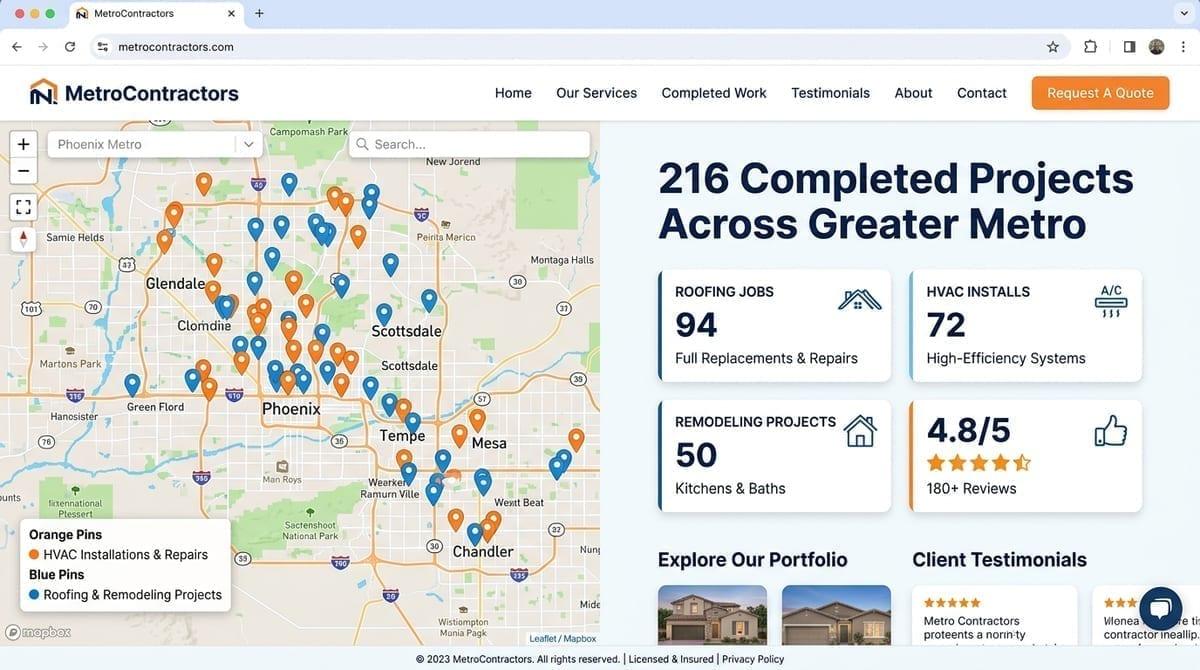
- Counts that match the map for the selected trade and metro.
- Pins with intentional imprecision—offsets and ZIP-level placement, never exact driveways.
- Micro-stories per pin: scope, duration, materials—useful and unique without identifying clients.
- Roll-forward data so high-value city pages stay tied to real production volume.
Schema, Reviews, and Local Entities
LocalBusiness (and subtype where it fits), Service entities for major lines, and FAQ markup only on visible FAQs. License numbers, insurance, and warranty copy stay consistent across GBP, footer, and structured data.
FAQ: We cover 40 cities—duplicate content? Not if each page layers trade FAQs, local risk factors (wind, hail, freeze), permits culture, and dynamic project-derived content—empty templates with swapped city names are what fail.
For massive programmatic scale, see Programmatic SEO with AI.
Getting Started
- Preview — See your trades, photos, and CTAs in a layout built for estimates.
- Build — Wire every trade, service area story, and trust block your estimators actually use on the phone.
- Launch — Fast stack, no plugin treadmill; update offers when the season turns.
Bottom Line
Your crew is judged before the truck leaves the yard. Give them a digital storefront that is as tight as your safety briefing—clear, fast, credible, easy to contact.
That is how you fill the schedule.